A human-handled support call in finance costs somewhere between $6 and $12. The same call handled by an AI voice agent costs about $0.30 to $0.50, according to ElevenLabs data. Sit with that gap for a second, because it is the whole reason an AI voice agent for finance has moved from science project to a real line item on real budgets.
If you run customer operations at a bank, NBFC, fintech, or insurer, you have probably heard the pitch and stayed skeptical. Fair enough. Regulated finance is not a place where you deploy something just because a demo sounded smooth.
So here is the honest version, up front. An AI voice agent for finance is software that answers and places phone calls in natural language, authenticates callers, pulls live account data, and completes tasks like balance checks, EMI reminders, or fraud verification, while logging every step for audit. Done right, it lowers cost per call, holds compliance scripts perfectly, and runs around the clock.
This guide walks through the real benefits, the use cases that pay off first, the ROI you can actually expect, and the compliance reality that most global guides quietly skip.
What Is an AI Voice Agent for Finance?
Let me start with a clean, quotable definition before we get into the money.
An AI voice agent for finance is software that handles inbound and outbound phone calls for banks, lenders, and insurers using natural language. It authenticates the caller, answers account questions from live data, and completes actions like card blocks or payment reminders, while logging every interaction for compliance and audit.
Beyond the Old IVR Menu
You already know the old IVR experience. Press 1 for balance, press 2 for cards, press 9 to hear the menu again while your blood pressure climbs. That system routes. It does not understand.
A modern voice agent is different in kind, not just degree. It uses natural language understanding to grasp what a caller means, adapts when they change their mind mid-sentence, and connects to your core systems to actually do the thing. The result is a call that feels like talking to a capable person, not fighting a phone tree.
How the Technology Actually Works
Under the surface, three layers do the work, and each one matters for finance:
Speech and language layer: Speech-to-text turns the caller's words into text, a large language model reasons over it, and text-to-speech replies in a natural voice. In finance, this layer has to handle terms like SEPA, payoff balance, and disputed charge without stumbling.
Systems of record: The agent connects to core banking, CRM, and ledger systems so every number it speaks is grounded in live data, not a guess.
Control and compliance layer: This is the part that authenticates the caller, blocks unsafe actions, and produces the audit trail your risk team will demand. It is the difference between a shippable agent and a demo that leaks a balance to the wrong person.
Why Financial Businesses Are Moving to Voice AI
The benefits story is not really about novelty. It is about unit economics and consistency, two things finance leaders care about deeply. This shift is also driving adoption of customer support automation, where AI voice agents help businesses handle repetitive queries while improving response times.
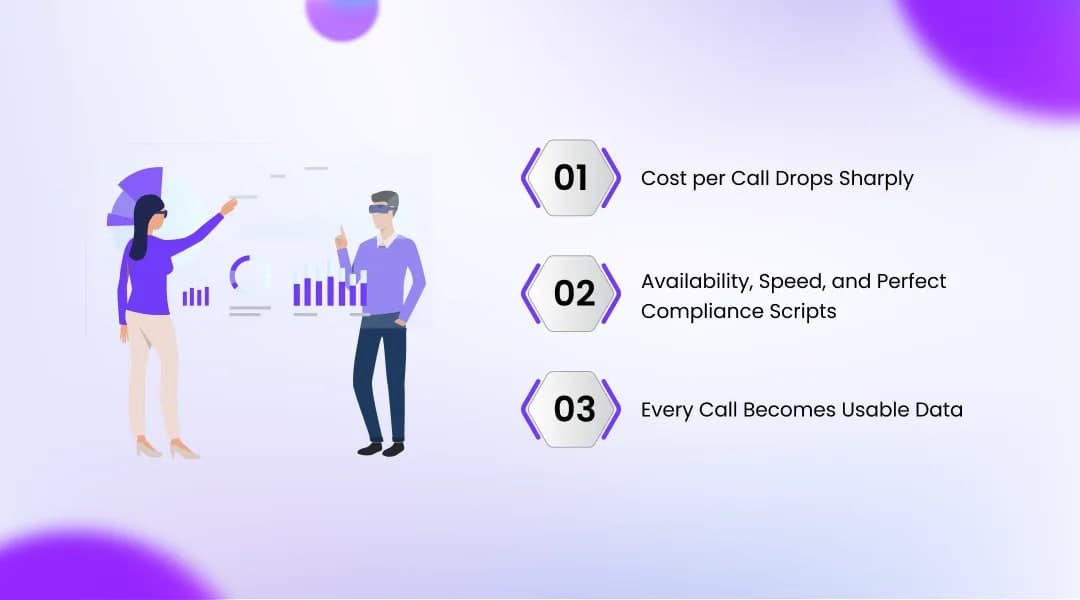
Cost per Call Drops Sharply
The headline benefit is cost. Gartner projects conversational AI will remove roughly $80 billion in contact center labor costs by 2026, and finance is a big share of that spend. Financial services make up about a quarter of global contact center spending, so the savings land hard here.
The math is simple once you see it. If a human call costs $6 to $12 and an AI-handled call costs cents, then every routine call you deflect is near-pure margin recovered. Multiply that across millions of balance and reminder calls and the picture changes fast.
Availability, Speed, and Perfect Compliance Scripts
Three benefits stack on top of cost, and they compound:
Always on: The agent works nights, weekends, and festival days, so a customer in a panic about a charge is not stuck on hold.
Faster resolution: A balance inquiry that took two to three minutes of menu navigation drops to seconds, which lifts satisfaction and lowers churn.
Verbatim disclosures: Regulators expect certain statements delivered exactly, every time. A voice agent reads them the same way on call one and call one million, and time-stamps proof.
Every Call Becomes Usable Data
Here is a benefit people underrate. Traditional post-call surveys get 5 to 10 percent response rates. A voice agent captures signal from 100 percent of interactions.
In the finance deployments we have worked on at OnDial, this turns out to be one of the quiet wins. Every call is transcribed, tagged, and searchable, so patterns like rising frustration around a fee or a confusing product surface early, before your NPS score tells you the bad news.
AI Voice Agent Use Cases in Finance
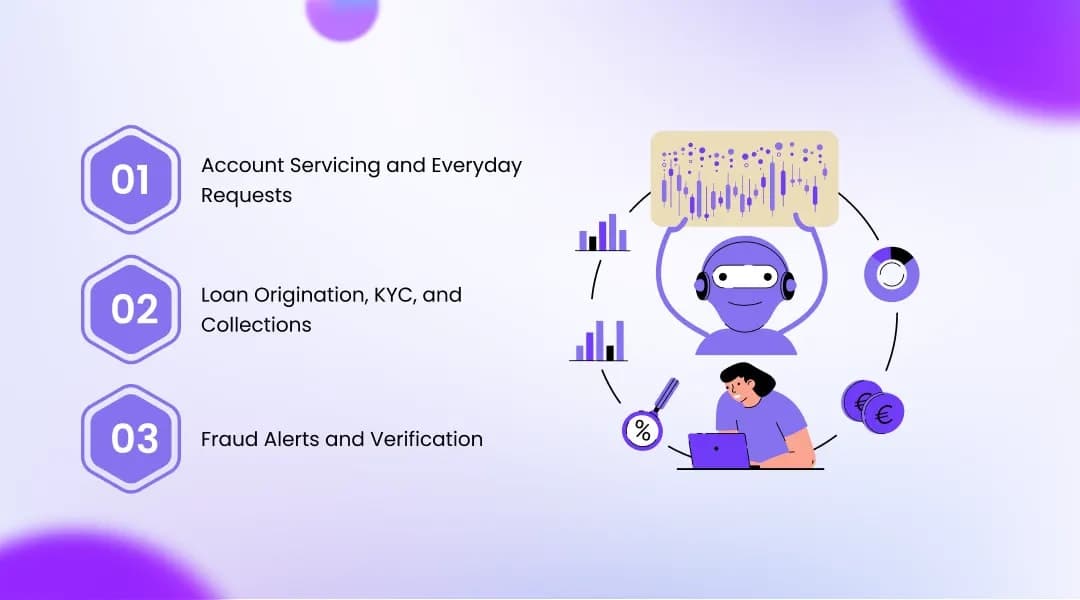
The biggest ROI in finance voice AI usually is not the flashy fraud-detection demo. It is the boring, high-volume stuff nobody wants to staff.
Account Servicing and Everyday Requests
These are your Tier 1 wins, the calls that build organizational confidence:
Balance and transaction inquiries: The single highest-volume call type, and the fastest to automate with strong containment.
Card actions: Reporting a lost card and freezing it instantly, without hold music or a callback queue.
Payment due dates and confirmations: Simple, repeatable, and endlessly requested, which makes them ideal first candidates.
Start here, and you get measurable returns while your team learns how the technology behaves on real traffic.
Loan Origination, KYC, and Collections
This is where voice AI gets genuinely interesting for lenders. Instead of a lengthy web form, an agent can run a natural conversation: what are you financing, what is your income, and so on, lifting application completion rates through progressive data capture.
KYC and re-verification are structurally suited to voice because the conversation is repeatable and the data captured is structured. On collections, agents can run EMI reminders at scale and capture promise-to-pay outcomes. One Indian digital bank reportedly moved from monitoring 4 percent of collections calls to 100 percent after adopting AI, according to data cited by Evident. That jump from spot-checking to full coverage is the real story.
Fraud Alerts and Verification
Speed is everything in fraud, and voice is uniquely direct here. Voice biometrics authenticates a caller by the unique characteristics of their voice instead of security questions, which shortens verification without weakening it.
Picture the flow. The agent calls: "We noticed a $1,200 charge in another city; was this you?" The customer says no, and the agent halts the transaction, blocks the card, and flags the fraud team. Total time can be under a minute, with no callbacks and no waiting. So which of your call types is quietly bleeding money right now?
What ROI Can Financial Businesses Actually Expect?
Let me give you the direct answer first, then the nuance, because both matter.
Most financial businesses see positive ROI from voice AI within 4 to 12 months. Returns come mainly from call containment: automating 30 to 60 percent of routine calls at a fraction of human cost. A mid-size contact center can save several hundred thousand dollars a year on deflected calls alone.
The Containment Math
Call containment is the share of calls an AI agent fully resolves without passing to a human. For routine banking inquiries, containment rates of 70 to 80 percent are achievable within the first year.
The numbers add up quickly. A European financial institution documented by Master of Code deployed a voice agent across balance checks, disputes, and payments, and now handles over 156,000 calls per month autonomously, with a 94 percent first-call resolution rate, 88 percent customer satisfaction, and $7.7 million in annual savings. That is not a projection. That is a live deployment with a payback measured in months.
Realistic Payback and an Honest Caveat
Not every deployment prints money on day one, and I would not trust anyone who told you otherwise. The trust-building truth is that only a handful of the fifty largest banks reported fully realized AI ROI last year, and a large share of projects stall between pilot and production.
Two things separate the winners from the stalls:
Use case discipline: Teams that start with one high-volume, low-complexity queue see payback fast. Teams that try to automate everything at once tend to stall.
Honest metrics: Containment alone is a vanity number if you hit it by handling easy calls and dumping the hard ones in a queue. Measure first-call resolution and customer satisfaction alongside it.
Compliance and Economics: The India Reality Most Guides Skip
Here is the content gap almost every global guide leaves wide open. If you are a financial business in India, the rules of the game are different, and the vendor who ignores that will get your numbers disconnected.
The Four-Layer Regulatory Stack
Deploying voice AI in Indian finance means clearing four overlapping frameworks, not one (and yes, your compliance team will ask about all four before they sign anything):
DPDP Act 2023: The data-protection floor. It governs consent, purpose limitation, retention, and erasure, with penalties reaching ₹250 crore. Every call processes personal data, so it always applies.
TRAI DLT: India's registration framework governing commercial outbound calls and messages. Senders, headers, and templates must be registered, and calls classified correctly.
RBI Fair Practices Code: For lenders, collection calls are restricted to set hours, must identify the caller, cannot use threatening language, and must offer a human escalation path.
IRDAI norms: For insurers, sectoral rules on solicitation and mis-selling sit on top of everything above.
This matters right now, not someday. TRAI's automated detection systems disconnected more than 47,000 numbers in a single quarter of 2026. Skip proper registration and your legitimate campaign can get blocked at the carrier level.
Hinglish, Regional Languages, and INR Unit Economics
Compliance is half the India story. Language and cost are the other half.
Code-switching is the norm: Real Indian calls blend Hindi and English mid-sentence, plus Gujarati, Tamil, Telugu, Marathi, and more. Speech models trained only on US English can lose 15 to 25 percent accuracy on Indian speech, so your agent needs models built for this reality.
INR economics decide viability: Per-minute costs in India typically run ₹4 to ₹6. A USD-priced global vendor can cost two to three times more for the same three-minute call, which quietly wrecks your unit economics at scale.
This is exactly the ground OnDial is built to stand on. Voice AI for Indian financial businesses is not a language feature bolted onto a US product; it is compliance, telephony, and vernacular fluency designed in from the start.
How to Deploy Voice AI Without Betting the Whole Contact Center
You do not need a big-bang rollout. You need a disciplined first move.
Start Small, Prove It, Then Scale
The pattern that works is boringly consistent:
Pick one Tier 1 queue: Balance inquiries, EMI reminders, or KYC scheduling. High volume, low risk, clear success metric.
Pilot on 5 to 10 percent of calls for 60 to 90 days, targeting containment above 70 percent, satisfaction above 80 percent, and accuracy above 90 percent.
Build the escape hatch: Always give the customer a clean path to a human. The caller who wants a person and cannot find one becomes a churn event.
Ramp from there. Move from 20 to 30 percent of a queue to fuller coverage only once the metrics hold.
Questions to Ask Any Vendor
Before you sign, put these on the table:
Compliance proof: Can you show a real audit trail for one call, including consent capture and DLT classification?
Latency: What are your p50 and p95 response times on actual phone calls, not browser demos? In finance, a two-second lag reads as a failure.
Data ownership and residency: Where is the data stored, who can access it, and how does erasure work under DPDP?
If a vendor answers these crisply, you are talking to a partner. If they get vague, you are watching a marketing conversation, not a deployment conversation.
Conclusion
An AI voice agent for finance is no longer a bet on the future; it is a practical tool with returns you can measure this quarter. Three things decide whether it works for you.
Start with high-volume routine calls where the containment math is obvious. Expect payback in months, not years, when you pick the right first use case. And in India, treat compliance as architecture, never an afterthought.
You are not choosing between automation and control. You are choosing one well-scoped use case, a clean audit trail, and a partner who understands both the technology and the regulatory ground you stand on.
That is the work we do at OnDial: voice AI for Indian financial businesses that speaks your customers' language, respects DPDP and TRAI rules, and proves its worth on real calls. If you are weighing your first finance use case, begin with the calls that cost you the most.