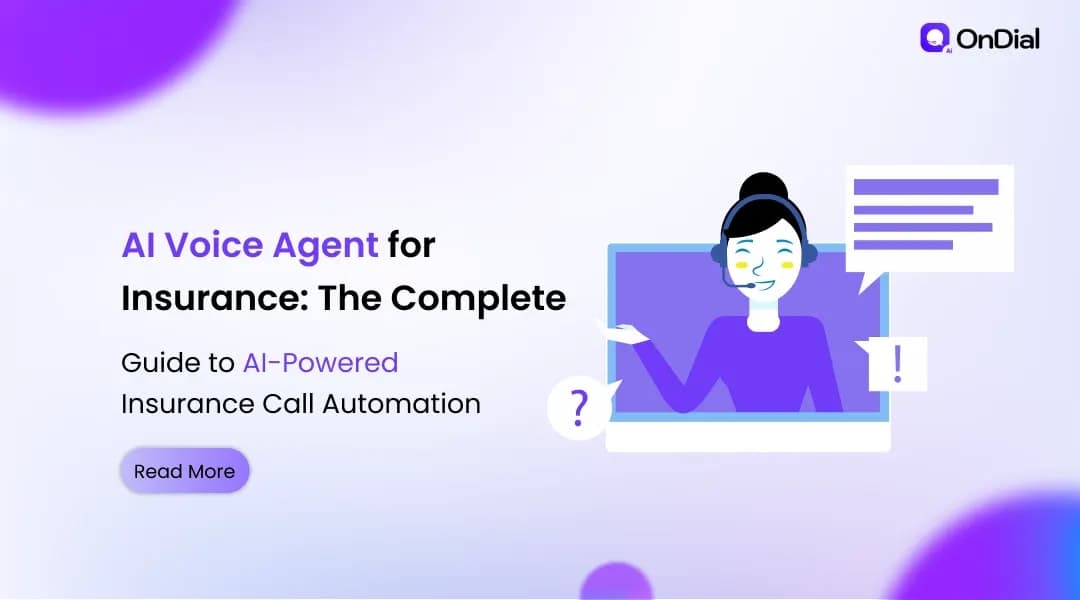
Insurance teams are now automating 70 to 80 percent of routine call volume with an AI voice agent for insurance, and claims processing time drops by up to 70 percent wherever the system handles First Notice of Loss intake. If you are still staffing every phone line by hand, that gap is why competitors are answering faster than you are.
I get why this sounds optimistic if you have heard vendors promise the same thing about chatbots before. An AI voice agent for insurance is a phone-based system that understands natural speech, retrieves real policy and claims data, and completes the call instead of just routing it, not a smarter IVR menu. It can verify a policyholder, file a First Notice of Loss, and update your Agency Management System before the call ends. Whether it's actually worth switching depends entirely on how much of your call volume is repetitive.
Here's what you'll learn: how these systems work, where they create the most value, what compliance really requires (including in India), what they cost, and how to evaluate one without buying more than you need.
What Is an AI Voice Agent for Insurance?
An AI voice agent for insurance is a phone-based system using speech recognition, natural language processing, and connected policy data to hold real conversations, verify caller identity, and complete tasks like FNOL intake, policy lookups, and billing updates without a human on the line.
How It Differs from Traditional IVR Systems
Legacy IVR systems are menu trees. Callers press one for claims, two for billing, and wait. The menu does not understand intent, so anyone off-script ends up repeating themselves to a human anyway.
An AI voice agent works the opposite way. A caller can say "my roof got damaged in the storm," and the system identifies intent immediately, asks clarifying questions, and pulls the right workflow.
The Technology Stack Behind It
Most platforms in 2026 combine four layers to make a call feel like a conversation, not a script:
Speech recognition (ASR): converts spoken words into text in real time, even with accents or noise.
Natural language understanding: determines what the caller wants, even when phrased conversationally.
Large language models (LLMs): generate responses and decide the next step.
Text-to-speech (TTS): turns the response into natural-sounding voice fast enough that callers never notice a delay.
Most platforms run cloud-first for speed; insurers with strict data residency needs in India sometimes choose on-premise infrastructure instead.
How AI Voice Agents Handle Insurance Call Automation
Insurance call automation covers two different categories of calls, and a good AI voice agent handles both without losing context.
First Notice of Loss (FNOL) and Claims Intake
FNOL, or First Notice of Loss, is the first call a policyholder makes to report an incident, and it is where AI voice agents earn their keep fastest. The agent confirms identity, asks structured questions about what happened, and captures the details your claims system needs.
In projects I've worked on at OnDial, one pattern that saves time is the agent texting the caller a secure link to upload damage photos mid-call, so the claim starts moving before the office opens the next day.
Policy Servicing, Billing, and Renewals
Most calls into an insurance call center are not claims at all. They are policy questions, payment confirmations, and renewal reminders- the repetitive share of volume that does not need a license to handle.
An AI voice agent answers "what's my deductible" instantly, pulled directly from the policy administration system, and can take a payment the moment things get complicated.
Where AI Voice Agents for Insurance Deliver the Most Value
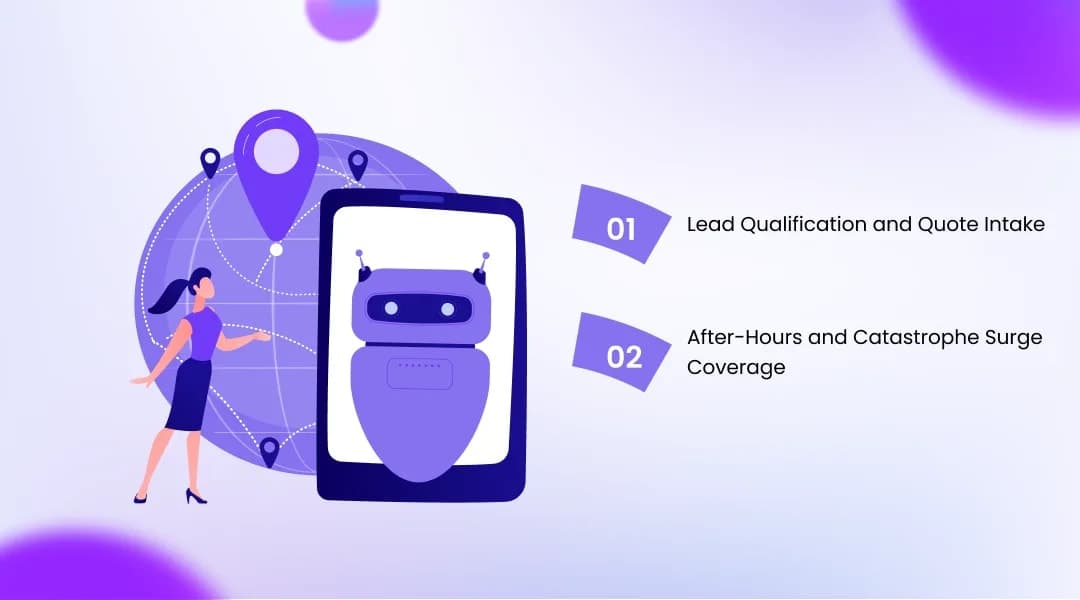
Beyond claims, this is where insurance customer service automation compounds value across lead intake and surge coverage.
Lead Qualification and Quote Intake
Speed to lead determines whether a quote turns into a policy. Someone shopping for coverage at 9 PM does not wait until Monday; if your agency does not answer, they call the next one.
An AI voice agent answers immediately, asks the qualifying questions a producer normally would, and routes a complete lead to a licensed agent the moment it is ready.
After-Hours and Catastrophe Surge Coverage
Claims do not happen during business hours. A burst pipe at 11 PM or a hailstorm flooding your phone lines with hundreds of calls in an hour is exactly when traditional staffing breaks down.
(I've watched agencies try to solve this with overtime and temp staff, and it never scales.) An AI voice agent absorbs that volume without dropping a call, capturing the same structured FNOL data a human would.
Is AI Voice Automation Secure and Compliant for Insurance?
Yes, AI voice automation can be secure and compliant for insurance when the platform supports SOC 2, HIPAA where health data is involved, and sector rules like TCPA in the US or TRAI and IRDAI in India, with encrypted recordings, consent capture, and a full audit trail.
Data Security Standards
Insurance data is sensitive by default. Claims involve medical details, financial information, and personal identifiers, so any platform handling it needs SOC 2 Type II certification at minimum, plus HIPAA compliance and signed Business Associate Agreements wherever health information is involved.
Every call should be encrypted, logged, and retrievable for audit. "The AI handled it" is not a defense if you cannot show what was said and agreed to.
India-Specific Compliance: TRAI DLT, IRDAI, and the DPDP Act 2023
If you call Indian policyholders, US-centric language about HIPAA and TCPA does not cover you. TRAI's Distributed Ledger Technology (DLT) framework requires Principal Entity registration, registered call headers, and DND scrubbing before any outbound call. IRDAI has signaled sector-specific guidance is coming for AI-driven insurance solicitation.
Layer the DPDP Act 2023 on top, with its rules on consent and data retention, and compliance stops being a checkbox. At OnDial, this is the layer we built around from day one, since a voice agent that isn't TRAI and DPDP aware is a liability waiting for its first audit.
Do AI Voice Agents Replace Insurance Agents?
Here's the part most vendor pitches skip: the goal was never to replace your agents. It was to stop wasting them.
What Stays Human
Complex underwriting judgment, emotionally difficult claims conversations, and relationship-driven renewals still need a person. No AI voice agent, including ours, should make a coverage call on a borderline claim alone.
Ask yourself this: how many calls your team handled last week actually needed that kind of judgment, versus how many were someone asking where their ID card is?
What the Data Actually Shows
Gartner projects conversational AI will cut contact center labor costs by 80 billion dollars in 2026, even though only about one in ten agent interactions will be automated. The savings come from AI absorbing repetitive volume, not from replacing the workforce.
That's the whole shift in one sentence.
Licensed producers spend less time on "where is my ID card" and more time on the underwriting judgment and relationship-building that actually requires a license.
What Does an AI Voice Agent Cost for Insurance Companies?
Per-Minute and Per-Outcome Pricing Models
Pricing runs two ways. Per-minute platforms charge roughly $0.08 to $0.40 a minute, while outcome-based pricing charges per completed task, such as a qualified lead or a resolved billing call. Indian deployments often run ₹8 to ₹25 per successful outcome.
Outcome-based pricing tends to align incentives better. You are not paying for a call that rang and dropped; you are paying for a claim that got filed correctly.
Calculating Your Real ROI
A human agent costs an agency roughly 7 to 12 dollars per complex interaction once you account for salary, overhead, and turnover. Voice AI brings that closer to a dollar for the same routine call types.
Run the math against your actual call volume, not a vendor's case study. At 5,000 routine calls a month, the staffing cost behind answering "what's my deductible" adds up fast.
How to Choose and Implement an AI Voice Agent for Your Insurance Business
Choosing the right AI phone agent for your insurance agency comes down to a few non-negotiables, whether you run a single location or a multi-state carrier.
Questions to Ask Before You Sign
Can it integrate with your Agency Management System (AMS)? If not, every detail has to be re-entered manually, defeating the purpose.
What happens when it does not know the answer? A good system escalates to a human with full context; a bad one guesses, and a wrong coverage statement is a regulatory problem.
Is compliance built in or bolted on? Ask for documentation, not a verbal assurance, around DND scrubbing, consent capture, and audit logging.
A Realistic Implementation Timeline
Most platforms go live in two to six weeks once your call flows, AMS integration, and compliance sign-off are mapped out. Start with one high-volume, low-risk use case before automating claims intake.
Prove it works on something low-stakes first. Once your team trusts the system, expanding into FNOL and renewals gets easier to approve internally.
Conclusion
An AI voice agent for insurance is not a replacement for your team. It is the system that finally answers every call your team could not get to. Three things matter most: it automates the repetitive share of routine calls, not the judgment calls; compliance built for your market, whether TRAI and DPDP in India or HIPAA and TCPA elsewhere, cannot be an afterthought; and the strongest ROI comes from starting with one high-volume use case instead of automating everything at once.
If missed calls and hold-time complaints are costing you quotes, that gap is exactly what we built OnDial to close. Talk to us about what a pilot would look like for your call volume.