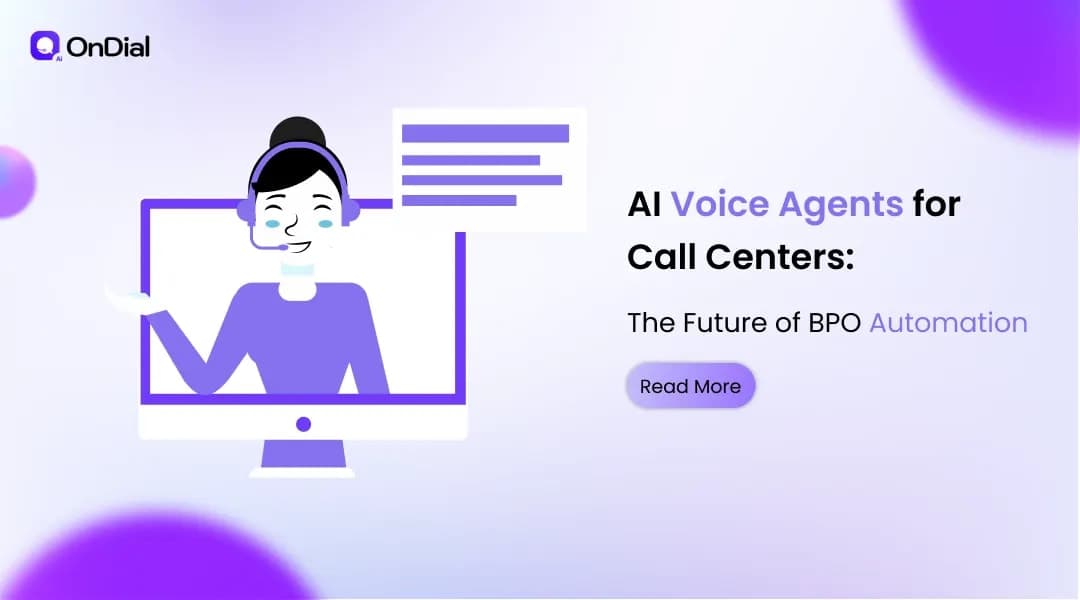
Call centers and BPOs are under constant pressure to handle more conversations without allowing costs, wait times, or service quality to move in the wrong direction.
Hiring more agents can increase capacity, but it also increases training requirements, management overhead, scheduling complexity, and quality assurance demands. Traditional IVR systems can route calls, but they often make customers navigate menus before they reach the right person.
AI voice agents offer another operating model.
Instead of treating every call as a human-only interaction, businesses can separate routine conversations from cases that require judgment, empathy, negotiation, or specialized expertise. AI can handle the predictable work while human agents focus on the conversations where people create the most value.
That makes AI voice agents particularly relevant for modern call centers, customer support teams, and BPO operations serving customers across India and international markets.
What Are AI Voice Agents for Call Centers?
An AI voice agent is a conversational software system that can communicate with customers over phone calls using speech recognition, natural language understanding, conversation logic, and voice synthesis.
Unlike a traditional IVR, the caller does not necessarily need to follow a fixed menu.
A customer can explain a problem naturally. The AI can identify the intent, ask follow-up questions, retrieve information from connected systems, complete an approved action, and escalate the conversation when human intervention is necessary.
For a call center, that means voice automation can move beyond simple call routing.
The objective becomes resolution.
For example, instead of asking a customer to press multiple keys to reach the billing department, an AI voice agent can understand that the customer wants to know why a payment failed, retrieve the relevant information, explain the next step, and transfer the call if the situation requires a specialist.
Why Call Centers Are Moving Beyond Traditional IVR
Traditional IVR still has a place in many contact centers. It can provide predictable routing and basic menu navigation, particularly for simple workflows.
The problem appears when customer intent does not fit neatly into a predefined menu.
A caller might say, "My payment went through, but my account still shows an outstanding balance. Can you check what happened?"
A rigid IVR may force that caller through several menu options. A conversational AI system can identify the intent from the spoken request and begin working toward a resolution.
The difference is important because customer experience is influenced not only by whether a call is answered, but also by how much effort the customer needs to spend before getting useful help.
For BPOs, conversational automation also creates an opportunity to standardize routine workflows across large volumes of calls without requiring every interaction to start with a human agent.
How AI Voice Agents Work Inside a Call Center
A production voice AI workflow usually involves several connected stages.
1. Call Detection and Speech Recognition
The system receives the call and converts spoken language into information that the AI can interpret.
This stage needs to account for accents, background noise, interruptions, different speaking speeds, and multilingual conversations.
2. Intent and Context Detection
The AI determines what the caller wants and identifies relevant context.
The intent might be order tracking, appointment scheduling, account information, payment follow-up, complaint registration, lead qualification, or another defined business workflow.
3. Business Logic and Knowledge Retrieval
The agent uses approved business information, conversation rules, and connected systems to determine what it can say or do.
This is where integration becomes critical.
An AI that can only answer general questions has limited operational value. An AI connected to CRM, ticketing, scheduling, order, or account systems can participate in an actual business process.
4. Action or Resolution
The agent completes the permitted action.
This could mean scheduling an appointment, updating a record, collecting information, creating a ticket, confirming a status, sending a follow-up, or qualifying a lead.
5. Human Handoff
Not every call should be automated from beginning to end.
When the conversation becomes complex, sensitive, emotional, or outside the AI's defined authority, the system should transfer the caller to an appropriate human agent.
The handoff should include relevant context so the customer does not have to repeat the entire conversation.
6. Post Call Data and Analytics
After the conversation, the system can record the outcome, transcript, summary, intent, escalation reason, and other approved data.
This creates a feedback loop that call center managers can use to identify recurring problems and improve workflows.
The Best Call Center Tasks to Automate First
The strongest starting point is not necessarily the task with the highest call volume.
It is the task that combines high volume with predictable intent, clear business rules, and measurable outcomes.
Customer Support and FAQs
AI voice agents can handle repetitive questions about products, services, account processes, operating hours, policies, and order information.
These calls are often suitable for automation because the required answers can be defined and connected to an approved knowledge source.
Appointment Scheduling and Reminders
Healthcare, education, financial services, service businesses, and other organizations can use voice automation to schedule appointments, confirm bookings, handle rescheduling requests, and send reminders.
This can reduce the amount of manual calling required by front office and support teams.
Order and Delivery Updates
E-commerce and logistics businesses receive recurring calls about order status, delivery timing, failed deliveries, and returns.
When the voice agent can securely access the relevant system, it can provide status information without requiring a human agent to look up the same information repeatedly.
Lead Qualification
BPOs and sales teams can use AI voice agents to ask predefined qualification questions, collect customer requirements, categorize leads, and route high intent prospects to sales representatives.
The human team receives structured information instead of starting every conversation from zero.
Surveys and Customer Feedback
Voice AI can conduct post interaction surveys, collect structured responses, ask follow-up questions, and record feedback.
For large customer operations, this creates a scalable way to gather feedback without requiring a human interviewer for every call.
AI Voice Agents and Human Agents Should Work Together
One of the biggest mistakes in call center automation is treating the decision as AI versus humans.
The better question is which part of the customer journey should be handled by AI and which part should remain human.
AI is well suited to repetitive, structured, high volume interactions.
Humans remain essential for complex complaints, sensitive cases, negotiations, exceptions, relationship management, and situations where judgment matters.
This hybrid approach also creates a safer implementation path.
A business can begin by automating a narrow category of calls. Human agents remain available for escalation while managers monitor outcomes. Once the workflow performs consistently, additional call types can be introduced.
For BPOs, this can change the role of the human workforce rather than simply reducing headcount.
Agents can spend less time answering repetitive status questions and more time handling escalations, retention conversations, complex support cases, and higher value interactions.
Measuring AI Voice Agent Performance
Deploying an AI voice agent without measuring its performance creates another black box.
Call centers should establish a baseline before automation and compare results after deployment.
Average Handle Time
Measure whether routine conversations are becoming shorter without creating repeat calls.
A lower handle time is useful only when the customer actually receives an acceptable resolution.
First Call Resolution
First call resolution helps determine whether the issue was solved during the initial interaction.
If automation reduces handle time but causes customers to call back repeatedly, the system is not genuinely improving the operation.
Escalation Rate
Track how often AI transfers calls to human agents and why.
A high escalation rate for one specific intent can indicate that the workflow needs better knowledge, integrations, conversation design, or business rules.
Customer Satisfaction
Customer satisfaction should remain part of the automation scorecard.
Speed alone is not enough. The goal is to make the interaction easier while maintaining trust and resolution quality.
Automation Resolution Rate
Measure the percentage of eligible calls that the AI completes without human intervention.
This metric should be evaluated alongside resolution quality, not treated as the only success indicator.
Cost Per Resolution
For BPOs and large contact centers, cost per successful resolution can provide a more useful business metric than cost per call.
The important question is not simply how cheaply a call was handled.
It is how efficiently the organization solved the customer's problem.
What Call Centers Should Look for in an AI Voice Platform
Choosing a voice AI platform requires more than checking whether it can make or receive calls.
Natural Conversation
The system should understand interruptions, clarifications, follow-up questions, and conversational language rather than relying entirely on rigid scripts.
Multilingual Capability
This is especially important for Indian businesses.
A practical deployment may need English, Hindi, Hinglish, Gujarati, Tamil, Telugu, Marathi, Bengali, or other regional languages depending on the customer base.
For international BPOs, language support should also match the markets being served.
CRM and Business System Integration
The AI should work with the systems that already contain customer and operational data.
Depending on the use case, that can include CRM platforms, help desks, calendars, order management systems, ticketing tools, telephony systems, and internal APIs.
Human Handoff
A human escalation path should be designed before deployment.
The AI should know when to stop, who to transfer to, and what context needs to accompany the transfer.
Analytics and Monitoring
Managers need visibility into call outcomes, intents, escalation patterns, customer sentiment, resolution rates, and other operational signals.
Analytics are not just reporting features. They are part of the improvement process.
Security and Governance
Call center deployments can involve personal, financial, healthcare, or other sensitive information.
Organizations should evaluate data handling, access controls, retention policies, compliance requirements, and auditability before deploying voice automation at scale.
AI Voice Agents Across BPO Use Cases
BPO operations are rarely limited to one type of call.
A single operation may support several clients across different industries, each with different workflows.
For example, an e-commerce account may use AI for order tracking and delivery updates. A healthcare account may use it for appointment scheduling and reminders. A financial services account may use it for payment reminders and structured customer inquiries.
This flexibility makes AI voice automation relevant to the broader BPO operating model.
Call centers can also use AI for outbound workflows such as follow-ups, renewals, surveys, lead qualification, reminders, and reactivation campaigns.
For businesses serving multiple sectors, AI voice agents for call centers and BPO operations can provide a foundation for designing these workflows around specific client requirements.
How Indian Call Centers Can Use Multilingual Voice AI
India presents a particularly strong use case for conversational voice automation because customer interactions often cross language boundaries.
A customer may begin in English, switch to Hindi, and use regional terminology during the same conversation.
A useful AI voice system therefore needs to understand more than a fixed language list. It needs to handle the way people actually communicate.
For Indian call centers, deployment should be tested using real conversation patterns rather than only scripted demonstrations.
Test regional accents, code switching, background noise, interruptions, informal expressions, and common customer objections.
The goal is not simply to prove that an AI can speak a language.
The goal is to prove that it can successfully complete the business workflow in that language.
Building a Practical AI Voice Automation Strategy
A successful deployment does not need to automate every call on day one.
Start with one workflow.
Step 1: Analyze Existing Calls
Review call recordings, transcripts, disposition codes, repeat contacts, and escalation reasons.
Identify the highest volume repetitive interactions.
Step 2: Select a Defined Use Case
Choose a workflow with clear objectives and measurable outcomes.
Order tracking, appointment confirmation, lead qualification, and basic account inquiries are common starting points.
Step 3: Map the Conversation
Document how customers start the conversation, what information the AI needs, what actions it can take, and when the conversation must move to a human.
Step 4: Connect Business Systems
Integrate the AI with the systems required to resolve the selected workflow.
Without the right data and actions, automation can become a more conversational version of an IVR.
Step 5: Launch With Human Oversight
Begin with controlled traffic.
Monitor unsuccessful conversations, escalations, customer feedback, and operational metrics.
Step 6: Improve and Expand
Use real conversation data to identify failure points.
Improve the knowledge base, prompts, routing logic, integrations, and escalation rules before expanding to additional call types.
This approach allows organizations to build automation around evidence instead of assumptions.
The Future of BPO Automation Is Hybrid
The next stage of BPO automation is unlikely to be a simple replacement of human agents with machines.
A more practical model is a coordinated system where AI handles volume and repetition while human teams handle complexity and judgment.
AI voice agents can answer calls outside business hours, manage repetitive interactions during peak periods, support multilingual customers, collect structured information, and prepare context before a human takes over.
Human agents can then spend more time on conversations that require understanding, negotiation, empathy, and decision making.
That changes the economics of the operation without removing the human element that customers still value.
The strongest call centers will therefore not be the ones that automate the most calls.
They will be the ones that automate the right calls.
Conclusion
AI voice agents are becoming an important part of call center and BPO automation because they can connect conversational voice interactions with real business workflows.
The value is not simply that an AI can answer a phone call.
The value comes from what happens after the call is answered.
A well designed voice agent can understand intent, retrieve information, complete approved actions, update systems, collect feedback, and escalate complex cases with context.
For call centers, the opportunity is to build a hybrid operation where AI absorbs repetitive demand and human agents focus on the interactions where their expertise matters most.
Businesses evaluating this approach should start small, measure resolution quality, integrate the systems that matter, and expand automation based on real operational results.
OnDial provides AI voice automation for inbound and outbound business conversations, including customer support, lead qualification, appointment scheduling, multilingual communication, and workflow automation.
The future of BPO automation is not about removing people from every conversation.
It is about giving every conversation the right level of intelligence, automation, and human involvement.