The average insurance company retains 84 percent of its policyholders each year. That sounds like a reasonable number until you calculate what the remaining 16 percent actually costs. Acquiring a new policyholder costs seven to nine times more than retaining an existing one. For a carrier writing 800 dollars in average annual premium, each lapsed policy burns through 5,600 to 7,200 dollars in replacement acquisition costs, against revenue that was already secured. Multiply that across a mid-sized book of business and you are not looking at a leakage problem. You are looking at a structural revenue hemorrhage that compounds every renewal cycle.
The root cause is not that policyholders want to leave. Industry data consistently shows that the majority of non-renewals happen because of inaction, not dissatisfaction. The renewal notice arrives. The policyholder means to call back. Life intervenes. The coverage lapses. By the time the insurer notices, the customer has either gone without coverage or signed with a competitor who happened to call first.
The solution is not hiring more renewal agents. Most insurers and agencies already know that staffing costs cannot scale alongside renewal volume without destroying margins. The solution is deploying an AI voice agent that makes the outbound renewal call before the policyholder forgets, handles the conversation without human intervention, logs the outcome automatically, and escalates to a licensed agent only when the situation genuinely requires one.
This blog explains exactly how AI voice agents for insurance policy renewal work, what the business case looks like in real numbers, where the technology fits into a renewal workflow, and what separates a production-grade deployment from a proof of concept that never delivers results.
The True Financial Cost of Policy Lapse and Non-Renewal
Understanding why AI voice agents have become a serious retention tool in insurance starts with understanding the actual economics of policy lapse. The numbers are larger than most operations teams have fully calculated.
The U.S. individual life insurance lapse ratio climbed from 5.1 percent in 2023 to 7.0 percent in 2024, with online self-directed buyers lapsing at rates as high as 18 percent. In property and casualty lines, the damage concentrates around renewal events, where 57 percent of auto insurance customers shopped for alternatives in 2025 and 29 percent actually switched. These are not fringe behaviors. These are systematic patterns that occur every renewal cycle without proactive intervention.
The Revenue Math That Changes the Conversation
Consider a carrier managing a book of 340,000 policies at 84 percent retention. That means 54,400 policies lapse annually. At an average premium of 800 dollars, the direct revenue loss is 43.5 million dollars per year in premium alone. The replacement acquisition cost, at seven to nine times the retention cost per policy, makes the total economic impact substantially larger. A two-point improvement in retention, moving from 84 percent to 86 percent, recovers 5.4 million dollars in annual premium and avoids millions more in replacement spending.
Agencies at smaller scale face the same structural problem in proportion. An independent agency with 5 million dollars in annual premium running at 85 percent retention and moving to 92 percent through automated renewal outreach retains 350,000 dollars in additional premium annually. That math explains why renewal retention is consistently identified as the highest-ROI automation opportunity in the insurance industry.
Why the Standard Renewal Process Fails
The renewal process at most insurers and agencies remains reactive. A notice goes out by mail or email. The insurer waits. Some policyholders call in. Many do not. Follow-up calls are made when agents have time, which means the highest-risk policyholders are contacted inconsistently and often too late.
According to research on insurance renewal behavior, clients who do not respond to renewal outreach within 14 days of the initial 60-day notice are four times more likely to shop with a competitor. A reactive workflow cannot catch these at-risk policyholders fast enough. An AI voice agent working an automated outbound calling sequence can.
What AI Voice Agents Actually Do in a Renewal Workflow
AI voice agents for insurance policy renewal are not robocalls with recorded messages. They are autonomous conversational systems that conduct a two-way dialogue with the policyholder, respond to questions, capture intent, handle common objections, and pass structured outcomes back to the insurer's CRM or policy management system in real time.
A properly deployed AI renewal agent operates across a defined workflow that begins well before expiry.
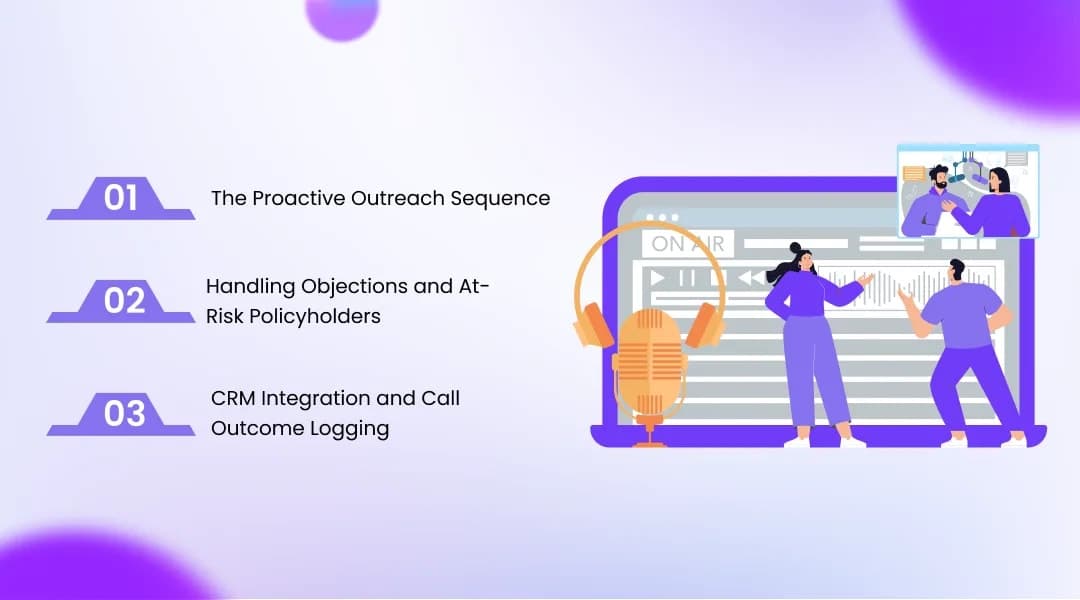
The Proactive Outreach Sequence
The agent initiates outbound calls starting 30 to 60 days before policy expiry, not 10 days before. Early engagement gives the insurer the maximum window to address concerns, explain premium changes, or offer bundling options that improve retention. The first call confirms the policyholder's intent to renew, answers basic coverage questions, and records the outcome. If the policyholder confirms renewal immediately, the agent can send a secure payment link or initiate the renewal confirmation directly. If the policyholder has questions about a premium increase, the agent explains the reason tied to market conditions or their individual risk profile and escalates to a licensed agent only if the conversation requires product advice beyond the agent's scope.
Handling Objections and At-Risk Policyholders
Not every renewal conversation is straightforward. Policyholders who received a premium increase, filed a recent claim, or have been disengaged from the insurer for months require a different conversational approach than policyholders renewing without friction. An AI voice agent can be configured to identify each policyholder's profile before the call begins and adjust the conversation accordingly. A policyholder facing a 15 percent premium increase receives a clear explanation tied to loss history and market factors. A policyholder with no claims and no engagement receives a shorter confirmation-focused call. This level of personalisation at scale is impossible with a manual calling team operating under daily volume pressure.
CRM Integration and Call Outcome Logging
Every call produces a structured outcome record that is pushed to the insurer's CRM or policy management platform without requiring manual data entry. Renewal confirmed. Payment initiated. Escalated to agent. No answer, retry scheduled. This real-time logging eliminates the after-call administrative work that consumes 10 to 15 minutes of agent time per call in a traditional renewal team and creates inconsistent record-keeping. It also gives operations managers a live dashboard of renewal pipeline status, completion rates, and policyholder intent that would be impossible to assemble from a manual calling process.
The Business Case for Automating Renewal Calls
Insurance agencies that automate renewal and follow-up workflows increase retention rates by 8 to 14 percentage points compared to those using manual processes, according to the Big I 2025 Agency Universe Study. Agencies with mature automation practices that move from manual to fully automated renewal sequences report retention improvements ranging from 12 to 22 percentage points over baseline, with some studies positioning 92 to 94 percent retention as achievable for agencies that implement systematic proactive outreach.
The cost comparison between automated AI renewal calling and traditional staffed renewal teams is equally clear. A human renewal agent handling 40 to 60 outbound calls per day at fully loaded labor cost, including salary, benefits, training, and management overhead, represents a fixed cost that does not scale efficiently with policy volume. An AI voice agent handling hundreds of calls simultaneously, at any hour, without overtime, sick days, or performance variability, delivers a cost-per-renewal-contact that is a fraction of the human-staffed equivalent.
Speed-to-Contact as a Retention Driver
Speed of outreach is a more significant retention variable than most insurers measure explicitly. The moment a renewal window opens, the policyholder is by definition in an active decision period. Every day that passes without contact from the incumbent insurer is a day the policyholder can be reached by a competitor. AI voice agents eliminate the contact lag that manual renewal teams create through queuing, scheduling constraints, and agent availability. An automated outbound sequence can reach every policyholder in the renewal window within the same day the window opens, guaranteeing first contact consistently across the entire book.
Cross-Sell and Multi-Policy Retention
Insurance households with three or more policies show a retention rate of 96 percent compared to 78 percent for single-policy holders, according to J.D. Power's 2025 Insurance Loyalty Study. The renewal call is the single highest-intent moment to surface a relevant cross-sell or upsell. An AI agent completing a renewal confirmation can be configured to surface a bundling offer, an additional coverage type relevant to the policyholder's profile, or a loyalty discount for adding a second line. Automated cross-sell conversion rates in insurance renewal workflows reach 18 to 28 percent, compared to 8 to 12 percent for manual cross-sell outreach, according to Forrester Research 2025 data. The renewal call is not just a retention touchpoint. It is a revenue expansion opportunity.
How OnDial Deploys AI Voice Agents for Insurance Renewal
OnDial is a platform built specifically for deploying production-grade inbound and outbound AI voice agents across more than 20 industries, including insurance. What makes OnDial relevant to the insurance renewal problem specifically is the combination of conversational speed, language capability, compliance infrastructure, and deployment flexibility that real renewal workflows require.
OnDial's AI voice agents operate with sub-500 millisecond response latency. In a renewal conversation, this matters because any noticeable pause or robotic hesitation breaks the policyholder's trust in the interaction immediately. Conversations that feel natural and responsive produce higher confirmation rates than conversations that feel automated. OnDial's latency specification ensures the dialogue flows at a pace that feels like a real agent, not a phone tree.
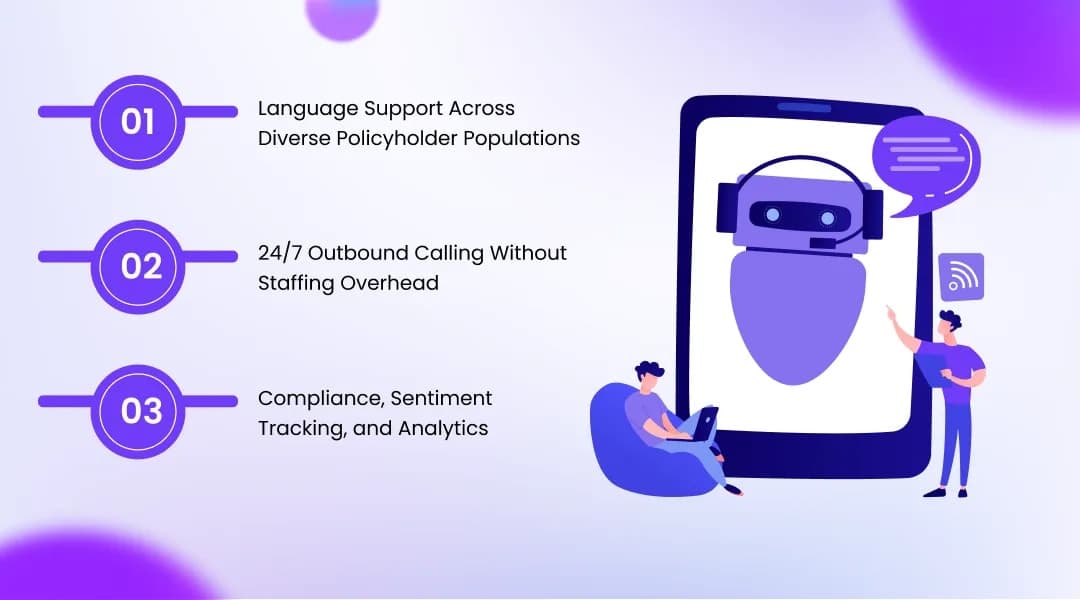
Language Support Across Diverse Policyholder Populations
Insurance in India and across multilingual markets presents a specific challenge that generic voice automation platforms fail to address. Policyholders in India speak one of dozens of regional languages, frequently switch between their regional language and English within the same sentence, and have deeply held expectations about being served in their mother tongue. OnDial supports more than 100 languages, including 9 Indian languages with over 80 Indian voice variations. This means an insurer serving policyholders across Maharashtra, Tamil Nadu, Gujarat, and West Bengal can deploy a single renewal calling infrastructure that conducts each call in the policyholder's preferred language, with a voice that sounds local and natural rather than generic.
This is not a cosmetic feature. Renewal conversations conducted in a policyholder's native language produce meaningfully better engagement, higher confirmation rates, and lower call abandonment than English-only automated calls for non-English-speaking populations.
24/7 Outbound Calling Without Staffing Overhead
OnDial's AI voice agents run 24 hours a day, seven days a week, without supervision or management overhead. For insurance renewal workflows, this means the calling sequence continues outside business hours, reaching policyholders who are unreachable during the day but available in the evening, and ensuring that no renewal window passes without contact simply because the team is offline. The platform handles inbound calls that return from outbound campaigns with the same AI agent capability, so policyholders who call back after hours receive a consistent service experience rather than reaching voicemail.
Compliance, Sentiment Tracking, and Analytics
OnDial's platform is GDPR and CCPA compliant, which matters for insurance renewal calling because policyholder data handling must meet regulatory standards across every call. Beyond compliance, OnDial captures call sentiment analysis and smart analytics across every renewal interaction. Operations managers can see which renewal conversations are trending toward confirmation, which policyholders are expressing concern about pricing, and which calls resulted in escalation to a human agent. This call-level intelligence is impossible to produce at scale from a manual renewal team and gives insurance operations leaders the visibility to continuously optimise the renewal sequence.
Implementation: What Deployment Actually Looks Like
Deploying an AI voice agent for insurance renewal does not require dismantling the existing technology stack. OnDial offers both API and no-code deployment options, which means insurers and agencies at very different technology maturity levels can implement the platform without a long integration project.
A typical insurance renewal deployment follows a defined sequence. First, the policyholder data feed is connected, pulling renewal dates, policyholder contact information, policy type, and premium change data from the existing policy management system or CRM. Second, the renewal conversation script is configured, including the initial outreach message, the objection handling branches for common scenarios like premium increases and coverage questions, and the escalation triggers that route calls to a licensed agent. Third, the calling schedule is set, defining when outreach begins relative to expiry, how many contact attempts are made, the interval between attempts, and what channels follow up an unanswered call. Fourth, CRM integration is tested to confirm that every call outcome is logged accurately and in real time.
Most organisations moving through this sequence for a straightforward renewal calling deployment are operational within days, not months. The no-code deployment path removes the dependency on an IT team entirely, which matters particularly for independent agencies and mid-sized insurers whose technology resources are already committed.
Where AI Calling Fits Alongside Human Agents
The question that comes up consistently when insurers evaluate AI voice agents for renewal is whether the technology replaces licensed agents or supports them. The answer is structural. AI handles the volume. Humans handle the complexity.
The majority of renewal conversations are confirmations. The policyholder is renewing. They have no significant questions. They need to hear the expiry date, confirm their intent, and receive a payment link. There is no reason for a licensed agent to conduct this conversation. AI handles it at a fraction of the cost in a fraction of the time.
A smaller segment of renewal conversations involves genuine complexity. A policyholder who wants to restructure their coverage, compare products across lines, or escalate a complaint about a claim experience requires human expertise and relationship-building skills that an AI agent does not replace. OnDial's AI agents are configured to identify these moments in real time and transfer the call to a human agent with full context attached, including a summary of the conversation to that point, the policyholder's profile, and the specific concern that triggered escalation. The human agent picks up where the AI left off without asking the policyholder to repeat information.
This architecture allows a renewal team of six agents to manage the same book of business that would previously require 30 agents to contact manually, with the human agents focused entirely on complex cases and revenue-generating conversations rather than confirmation calls.
Conclusion
Three points from this blog matter most for any insurance leader evaluating renewal automation. First, the majority of policy lapses happen because of inaction, not dissatisfaction, which means proactive, timely outreach at scale is the primary lever for improving retention. Second, the economics of AI renewal calling are unambiguous: automated outreach costs a fraction of staffed renewal teams, reaches policyholders earlier in the decision window, runs 24 hours a day without overtime, and produces structured outcome data that a manual process never generates. Third, the technology works across languages and markets, which makes it relevant not just for large English-speaking carriers but for any insurer serving multilingual populations in India or other diverse markets.
OnDial delivers exactly what this problem requires. With sub-500 millisecond response latency that keeps renewal conversations feeling natural, support for over 100 languages including 9 Indian languages with 80-plus voice variations, 24/7 inbound and outbound call handling with no human staffing requirement, full CRM integration, call sentiment analysis, and GDPR and CCPA compliant data handling, OnDial is built for the kind of production-grade insurance renewal deployment that produces measurable retention results, not just a promising pilot. The platform works across both API and no-code deployment paths, which means insurers at any technology maturity level can be operational quickly.
If your renewal process still relies on manual outreach and reactive follow-up, the retention and revenue opportunity cost is accumulating every day. Schedule a demo with OnDial to see how AI renewal calling works for your specific book of business and what a realistic retention improvement looks like in your numbers.