Every clinic administrator in India recognises this moment. It is 9:15 on a Tuesday morning and the 9:00 appointment has not arrived. The 9:30 appointment has not confirmed. The receptionist is managing incoming calls, the waiting room is quieter than the booking system suggested, and the doctor's slot has gone to waste.
Patient no-show rates in Indian outpatient settings range between 20 and 30 percent of all scheduled appointments. For a clinic processing 60 appointments per day, that is 12 to 18 empty slots every working day. At an average outpatient consultation value of Rs. 800, a 25 percent no-show rate costs a mid-size clinic approximately Rs. 9,600 per day and close to Rs. 28 lakh per year from consultation revenue alone.
Most of these no-shows are preventable. Patients forget. They need to reschedule. Their contact details changed, or they simply did not receive a timely reminder. What keeps these problems unsolved is that the traditional solution, placing individual reminder calls through front-desk staff, does not scale without adding headcount, creates inconsistency in timing and language coverage, and pulls staff away from inbound calls where new patient inquiries are actively waiting.
AI voice agents for healthcare appointment management solve this problem at the system level. They automate the full reminder sequence, handle inbound rescheduling, and communicate with patients in their preferred language without any human involvement in the call. Healthcare facilities that reduce patient no-shows with AI calling consistently recover measurable revenue within the first 90 days. This blog covers how automated appointment reminders in healthcare settings across India work, what the no-show reduction numbers look like, and what providers across every clinical setting are recovering.
The Full Financial Cost of Patient No-Shows in Indian Healthcare
The direct revenue loss from empty slots is the easiest dimension of the no-show problem to measure, but it is not the largest one. Most clinic management systems record a missed appointment as an operational note, not as a financial metric. When the calculation is done properly across all revenue streams, the numbers change how providers think about the problem.
A mid-size outpatient clinic with a 20 percent no-show rate on 60 daily appointments loses 12 appointments per working day. At Rs. 800 per consultation, this is Rs. 9,600 in direct daily revenue loss. Across 250 working days per year, this compounds to approximately Rs. 24 lakh from consultation fees alone. For a specialist clinic with consultation values at Rs. 2,500 per appointment and the same no-show rate, the annual consultation revenue loss exceeds Rs. 75 lakh without accounting for any ancillary revenue.
The cascading losses are harder to capture but substantially larger in aggregate. When a patient does not arrive, the doctor's time is lost, the diagnostic equipment for that slot sits idle, and the paramedical staff are underutilised. In a multi-specialty hospital where a single appointment involves preparation time, coordinator involvement, and room allocation, the fully loaded cost of a no-show is typically three to four times the consultation fee alone. When all cost streams are included, the annual revenue impact of a persistent 20 percent no-show rate at a mid-size multi-specialty hospital can exceed Rs. 50 lakh per year.
Why Manual Reminder Calls Do Not Scale
Manual reminder calls in healthcare settings fail for reasons that have nothing to do with staff quality. The volume of appointments at any moderately busy clinic exceeds what a small front-desk team can reliably reach before each appointment date. A receptionist placing reminder calls across a list of 50 confirmed appointments spends two to three hours per day on outbound calling alone. During those same hours, inbound calls from new patients are waiting in a queue that drives frustration and abandonment.
The timing problem is equally significant. Clinical evidence consistently shows that appointment reminders are most effective when delivered 48 hours before the appointment and again 2 to 4 hours before. Achieving that exact timing across every patient, every day, regardless of staff workload or clinic volume, requires a system. A human-driven process produces inconsistent timing at best and complete gaps at worst, which is why even clinics with dedicated reception teams still see no-show rates above 20 percent despite genuine effort.
The Language Coverage Gap That Drives No-Shows in India
India's healthcare providers serve a linguistically diverse patient population across every urban and semi-urban market. A hospital in Gujarat sees patients whose first language is Gujarati. A clinic in Tamil Nadu serves patients most comfortable in Tamil. A multi-specialty hospital in Mumbai handles Hindi, Marathi, Gujarati, Urdu, and English across the same morning session. Manual reminder calls cannot consistently cover this range, and the healthcare voice AI infrastructure to bridge this gap has historically not been part of the conversation at most Indian facilities.
Patients are significantly more likely to confirm or reschedule when a reminder arrives in their native language. The language gap in manual systems is one of the least-discussed structural causes of high no-show rates in Indian healthcare. It persists even when some form of reminder system is in place, because the communication does not land with the clarity needed for the patient to take action.
How AI Voice Agents Handle Healthcare Appointment Management End to End
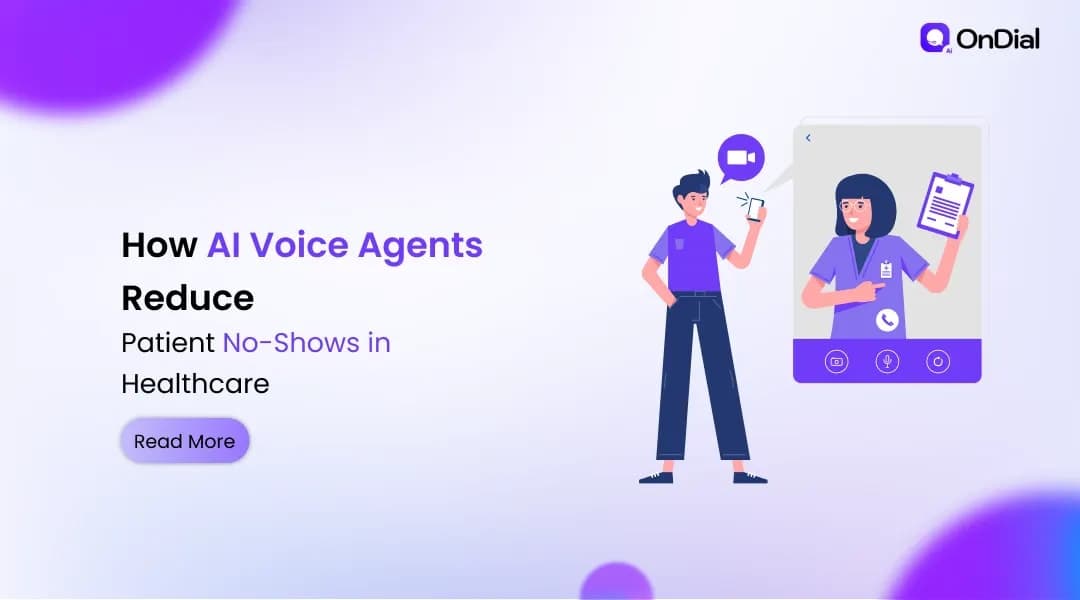
An AI voice agent for healthcare appointment management is an autonomous calling system that handles appointment confirmation, reminder delivery, cancellation processing, and inbound patient inquiry without requiring any staff involvement in the call. The AI agent calls the patient at the configured time, speaks in the patient's preferred language, confirms the appointment details, offers options to confirm or reschedule, and logs the outcome to the clinic's system in real time. The entire interaction typically runs between 45 and 90 seconds.
The critical distinction between an AI voice agent and a traditional IVR reminder is natural language understanding. An IVR plays a recorded message and waits for a keypress. An AI voice agent speaks, listens, and responds in context. When a patient says they need to reschedule because of a conflict, the AI agent understands the intent, offers alternative slots from the live calendar, and confirms the new booking before the call ends.
The Three-Touch Reminder Sequence That Reduces No-Shows
The appointment management workflow for AI voice agents follows a three-touch sequence built around clinical evidence on what timing actually changes patient behaviour. The first call goes out immediately after booking to confirm details and give the patient an opportunity to flag a conflict. The second call goes out 48 hours before the appointment with full details and a clear option to confirm, cancel, or reschedule. The third call, shorter and more direct, goes out 2 to 4 hours before the appointment as a same-day reminder for patients who may have forgotten since the previous day.
When a patient cancels during any of these calls, the AI agent immediately opens the slot and triggers the waitlist notification workflow. This automated back-fill capability is one of the highest-value operational outcomes of AI-driven appointment management, because a human-driven cancellation process rarely operates quickly enough to recover a same-day slot. An AI system surfaces the cancellation in real time and can initiate outreach to the next waitlisted patient within the same minute, recovering revenue that would otherwise be permanently lost.
Inbound Patient Handling Without a Dedicated Receptionist
AI voice agents handle the inbound call volume that front-desk staff currently manage manually across every shift. A patient calling to book an appointment, check available slots for a specific doctor, ask about test preparation, or get directions is asking questions that do not require clinical judgment. They require accurate, available, and immediate responses. An AI voice agent handles all of these inbound queries simultaneously, with zero hold time, and books appointments directly into the calendar when the patient is ready to proceed.
In a typical outpatient clinic, 30 to 50 percent of incoming calls are routine inquiries that do not require a trained staff member. Every one of those calls managed by a healthcare voice AI system frees up a staff member for the calls that genuinely require human involvement, such as clinical escalations or complex billing queries. The result is a front desk that answers more of the calls that matter and loses significantly fewer new patients to call abandonment during peak hours.
No-Show Reduction Numbers After AI Deployment
Healthcare providers deploying AI voice agent-driven appointment management consistently report no-show rate reductions of 30 to 60 percent within the first 90 days of deployment. A clinic running at a 25 percent no-show rate that implements a structured AI reminder sequence can realistically reach 10 to 15 percent within the first quarter. For a mid-size clinic handling 80 appointments per day, that improvement represents 8 to 12 recovered appointments per working day at the full consultation rate, with no increase in staff headcount.
The financial case for businesses that reduce patient no-shows with AI calling becomes measurable from the first month. A clinic recovering 10 appointments per day at Rs. 800 per consultation adds Rs. 8,000 in previously lost daily revenue, or approximately Rs. 2 lakh per month. At a specialist consultation rate of Rs. 2,500, recovering 10 slots adds Rs. 25,000 per day. These numbers are conservative because they capture only direct consultation revenue and do not include downstream improvements in diagnostic revenue and follow-up bookings that compound across subsequent quarters.
What OnDial Delivers for Healthcare Providers
OnDial deploys AI voice agents with sub-500 millisecond response latency, which means patient-facing calls feel conversational rather than delayed or robotic. The platform runs 24 hours a day, 7 days a week, without human oversight required for routine appointment reminder calls. Outbound reminder sequences execute at the configured time even when clinic staff are not present, so evening-before and morning-of reminders go out on schedule regardless of office hours.
OnDial handles both outbound reminder sequences and inbound patient inquiry within the same platform, so healthcare providers do not need separate tools for the two directions of patient communication. The platform's smart analytics and call sentiment tracking surface data that most clinics have never measured: confirmation rates by reminder touch, language preference distribution across the patient base, and patient sentiment scores by call type. This makes ongoing optimisation of the reminder programme evidence-based rather than intuitive.
Multilingual Patient Communication Across 9 Indian Languages
OnDial supports 9 Indian languages with more than 80 Indian voice variations, enabling healthcare providers to configure reminder calls at the individual patient level so each patient receives their reminder in their registered preferred language. The AI agent understands patient responses spoken in that language and responds naturally, without requiring the patient to switch to Hindi or English at any point in the call. Language selection applies automatically from the patient registration record, so neither the patient nor the staff member needs to manage it on a call-by-call basis.
This native-language capability directly addresses one of the structural causes of high no-show rates in non-Hindi-speaking regions of India. Automated appointment reminders in healthcare settings in Tamil Nadu, Kerala, West Bengal, Gujarat, Karnataka, and Andhra Pradesh produce significantly higher patient confirmation rates when delivered in the patient's native language than Hindi-only or English-only systems produce. Patients engage more readily with communication they fully understand without cognitive effort, and confirmation rates rise as a direct consequence of language-matched outreach at scale.
Patient Data Protection and DPDP Act 2023 Compliance
Healthcare providers in India operate under the Digital Personal Data Protection Act 2023, which governs how patient names, contact numbers, and appointment details can be used for automated communication. OnDial is built with GDPR and CCPA compliant data handling, which satisfies the core consent, processing, and data retention obligations of DPDP Act 2023 as they apply to healthcare appointment reminder workflows. Patient data processed for reminder calls stays within the explicitly consented purpose, and every automated call includes a clear opt-out option for the patient.
Healthcare providers should capture explicit consent for automated reminder calls at the point of patient registration. This single configuration step satisfies the consent obligation under DPDP Act 2023 and removes regulatory exposure from the entire automated calling programme. OnDial's platform supports this consent workflow without requiring custom development, and the audit trail for consent and opt-out events is logged automatically for compliance documentation purposes.
AI Voice Agents Across Healthcare Settings in India
The use of an AI call agent for hospital patient follow-up and appointment management extends across every healthcare setting type in India. This is not a solution applied narrowly to one workflow. It is a calling infrastructure that different healthcare organisations configure differently for their specific patient communication requirements across the full care cycle.
Diagnostic centers and pathology labs use AI voice agents to confirm sample collection appointments, notify patients when reports are ready for collection or digital delivery, and handle inbound queries about test preparation and pricing, significantly reducing walk-in confusion and the front-desk call volume that bogs down lab operations.
Multi-specialty hospitals deploy an AI call agent for hospital patient follow-up after discharge, ensuring patients have collected prescriptions, understood post-care instructions, and scheduled their next review appointment before 30 days have elapsed, which directly supports clinical quality metrics and readmission reduction programmes.
Specialist clinics in cardiology, orthopaedics, and ophthalmology use AI agents to manage waitlists actively, calling the next patient within minutes of a cancellation being processed and confirming the back-fill slot before the appointment date rather than leaving it empty.
Pharmacy chains use AI calling to notify patients when recurring prescriptions are due for renewal, reducing medication adherence gaps that result in avoidable repeat consultations and emergency visits.
Dental practices and dermatology clinics use AI agents to maximise confirmed pre-bookings on days with mixed scheduled and walk-in patient models, reducing the operational uncertainty that comes from unpredictable daily attendance volumes.
Each of these configurations runs on the same underlying OnDial platform infrastructure. The script content, call timing, language settings, and system integration are adjusted to the specific healthcare setting. This means a healthcare organisation can expand from one use case to multiple without re-evaluating the platform from scratch.
Conclusion
The patient no-show problem in Indian healthcare is a systems problem, not a staffing problem. Three conclusions from this analysis define the path forward. First, no-show rates of 20 to 30 percent in Indian outpatient settings represent direct revenue losses that most providers absorb without tracking them as financial metrics, with the annual impact at a mid-size clinic crossing Rs. 28 lakh. Second, manual reminder systems cannot deliver the timing consistency, full patient coverage, and multilingual communication required to reduce patient no-shows with AI calling at scale across India's diverse healthcare population. Third, AI voice agents for healthcare appointment management eliminate the root causes by automating the three-touch reminder sequence, handling inbound rescheduling at zero hold time, and delivering native-language interactions that produce measurably higher confirmation rates than any manually staffed process can sustain.
OnDial delivers exactly this capability at production scale. With sub-500 millisecond response latency, support for 9 Indian languages and more than 80 voice variations, 24/7 outbound and inbound call handling, and GDPR-compliant data handling aligned with India's DPDP Act 2023 requirements, OnDial gives hospitals, clinics, diagnostic centers, and specialist practices the AI voice agent infrastructure to recover lost appointment revenue from the first month of deployment. Both API integration for facilities with existing HMS platforms and a no-code option for clinics that need to move fast are available without a lengthy implementation project.
If patient no-shows are costing your healthcare facility revenue every working week, the most practical next step is to see the system working on your actual appointment volume. Contact OnDial to schedule a demo or start a free trial. Discover exactly what a structured AI appointment management workflow can deliver for your specific clinical setting.