Here's a number that stopped me mid-scroll the first time I saw it: AI-native voice platforms are now resolving customer calls in under 3 minutes on average, compared to the 4 to 7 minute industry standard for agent-assisted calls. That's not a marginal improvement. That's the difference between a customer who hangs up happy and one who calls back annoyed an hour later.
If you're reading this, you've probably already felt the tension. You know your customers expect instant answers. You also know "AI on the phone" can go very wrong if it's done badly. I get it. AI voice call automation, when built right, doesn't replace the warmth of good service. It removes the friction around it: the hold music, the repeated questions, the 6 PM call that nobody picks up.
At OnDial, we build voice AI for businesses that have outgrown manual phone handling but still want every caller to feel heard, not processed. In this guide, I'll walk through what AI voice call automation actually is, where it genuinely improves customer experience, where the Indian market is different from the global playbook, and how to start without making your CX worse before it gets better.
What Is AI Voice Call Automation, Really?
Most people picture a robotic phone menu when they hear "automated calls." That picture is outdated. AI voice call automation is software that listens, understands intent, and responds in natural conversation, without forcing callers through a rigid menu tree. It's the difference between "press 1 for billing" and a system that just understands you said "I have a question about my bill."
AI Voice Agents vs Traditional IVR
Traditional IVR systems work on scripts and touch-tone logic. You say or press something, and the system matches it to a pre-built path. If your phrasing doesn't fit the script, you're stuck repeating yourself or getting transferred in circles.
AI voice agents work differently. They use real-time language understanding instead of keyword matching. A few practical distinctions:
Flexible phrasing: You can say "my package never showed up" instead of the exact phrase "track my order," and the system still understands.
Context retention: A good AI voice agent remembers what you said two sentences ago in the same call, not just the last keyword.
Natural interruption handling: You can cut in mid-sentence, correct yourself, or change your mind, and the system adapts instead of restarting.
This matters for customer experience because frustration in phone support almost always comes from feeling unheard. 52% of customer service professionals say outdated IVR systems are among the biggest frustrations in the support experience, which tells you the old model has been quietly damaging CX for years.
The Technology Underneath: NLP, LLMs, and Speech AI
You don't need to be technical to use voice AI, but understanding the basic stack helps you ask the right questions when evaluating a vendor. Three components work together:
Speech recognition converts the caller's spoken words into text the system can process, ideally with high accuracy across accents and background noise.
NLP (Natural Language Processing) interprets what the caller actually means, not just the words they used.
An LLM (Large Language Model) acts as the reasoning layer, deciding what to say next and pulling in relevant business data like order status or appointment slots.
In projects I've worked on, the biggest quality gap between a good voice AI deployment and a frustrating one almost never comes down to the LLM. It comes down to speech recognition accuracy on real phone lines, with real accents and real background noise. That's a detail vendors rarely lead with, but it's the one that decides whether your customer feels understood on the first try.
How AI Voice Call Automation Improves Customer Experience
Here's the part that actually matters to your customers: not the technology, but what changes for them when they call your business.
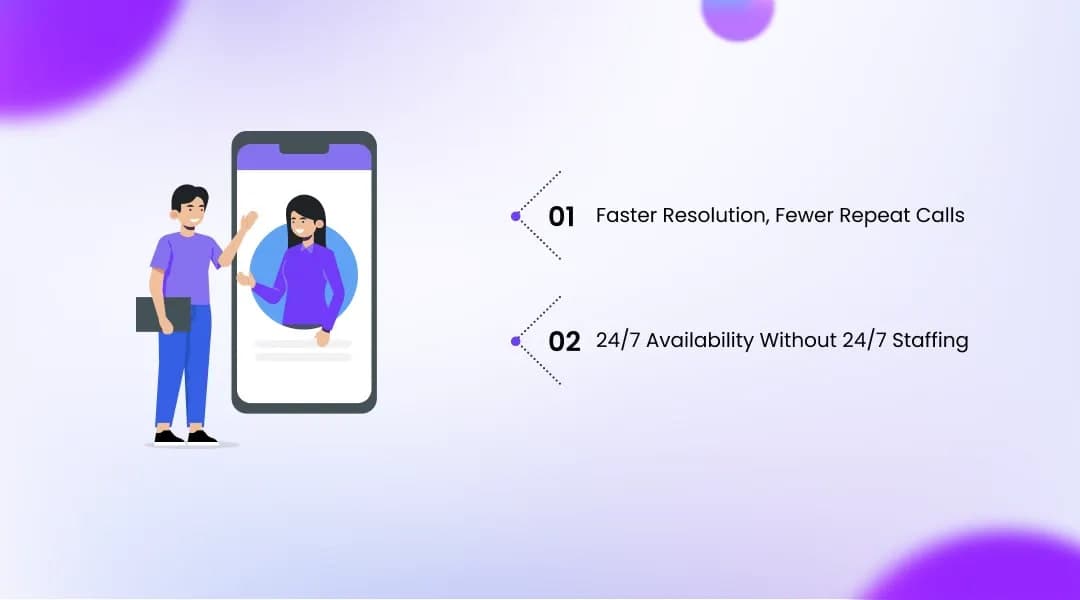
Faster Resolution, Fewer Repeat Calls
Speed is the most measurable CX win. When AI handles routine questions instantly instead of routing them through hold queues, two things improve together: how fast a customer gets an answer, and how often they have to call back for the same issue.
This matters more than it sounds. 65% of consumers say contacting customer service multiple times for the same issue is the most frustrating part of dealing with a business, and around 80% say they'd rather switch to a competitor after more than one bad experience. First Contact Resolution isn't a backend metric anymore. It's a loyalty metric.
I've personally seen this play out with service businesses that previously relied on voicemail after hours. The moment a caller has to wait, they start mentally drafting their complaint. The moment they get answered, even by AI, that tension drops.
24/7 Availability Without 24/7 Staffing
Customer expectations didn't ask permission before changing. People now expect a response regardless of time zone or day of the week. AI voice agents don't need shifts, breaks, or overtime approval to stay available.
The data backs up just how costly the gap has become:
American businesses handle over 8 billion customer service calls annually, and many of those calls arrive outside standard hours.
78% of consumers now expect immediate responses at any hour, which is a structural shift, not a passing preference.
A healthcare provider that adopted proactive automated reminder calls reduced patient no-shows by 37%, simply by making sure reminders actually went out on time, every time.
Where Conversational AI for Business Actually Pays Off
Not every phone interaction needs AI, and pretending otherwise is how bad deployments happen. The strongest results show up in high-volume, low-complexity interactions: the calls that drain your team's time without requiring real judgment.
Customer Support and Service Queries
Order status, billing questions, account lookups, basic troubleshooting: these are the bread and butter of conversational AI for business. They're repetitive for your team and urgent for your customer, which makes them the perfect candidate for automation.
A few patterns I've seen work consistently well:
Tier-1 deflection: Routine FAQs get answered immediately, so human agents only see the calls that actually need judgment.
Sentiment-aware escalation: A well-built voice AI agent can detect frustration in tone and proactively offer a human handoff before the caller has to ask twice.
Omnichannel continuity: The same conversation context carries over if the customer follows up by SMS or email, so they never have to repeat their issue.
Appointment Booking, Reminders, and Follow-Ups
Scheduling is one of the most universally painful parts of phone-based business, across clinics, salons, real estate, and service providers. AI voice automation handles this cleanly because the logic is structured: check availability, confirm a slot, send a reminder.
The ROI here is concrete and specific:
A healthcare provider using proactive AI calls cut no-shows by 37%, which directly protects revenue that would otherwise be lost to empty appointment slots.
Outbound feedback calls after service interactions let businesses capture sentiment immediately while the experience is still fresh, instead of relying on delayed surveys nobody answers.
Definition sentence: Conversational AI for business refers to systems that hold natural, multi-turn phone conversations to complete real tasks like booking, billing, or support, not just answer simple questions.
AI Call Automation for Businesses in India: Why Context Matters
Most global guides on this topic are written for English-only, single-market businesses. That's not the reality most Indian companies operate in, and frankly, copying a US-built playbook here usually backfires.
Language, Code-Switching, and the Missed-Call Problem
Indian callers regularly switch between English and a regional language mid-sentence. A customer might open in English, drop into Hindi, and slip in an English noun like "delivery" or "EMI" without missing a beat. Voice AI that cannot handle this kind of code-switching mid-utterance is not production-ready for the Indian market, no matter how good its English benchmarks look.
The missed-call problem compounds this. Many Indian MSMEs simply cannot answer every call during peak hours, and the cost adds up fast. A receptionist typically covers only around 24% of weekly hours for a fixed monthly cost, while an AI voice agent can cover the full week and handle multiple calls at once. For a small business, that's not a luxury upgrade. It's closing a leak that's been bleeding leads for years.
Compliance and Trust in a Regulated Communication Landscape
Trust is not optional in voice automation, especially in India's regulatory environment. Outbound automated calling touches TRAI's DLT registration requirements and DPDP consent obligations, and getting this wrong isn't just a CX problem, it's a compliance one.
One honest limitation worth naming: not every vendor handles this well. Skipping DLT registration in week one, weak consent logging, or choosing a TTS voice that doesn't match your brand's tone are common, costly mistakes. At OnDial, we treat this as foundational, not an afterthought, because a business's reputation on the phone is built call by call.
How to Start Without Wrecking Your Customer Experience
The businesses that get burned by voice AI almost always made the same mistake: they tried to automate everything on day one.
Pick the Right First Use Case
Start narrow. Choose one high-volume, low-ambiguity interaction type, like appointment confirmations or basic order status checks, and get that working well before expanding scope. This protects customer experience while your team learns what the AI handles confidently and where it still needs backup.
Map your call volume by type before choosing where to start.
Pick the use case with the clearest "right answer" so the AI has less room to guess wrong.
Set a realistic automation target, not 100% from week one.
Keep a Human Escalation Path Visible
No matter how good the AI gets, some callers will want a human, and some situations genuinely need one: complaints, sensitive billing disputes, or anything emotionally charged. Make that handoff fast and frictionless. A caller who feels trapped in an automated loop will remember that far longer than they'll remember the calls that went smoothly.
In my experience building these systems, the businesses with the best long-term CX outcomes aren't the ones automating the most. They're the ones who got the handoff right.
Conclusion
AI voice call automation isn't about replacing the human voice in your business. It's about making sure no caller hits silence, confusion, or a 20-minute hold queue before they reach a real answer. The businesses winning at this in 2026 aren't the ones automating everything. They're the ones being deliberate about where AI removes friction and where a human still needs to carry the conversation.
If there's one thing worth taking away from this guide, it's that customer experience improves the moment a call gets answered correctly the first time, whether that's by a person or a well-built AI voice agent. That's the real metric.
At OnDial, this is the exact problem we build for: AI voice agents that understand how Indian businesses and their customers actually talk, with the compliance and partnership approach to back it up. If missed calls or slow response times are costing you customers right now, that's worth a conversation, not another quarter of guessing.