The global AI customer service market reached $15.12 billion in 2026, growing at a 25.8% compound annual rate, according to MarketsAndMarkets. Within that figure, the voice AI segment is accelerating even faster, at 34.8% CAGR, according to AllAboutAI. If you have been watching this space and wondering when the signal becomes loud enough to act on, that moment has arrived.
I understand the hesitation. The customer service technology space is crowded with vendors who promise revolution and deliver frustration. At OnDial, we have worked with businesses across industries who came to us burned by chatbots that went off-script and IVR systems that drove customers to competitors. The question most leaders are genuinely asking is not whether AI voice is real. It is whether it is right for them, and whether it will actually hold up when a real customer calls with a real problem.
AI voice communication in customer service refers to AI-powered systems that understand spoken language, respond naturally in real time, and take meaningful action. These systems do not just answer questions. They resolve issues, book appointments, and escalate intelligently.
In this article, you will learn how these systems actually work, why the business case is now backed by hard data rather than hype, which industries are already seeing returns, and how to implement voice AI without disrupting the team you have already built.
What Is AI Voice Communication in Customer Service?
AI voice communication in customer service is the use of voice-based artificial intelligence to handle, assist, or augment phone-based customer interactions, replacing scripted menus with natural, responsive conversation.
This is not your grandmother's phone tree.
How Conversational AI Works Behind the Call
When a customer calls a business using an AI voice platform, several technologies work together in real time. Natural Language Processing (NLP) parses what the customer says and extracts intent. A Large Language Model (LLM) generates a contextually appropriate response. Speech synthesis delivers that response in a natural-sounding voice with appropriate pacing and tone.
The system does not just listen and reply. It accesses CRM data to recognise the caller, checks order history or account status, and takes action. It confirms a booking, processes a return, or routes the call to the right human agent with full context already captured. The customer does not repeat themselves. The agent does not start from zero.
I have seen this architecture make a material difference in the first week of deployment. Not because the technology is magic, but because it removes the friction that erodes trust in every call: wait times, wrong departments, and inconsistent answers.
The Shift from IVR to Intelligent Voice AI
Interactive Voice Response (IVR), the "press 1 for billing, press 2 for support" model, has defined phone-based customer service for decades. According to Sinch research, 85% of consumers say they hate IVR menus. That is not a small dissatisfaction number. That is a near-universal frustration your business has been absorbing silently.
Conversational AI replaces those rigid decision trees with dynamic dialogue. The customer speaks naturally. The system understands context, not just keywords. The conversation moves forward rather than looping back to a menu.
Gartner defines voice AI as a subset of conversational AI that transforms voice into a dynamic customer experience channel. That definition matters because it reframes the technology from a cost-cutting tool to a relationship-building one, and that framing changes how you build your implementation strategy.
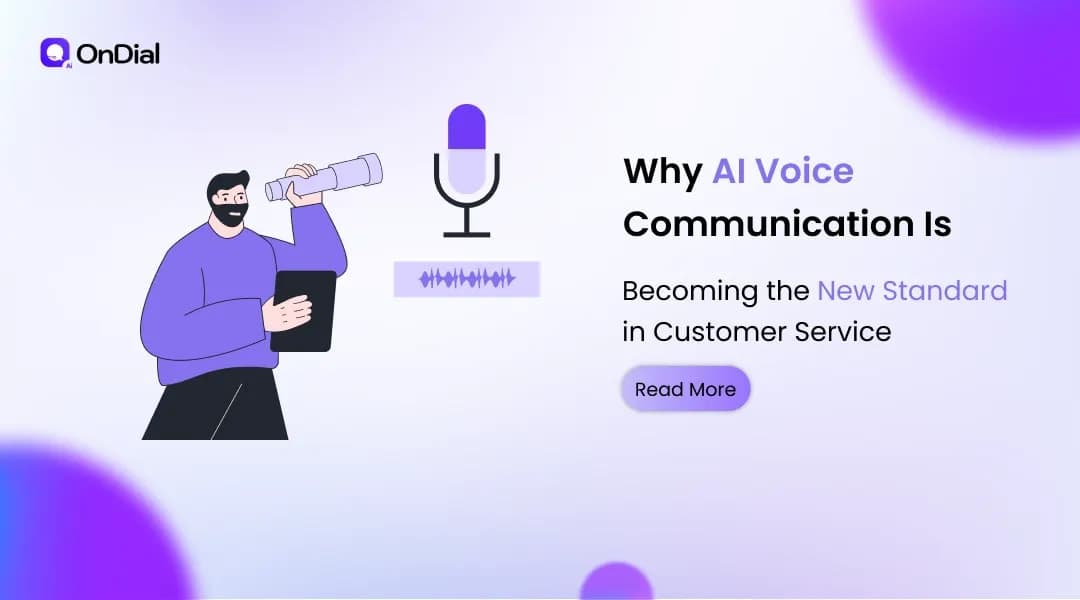
Why AI Voice Agents Are Becoming the New Standard
Here is a counter-intuitive point worth sitting with: AI voice agents are not becoming the standard because they are cheaper. They are becoming the standard because customers now expect them to exist, and they penalise brands that do not offer them.
The Business Case Is Now Proven, Not Theoretical
For years, adoption arguments were forward-looking projections. Now the data is retrospective. Companies actually doing this are reporting results.
Gartner projects conversational AI will reduce contact center labor costs by $80 billion by the end of 2026. Businesses are seeing an average return of $3.50 for every $1 invested in AI customer service, with leading organisations reporting up to 8x ROI (SumGenius). In one documented case, Klarna's AI assistant cut average resolution time from 11 minutes to just 2 minutes. Philippine Airlines deployed a unified AI platform and watched average contact center wait times fall to under a minute while monthly service costs dropped by approximately 30%.
These are not experimental deployments. These are production systems handling real call volume.
At the same time, and I want to be honest about this, the numbers also reveal something important. According to Lorikeet, 88% of contact centers report using some form of AI, but only 25% have fully integrated it into daily workflows. The gap between "using AI" and "deploying AI effectively" is where most organisations stall. The technology is not the hard part. The integration, the intent, and the change management are.
Customer Expectations Have Already Changed
According to Zendesk, 74% of consumers now expect customer service to be available 24/7. According to the same research, 51% of consumers prefer interacting with AI agents over humans when they want immediate service.
Stop and think about what that means operationally. More than half your inbound callers, when speed matters most to them, are not demanding a human. They are demanding resolution.
(Here is the thing that trips up most decision-makers: they assume their customers are in the 79% who say they prefer humans overall. But that 79% is a sentiment number, not a behaviour number. When the clock is ticking and the issue is routine, people choose fast over familiar.)
The brands that understood this early have already reset the baseline. If a competitor answers every call within seconds at 2 a.m., your business looks slow, regardless of how good your human team is during business hours.
Key Benefits of AI Voice Communication for Businesses
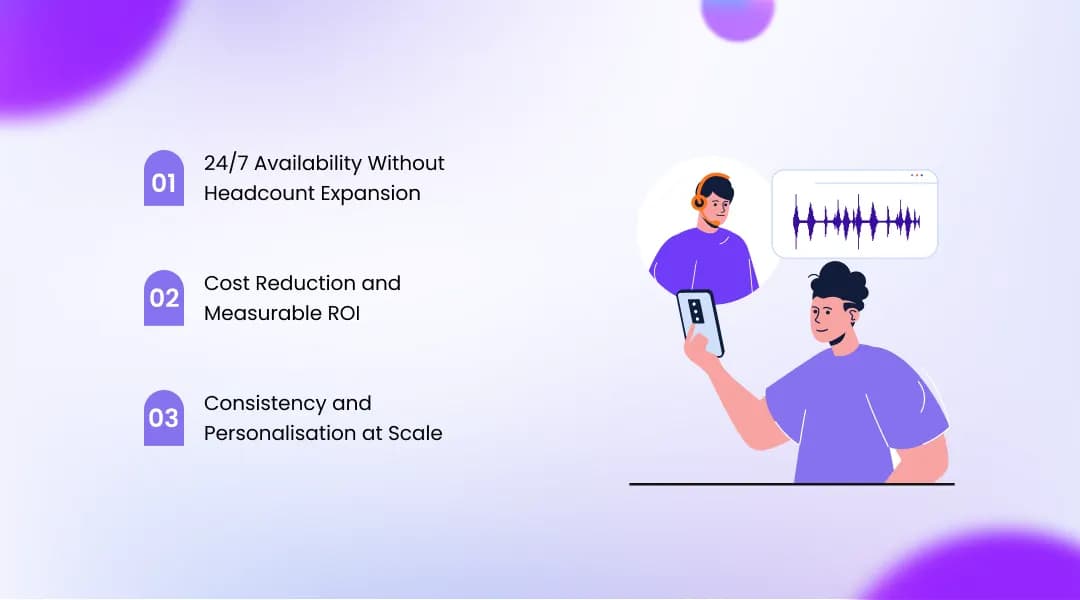
24/7 Availability Without Headcount Expansion
An AI voice assistant does not take breaks, experience burnout, or go off-script after a long shift. It handles parallel calls simultaneously, something no human team can match without significant staffing investment.
For businesses in India and across emerging markets, where customer bases span multiple time zones and language preferences, this is particularly significant. A voice AI platform can be configured to handle regional languages, code-switching, and local dialects, making it genuinely accessible rather than performatively available.
At OnDial, we have built AI voice solutions for clients who were missing 40 to 60% of incoming calls simply because volume exceeded capacity. The first outcome was not cost savings. It was revenue recovery.
Cost Reduction and Measurable ROI
The economics of AI voice communication are now well-documented. According to Gartner, the cost of AI-powered self-service sits at approximately $1.84 per contact, compared to $13.50 for agent-assisted interactions. That is not a marginal difference. That is a structural one.
Year-one ROI on AI customer service implementations averages 41%, climbing to 87% by year two and exceeding 124% by year three, as systems learn from accumulated interaction data (typedef.ai). The compounding effect is real: the more calls the system handles, the more accurate and efficient it becomes.
There is a caveat worth naming. A Gartner report from January 2026 notes that generative AI cost per resolution may exceed $3 per contact by 2030 as data center costs rise. The cost advantage is significant today, but it is not guaranteed to be permanent. Businesses that implement now and integrate deeply will be better positioned to manage those future economics than those starting from scratch later.
Consistency and Personalisation at Scale
Human agents, even excellent ones, deliver variable experiences. Tone shifts with fatigue. Information accuracy depends on training recency. Customer frustration from receiving different answers to the same question is one of the most documented trust-eroding patterns in support research.
Customer support automation through AI voice solves this at the root level. Every caller receives accurate, current information. Every interaction is logged, transcribed, and fed back into the system. Because the AI accesses CRM data in real time, it can personalise the conversation by referencing the customer's account history, loyalty status, or previous issues, without requiring the caller to re-establish context.
This is not personalisation as a feature. It is personalisation as infrastructure.
Real-World Industries Already Using Voice AI
Telecom and Banking Lead Adoption
Telecom providers lead all industries in voice AI adoption at 95%, followed closely by banking and financial services at 92%, according to data compiled across MarketsAndMarkets and AllAboutAI research.
The reason is structural. Both industries face massive inbound call volumes dominated by routine, repeatable inquiries: plan activation, billing questions, account verification, and fraud alerts. These are exactly the use cases where voice AI performs best, being deterministic, high-volume, and low-ambiguity.
Bank of America's Erica, their AI-powered voice assistant, resolves 98% of customer queries within 44 seconds. That is not an anecdote. That is a benchmark that their competitors now have to match.
In India specifically, telecom and banking sectors are among the fastest-growing adopters of voice AI, driven by multilingual customer bases and a mobile-first communication culture. For India-based businesses, a voice AI platform capable of handling regional language variations is not a premium add-on. It is a baseline expectation for genuine customer reach.
Healthcare, Retail, and Logistics Follow Fast
Healthcare is one of the fastest-growing sectors for AI voice adoption. According to Accenture, AI adoption in healthcare grew by 51.9% as providers automated appointment scheduling, prescription management, and patient communication. For a clinic handling hundreds of appointment calls per day, an AI voice agent that schedules, confirms, and follows up without human intervention frees clinical staff to focus on patient care.
In retail, Yum! Brands, the parent company of Taco Bell, Pizza Hut, and KFC, deployed AI voice ordering in partnership with Nvidia. Early pilots showed 10 to 15% faster order processing and up to a 20% reduction in order errors. In logistics, AI voice agents deliver real-time shipment updates, confirm deliveries, and manage driver communication automatically.
What these industries share is not complexity. They share high call volume, time sensitivity, and repetitive inquiry patterns. Those are the exact conditions where a well-configured voice AI platform outperforms a human-only operation.
How to Implement a Voice AI Platform Without Disrupting Your Team
Start Small, Pilot First, Scale on Evidence
The most common implementation mistake is scope. Businesses try to automate everything at once, discover edge cases they did not plan for, and conclude the technology does not work. It does work. The playbook just matters.
A sound implementation follows a pyramid logic, as articulated by Twilio's deployment methodology. Begin with the highest-volume, most deterministic workflows: FAQ responses, appointment scheduling, order status checks, and call routing. These deliver fast ROI and build organisational confidence. Then expand to more complex conversational tasks that touch multiple back-end systems such as returns processing, technical troubleshooting, and account management.
Concrete first steps for deploying a voice AI platform:
Audit your current call volume by inquiry type. Identify the top five repeating questions your team handles each day.
Map those to automation-ready workflows. Questions with consistent, factual answers are ideal starting points.
Select a voice AI platform that integrates cleanly with your existing CRM and telephony systems.
Pilot with one use case and measure resolution rate, customer satisfaction score, and handle time before expanding.
Review weekly and refine continuously based on actual call transcripts.
The Human-AI Collaboration Model That Actually Works
Will AI replace your customer service team? No. That is not the right question, and frankly, it is not the right goal.
The model that delivers the best outcomes, documented across the implementations referenced throughout this article, is what practitioners now call the human-AI collaboration model. AI handles high-volume, routine, and time-sensitive interactions. Human agents handle complex, emotional, or high-stakes conversations that require judgment and empathy.
According to Zendesk research, 75% of CX leaders see AI as a force for amplifying human intelligence, not replacing it. Agents using AI handle 13.8% more customer inquiries per hour and are 35% less likely to feel overwhelmed during calls, according to Deloitte data. That is a better job, not a threatened one.
At OnDial, our implementation philosophy is built on this principle. We believe transparency and partnership are not soft values. They are the technical requirements for AI that actually holds up over time. A voice AI system built without understanding your team's escalation logic, your brand's communication values, and your customers' emotional expectations will underperform. One built with that context will consistently exceed expectations.
Is AI Voice Communication Actually Worth It for My Business?
The honest answer: it depends on your call volume, your inquiry patterns, and your implementation commitment.
If you are handling more than 50 inbound calls per day with a significant proportion of routine, repeatable questions, the case is strong. If your team is regularly overwhelmed during peak hours, missing calls after hours, or spending agent time on inquiries that have deterministic answers, AI voice communication is not just worth it. It is the more cost-effective and customer-friendly option available to you right now.
If your call volume is low and conversations are primarily complex or relational, start with AI-assisted tools rather than fully automated voice agents. The technology is not one-size-fits-all, and any vendor who tells you otherwise is oversimplifying.
What the data does tell you clearly: businesses that implement AI voice communication thoughtfully see a 3.5x average return on investment, 74% faster first response times, and measurable improvements in customer satisfaction scores. The risk of waiting while competitors reset baseline expectations is now larger than the risk of implementing carefully.
Conclusion
AI voice communication in customer service is no longer a future trend. It is the operational baseline being set right now by the businesses your customers compare you to. Three things stand out from everything covered here. First, the data is no longer projected; it is reported, with a $15.12 billion market, 34.8% voice AI growth, and documented ROI that compounds year over year. Second, the right model is not AI replacing humans, but AI and humans each doing what they do best. Third, the biggest risk is not implementing poorly. It is waiting while others move.
You now have a clear view of what this technology does, what it costs, where it works, and how to start. The next step is a conversation about your specific call patterns, your existing systems, and what an implementation designed around your customers rather than a generic template would actually look like.
AI voice communication is the new standard. The businesses that shape how it sounds for their customers are the ones being built right now.