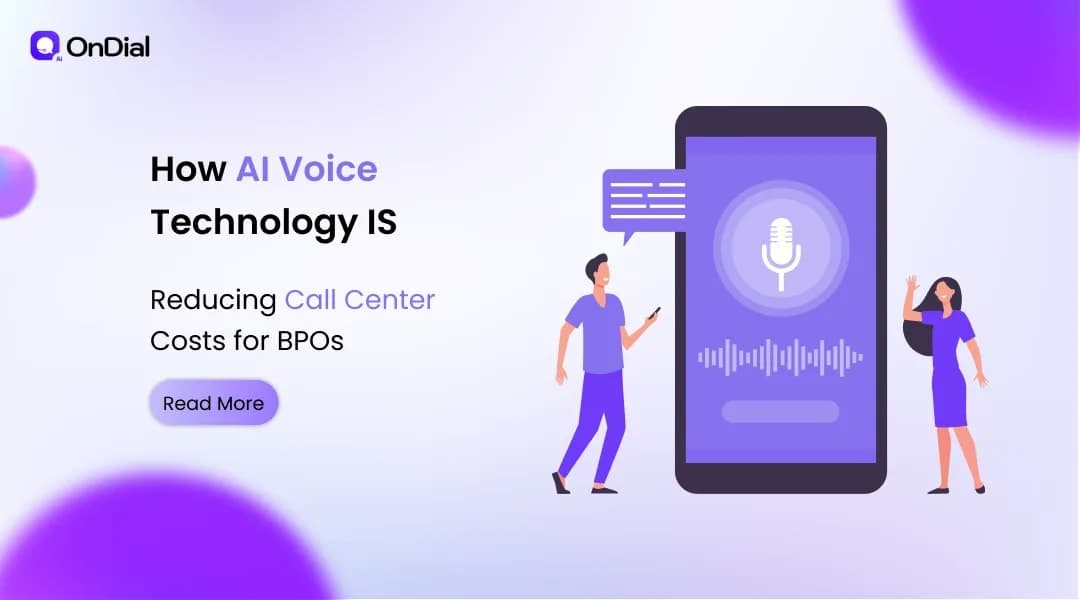
For BPOs, reducing call center costs is rarely as simple as cutting headcount. The real challenge is handling growing call volumes while maintaining service quality, meeting SLAs, managing staffing costs, and keeping customers satisfied.
AI voice technology changes that equation by allowing businesses to automate predictable conversations while keeping human agents available for calls that require judgment, empathy, negotiation, or specialized expertise.
For BPO leaders, the opportunity is not simply to replace human agents. It is to redesign the operation so every call is handled by the most appropriate resource.
That means AI can manage repetitive interactions, assist with high volume periods, complete post call work, and route complex conversations to people.
This article explains where the cost savings come from, which BPO processes are best suited for voice AI, how a hybrid model works, and which metrics should be tracked before deciding whether an implementation is financially worthwhile.
Why Call Center Costs Keep Rising
A traditional BPO has several expenses that increase as call volume grows.
The most obvious is labor. Every additional queue requires more agents, supervisors, quality analysts, trainers, workforce managers, and support staff.
But labor is only one part of the equation.
The hidden cost of every customer call
A human handled call can create costs before, during, and after the conversation.
Before the call, the business pays for workforce planning, staffing, training, telephony, and technology.
During the call, the cost is primarily associated with agent time, management overhead, and infrastructure.
After the call, agents may need to write notes, update CRM records, create tickets, schedule follow ups, or complete compliance documentation.
When thousands of calls are processed every day, these small activities become a major operational expense.
This is where AI voice technology can create savings without requiring an organization to eliminate its entire human support team.
What AI Voice Technology Actually Automates
AI voice technology combines speech recognition, language understanding, conversational logic, voice generation, and business system integrations.
Instead of forcing callers through rigid menus, an AI voice agent can understand what the customer is trying to accomplish and execute the appropriate workflow.
For example, a caller might ask for an order update, request an appointment, confirm account information, ask about a payment, or request a callback.
The AI can identify the intent, retrieve relevant information, respond to the customer, and record the outcome.
When the conversation becomes too complex, the system can transfer the caller to a human agent with relevant context.
For BPOs, that distinction is important. Automation becomes more valuable when it completes an actual business task instead of simply answering a question.
For a broader overview of how OnDial applies AI voice automation to call center operations, see AI Voice Agents for Call Centers and BPOs.
Six Ways AI Voice Technology Reduces BPO Costs
The financial impact of voice AI comes from several operational improvements rather than one single saving.
1. Automating repetitive calls
Many customer interactions follow predictable patterns.
Common examples include:
Order status requests
Appointment confirmations
Account verification
Payment reminders
Frequently asked questions
Basic troubleshooting
Delivery updates
Survey calls
Callback requests
Lead qualification
These conversations do not always require a human agent.
When AI handles appropriate routine calls, human agents can spend more of their working hours on interactions where their skills have greater value.
The result is better utilization of existing staff rather than simply adding more people whenever call volume increases.
2. Reducing after call work
After call work is one of the less visible sources of contact center cost.
An agent may finish a five minute conversation and then spend another minute or more entering notes, updating the CRM, selecting a disposition, creating a ticket, or recording the next action.
Across thousands of daily interactions, this time becomes significant.
AI can automatically generate summaries, classify call outcomes, capture customer information, and send structured data into business systems.
This means the BPO gets more productive time from the same workforce.
3. Managing peak call volumes
BPO staffing is difficult because call demand rarely stays constant.
Seasonal campaigns, product launches, billing cycles, service interruptions, holidays, and unexpected events can produce sudden increases in inbound traffic.
Traditional operations may respond by hiring temporary workers or scheduling overtime.
Both approaches add cost and introduce operational risk.
AI voice agents can absorb suitable additional call volume without requiring the BPO to recruit, train, and schedule a large temporary workforce.
That makes automation particularly useful for operations with significant demand fluctuations.
4. Providing coverage outside standard shifts
Supporting customers around the clock can require multiple shifts and additional staffing.
For global BPOs, the challenge becomes even more complicated because customers may call from different time zones.
AI voice agents can provide automated coverage during nights, weekends, holidays, and lower staffing periods.
Human agents can then remain focused on conversations where their involvement creates the most value.
The goal is not to eliminate the human workforce. It is to make 24 hour service financially easier to operate.
5. Improving agent utilization
A human agent should ideally spend time solving problems, building relationships, handling escalations, or completing valuable sales and service interactions.
Instead, agents often spend significant portions of their shifts handling repetitive requests.
When AI absorbs those interactions, the remaining human workload becomes more concentrated around complex cases.
This can improve productivity without increasing the size of the team.
BPO managers should therefore measure agent utilization before and after automation instead of looking only at the number of calls handled by AI.
6. Reducing the cost of scaling
Traditional expansion usually follows a familiar pattern.
More customers lead to more calls. More calls require more agents. More agents require more supervisors, training, infrastructure, and management.
AI changes the relationship between call volume and workforce growth.
A well designed voice automation system can absorb additional routine conversations without requiring a proportional increase in headcount.
This is particularly valuable for BPOs that need to grow quickly while protecting operating margins.
AI Voice Agents Should Not Handle Every Call
One of the biggest mistakes in call center automation is trying to automate everything.
Not every customer interaction should be handled by AI.
Complex complaints, sensitive financial discussions, emotionally difficult conversations, negotiations, high value sales opportunities, and unusual cases may require human judgment.
A better approach is to divide conversations into different categories.
Calls that AI can handle
AI is generally well suited to predictable, high volume workflows with clearly defined outcomes.
Examples include:
Appointment scheduling
Order tracking
Basic account questions
Payment reminders
Customer surveys
Lead qualification
Data verification
Routine notifications
Calls that should involve humans
Human agents remain valuable when conversations require judgment, empathy, negotiation, or exception handling.
A strong BPO operation therefore uses AI as the first layer of service and humans as the escalation layer.
This hybrid model can reduce costs while protecting customer experience.
Why CRM Integration Matters to Cost Reduction
Voice automation creates limited value if the AI can only talk.
The larger opportunity comes when the voice agent can access business information and take action.
For example, a customer might call about an order.
The AI should be able to identify the customer, retrieve the order status, provide the correct information, and record the outcome.
That requires integration with the CRM, help desk, database, scheduling system, or other business application.
With OnDial CRM Integration, call information can be connected to systems such as Salesforce, HubSpot, Zoho CRM, and Microsoft Dynamics.
This reduces manual data entry and helps ensure that the conversation becomes part of the operational workflow rather than remaining isolated inside the phone system.
How BPOs Should Measure AI Voice ROI
A BPO should not evaluate voice AI based only on the number of calls automated.
The more useful question is whether the technology improves the economics of the entire operation.
Cost per resolved interaction
Measure how much it costs to successfully resolve a customer interaction.
This should include relevant technology, telephony, labor, supervision, and post call work.
Average handle time
If AI reduces unnecessary conversation time or retrieves information faster, average handle time can decline.
However, lower AHT should not be treated as a success by itself. Resolution quality still matters.
First call resolution
If customers need to call again because the AI failed to resolve the issue, the apparent cost savings can disappear.
Track whether automation actually resolves the customer's request.
Escalation rate
A healthy hybrid system should know when to transfer a conversation.
Track how frequently AI escalates calls and whether those escalations are appropriate.
Agent utilization
Measure how much of the human team's time is spent on meaningful customer interactions versus repetitive work and administrative tasks.
Customer satisfaction
Cost reduction should never come at the expense of customer experience.
Track CSAT, complaint rates, repeat calls, abandonment, and other customer experience metrics alongside financial metrics.
For additional context on how automated calling can affect operational economics in India, see How Automated Calling Software Is Cutting Call Costs in India.
AI Voice Technology for Indian and Global BPOs
India's BPO industry operates across multiple languages, regions, industries, and customer segments.
That makes multilingual voice automation particularly relevant.
A customer in Gujarat may prefer Gujarati. Another caller may use Hindi or Hinglish. International BPO operations may need English, Spanish, Arabic, French, or other languages.
Voice AI can help BPOs support multilingual workflows without building completely separate teams for every language.
The technology also needs to handle accents, interruptions, natural speech, code switching, and different ways of expressing the same intent.
For Indian BPOs, these capabilities can be particularly important when serving customers across Tier 1, Tier 2, and Tier 3 markets.
For international BPOs, multilingual automation can help extend service coverage without creating a separate staffing model for every market.
A Practical Implementation Strategy for BPOs
BPOs do not need to automate an entire operation on day one.
A better approach is to start with a narrow workflow that has high volume, predictable conversations, and a measurable business outcome.
Step 1: Identify repetitive call categories
Analyze call recordings, dispositions, and customer intents.
Look for interactions that are frequent, structured, and relatively low risk.
Step 2: Establish the baseline
Before automation, record current metrics such as average handle time, cost per interaction, resolution rate, transfer rate, after call work, and customer satisfaction.
Without a baseline, it becomes difficult to prove whether the deployment created meaningful value.
Step 3: Connect business systems
Integrate the voice agent with the systems required to complete the workflow.
This could include a CRM, ticketing system, calendar, order database, or internal knowledge source.
Step 4: Build human escalation into the workflow
Define exactly when the AI should transfer the conversation.
The receiving agent should receive enough context to continue the interaction without forcing the customer to repeat everything.
Step 5: Test before expanding
Start with controlled traffic.
Review conversations, failed intents, transfers, customer feedback, and business outcomes.
Use these findings to improve the workflow before increasing automation volume.
Step 6: Expand based on measurable results
Once the initial workflow demonstrates reliable performance, expand into other suitable call categories.
This approach reduces implementation risk and makes the business case easier to validate.
The Future of BPO Cost Optimization Is Hybrid
The strongest case for AI voice technology is not that every BPO employee will disappear.
It is that the structure of the operation can change.
AI can handle repetitive conversations, provide after hours coverage, manage demand spikes, capture information, and complete routine workflows.
Human agents can focus on complex conversations, escalations, retention, negotiation, high value sales, and situations where empathy matters.
That division of work can create a more efficient contact center without sacrificing the human element.
As BPOs compete on cost, quality, speed, and scalability, the ability to combine AI automation with human expertise will become increasingly important.
Final Takeaway
AI voice technology can reduce call center costs for BPOs by attacking several sources of operational inefficiency at once.
It can automate repetitive calls, reduce after call work, improve agent utilization, provide 24 hour coverage, absorb peak demand, and allow operations to scale without increasing headcount at the same rate as call volume.
But successful automation is not about putting an AI agent in front of every customer.
The strongest deployments identify the right conversations for automation, connect the AI to business systems, measure real operational outcomes, and create a clear path to human support when necessary.
For BPO leaders, the most useful question is therefore not whether AI can replace agents.
The better question is:
Which parts of the customer conversation should AI handle, and where does human expertise create the most value?
That is where AI voice technology can move from a technology experiment to a practical cost optimization strategy.
For more information about AI voice automation for business communication, visit OnDial.