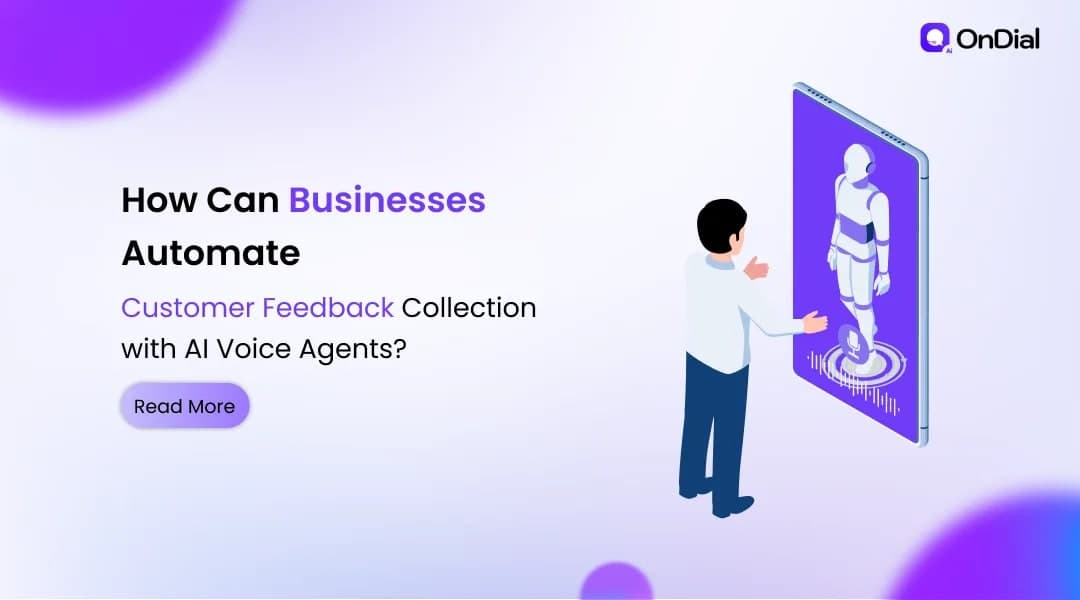
Here is a number that should bother anyone running a feedback program: email NPS surveys in India pull a median 12.4 percent response rate, while well-run AI voice surveys reach 45 to 65 percent, per feedback-industry data compiled by Caller Digital. To automate customer feedback collection with AI voice agents, you trigger an outbound call after a purchase or support interaction, let an AI voice agent ask two to four conversational questions, and have the spoken answers transcribed, sentiment-tagged, and synced to your CRM within seconds. No human dials a number. No customer opens an email.
I have watched capable teams pour budget into survey tools and still fly half-blind, and it is genuinely frustrating to sit on decisions you cannot back with data. The problem is rarely the questions. It is the channel doing the asking. This guide walks through why old methods fail, how voice automation actually works, how to build the loop step by step, and where it still has honest limits.
Why Traditional Feedback Collection Is Quietly Failing
The uncomfortable truth is that most feedback programs measure the opinions of the few people patient enough to fill out a form. That is not a representative sample. It is a self-selected sliver, and it quietly skews every dashboard built on top of it.
The Response Rate Problem Nobody Talks About
Email has been the workhorse of customer feedback for two decades, and the workhorse is exhausted. According to Perspective AI's 2026 benchmark, linked email surveys now convert at just 6 to 15 percent, with standard CSAT surveys averaging around 26.29 percent and NPS closer to 21.71 percent.
Those numbers matter because response rate caps everything downstream. When 8,760 customers in a 10,000-person cohort never answer, you have no idea whether the silent majority skews happy or ready to leave.
The survey that nobody answers is not data. It is decoration.
Survey Fatigue and the Silent Majority
There is also a listening gap that has nothing to do with math. Only 1 in 26 unhappy customers ever bothers to complain, so the rest simply drift away before a single form is submitted.
Survey fatigue makes this worse across every written channel, and length is a real killer with call center AI voice agents. Feedback-tool data from FeedbackRobot shows completion dropping by roughly 15 percent for every question added after the fifth. So the honest picture looks like this:
Inbox competition: email surveys fight for attention against dozens of unread messages and usually lose.
Effort tax: typing detailed answers into a small text box feels like homework, so people either skip it or leave one-word replies.
Timing drift: a survey sent days after the experience arrives when the memory has already faded, and the emotion is gone.
How AI Voice Agents Automate Customer Feedback Collection
So why do so many teams still send the email? Habit, mostly, and the assumption that voice is expensive or robotic. Neither is true anymore, and that is the shift worth understanding.
Voice-based automated feedback calls work because talking is easier than typing, and because a spoken answer carries tone, hesitation, and emotion that a rating scale flattens into a number. When you ask a question out loud, people answer instinctively, which is exactly where candid feedback lives.
What an AI Voice Survey Actually Does
An AI voice survey is an automated phone call where an AI agent asks structured questions, understands spoken replies in natural language, and records them in real time. This conversational feedback collection combines speech recognition, natural language processing (NLP), and text-to-speech so the exchange feels like a short conversation rather than a menu tree.
A well-built agent handles turn-taking, manages interruptions, and adapts on the fly, so a low score can trigger an immediate follow-up on the "why." In projects we have run at OnDial, that single adaptive follow-up is what separates a usable transcript from a hollow rating. The number tells you what happened. The spoken sentence after it tells you why.
Where Automated Feedback Calls Fit in the Journey
Timing is the quiet advantage here, because a call placed while the experience is still fresh captures attention that a delayed email never will with aI Call Center Features That Improve Customer Satisfaction. A trigger event kicks off the call, and the agent moves through two to four questions. That trigger is usually one of a few moments:
Post-purchase or post-delivery: confirm satisfaction while the product experience is still vivid.
Post-support interaction: measure CSAT on the specific resolution, not a vague overall mood.
Post-claim or post-renewal: catch friction in high-stakes processes before it turns into a public review.
Retell AI reports that enterprises using AI calling platforms frequently see far higher completion than email or SMS, where participation typically falls below 10 percent. That is the structural gap, not a marginal one.
Building an Automated Feedback Loop That Works
Here is the part most vendor pages skip: setup is not the hard part. Discipline is. A feedback engine only pays off when the questions are short, the timing is right, and every answer has somewhere to go.
Setting Up AI Voice Surveys for CSAT and NPS
CSAT measures satisfaction with a single interaction, while NPS measures how likely a customer is to recommend you overall. A third metric, Customer Effort Score (CES), captures process friction. One short voice call can combine an NPS question with an open follow-up, giving you the score and the reason in the same breath.
Setting up AI voice surveys for these metrics follows a repeatable pattern that you can stand up in hours, not weeks:
Define the metric and the next step: decide whether you measure CSAT, NPS, or CES, and what should happen after (a ticket, a callback, a review-link SMS).
Write the call as a conversation, not a script: draft two to four questions and keep the whole call under 90 seconds.
Pick voice and language: for Indian audiences, that often means Hindi, Hinglish, and regional languages, so the agent sounds local rather than foreign.
Keeping the Conversation Short and Human
The best feedback survey is the one that never looks like a survey. If the call feels like an interrogation, completion collapses, and you are back to the fatigue problem you were trying to escape. Two to four questions is the ceiling, not the target.
Neutral wording matters as much as length, because a leading question quietly manufactures the answer you wanted to hear. Ask "How was your experience with our team?" instead of nudging toward a rating. (I have written leading questions myself and only caught the bias when the glowing scores did not match the churn.) Keep it open, keep it short, and let the customer talk.
Turning Spoken Answers Into Real-Time Insight
A recording is not an insight. The value appears when hundreds of spoken answers become a structured, searchable, prioritized view of what customers actually feel, and modern voice platforms do this within seconds of the call ending.
Sentiment Analysis and Voice of the Customer Automation
Sentiment analysis is the automatic scoring of a response as positive, neutral, or negative based on both words and tone. This is where voice of the customer automation earns its keep, because the agent tags each call, clusters recurring themes, and surfaces emerging issues without a human reading every transcript.
The accuracy is now strong enough to trust at scale. SentiSum reports that leading AI voice-of-the-customer platforms reach 85 to 95 percent accuracy in sentiment classification, often exceeding human consistency across large volumes, so you can act on patterns the same day rather than waiting weeks.
Syncing Feedback to Your CRM
Insight that sits in a separate tool tends to die there, so the sync back into your systems is not a nice-to-have. A good agent writes transcripts, scores, and sentiment straight into a CRM such as HubSpot or Zoho within about a minute of the call ending.
That connection is what turns a survey into a workflow. A detractor score can auto-create a ticket, a promoter can auto-receive a review request, and your dashboard updates in real time with AI voice agents for every language. In our OnDial deployments, this CRM write-back is the step clients underestimate and later credit for most of the ROI.
Closing the Loop: From Feedback to Action
Collecting feedback and acting on it are two different projects, and the second one is where retention actually moves. Closing the feedback loop means acting on what a customer told you and following up so they know you listened.
Routing Unhappy Customers Before They Churn
The most valuable call is the one where a customer sounds upset, because you now have a rare chance to fix it before they leave silently. An AI voice agent can detect a low score mid-call and route that customer to a human with full context, or schedule an immediate callback. You intervene while the frustration is still recoverable.
This is not a marginal gain. Research summarized by Voice AI notes that companies acting on customer input see roughly a 10 percent lift in retention and a 15 percent reduction in churn. The unhappy customer you actually reach is worth far more than the happy one who would have stayed anyway.
Measuring ROI on Automated Feedback
Picture the same 10,000-customer cohort twice. At a 12 percent email response, you hear from 1,200 people; at a 55 percent voice response, you hear from 5,500 with OnDial. That single shift is where the return begins, and it compounds in three ways:
Better decisions: several times more data points mean your CSAT and NPS scores are statistically sound rather than a noisy guess.
Faster resolution: benchmarks cited by Retell AI show automation cutting first-response times by up to 37 percent.
Higher satisfaction: IBM research indicates that properly implemented voice AI has driven CSAT increases of as much as 30 percent.
Statista forecasts that 80 percent of businesses will adopt AI voice technology by 2026, so early movers who wire ROI tracking to their feedback data will hold a real edge.
What AI Voice Feedback Cannot Do, and Where Humans Still Matter
I would be selling you something if I pretended voice automation solved everything. It does not, and the teams that get the most from it are the ones that are honest about its limits.
Consent, Compliance, and the DPDP Act
Outbound feedback calls in India are under real regulation, and ignoring it is a fast way to lose trust and invite penalties. The Digital Personal Data Protection (DPDP) Act governs how you collect and process customer voice data, and TRAI's DLT framework shapes how outbound calling is registered and consented.
The practical rule is simple: call customers who have a relationship and a lawful basis to hear from you, disclose the purpose at the start, and store recordings securely with clear retention limits. Consent is not a checkbox you bury. It is the foundation the whole program stands on.
Sampling, Nuance, and Honest Limits
Voice raises response rates, but it does not erase bias. People who answer calls still differ from those who never pick up, so treat your sample as a strong signal rather than a perfect census.
There are also moments where a human should own the conversation:
Emotionally charged or sensitive situations: grief, disputes, or serious complaints deserve a person, not an agent.
Complex diagnostic feedback: deeply technical issues often need a back-and-forth that outruns a 90-second call.
High-value relationships: for your largest accounts, a personal check-in signals respect that automation cannot replace.
Used well, AI voice agents handle the high-volume listening so your people can spend their attention where it counts most.
Conclusion
If you want to automate customer feedback collection, the path is clearer than the noise suggests with AI surveys and customer feedback calls. Old email surveys are hitting single-digit response rates, AI voice agents recover the silent majority you never used to hear, and the real payoff comes from closing the loop by acting on what customers tell you. You move from guessing to knowing.
You do not need a giant program to start. You need one trigger, three sharp questions, and a place for every answer to go.
At OnDial, we build tailored AI voice agents that run feedback calls in Hindi, English, and regional languages, tag sentiment automatically, and write results straight into your CRM. If low response rates have left you deciding half-blind, that is exactly the gap our voice AI was built to close.