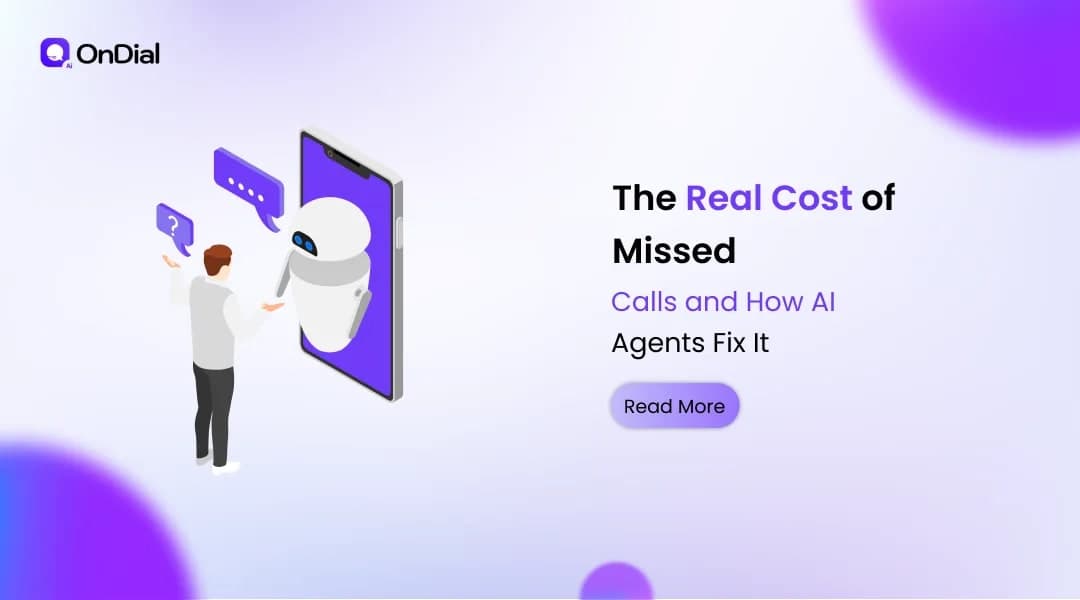
A ringing phone that nobody answers is not a small inconvenience. It is a quiet, recurring loss of revenue that most businesses never actually measure. Studies on call handling consistently show that a large share of business calls, often close to a third depending on the industry, go unanswered during business hours, and that number climbs sharply outside of standard office hours. Every one of those calls represents a customer who was ready to talk, ready to book, or ready to buy, and who is now deciding whether to call back, try a competitor, or simply give up.
The cost of missed calls for business owners is rarely visible on a monthly profit and loss statement. It shows up instead as a slow leak, a few lost leads here, a few frustrated existing customers there, a booking that went to the clinic down the street because someone actually picked up the phone. Over a year, that leak can add up to a meaningful percentage of total revenue, particularly for businesses where phone calls are the primary channel for new business, such as healthcare clinics, real estate agencies, home services, and financial services firms.
This blog breaks down exactly why missed calls happen, what they actually cost a typical business, why the traditional fixes such as voicemail, IVR menus, and hiring more staff consistently fail to solve the problem, and how AI voice agents change the economics entirely by making it possible to answer every call, every time, without adding headcount. By the end, you will understand not just the scale of the problem but the specific mechanics of how a platform like OnDial closes the gap.
The Hidden Revenue Drain: What Missed Calls Really Cost Your Business

Most business owners underestimate how often their phones actually go unanswered because they are not sitting by the phone counting rings. Front desk staff is helping a walk-in customer, a sales rep is on another call, or everyone is simply out to lunch at the same time. None of that is a failure of effort. It is simply what happens when call volume is unpredictable, and staffing is fixed.
The financial impact becomes clear once you translate missed calls into lost opportunities using your own numbers. If a business receives 500 inbound calls a month and misses even 20 percent of them, that is 100 potential customers who never got a live response. If a reasonable estimate of conversion value per call is 200 dollars, whether that is an appointment, a policy, a booking, or an order, the monthly lost revenue from missed calls alone reaches 20,000 dollars. Multiply that across a year, and the number becomes impossible to ignore.
Why Missed Calls Happen More Than You Think
Missed calls are not random accidents. They follow predictable patterns tied directly to how human teams operate, and understanding those patterns is the first step toward fixing them.
The most common reasons calls go unanswered include the following.
Staff is already on another call, and the line simply rings out or goes to voicemail.
Call volume spikes during specific hours, such as lunch breaks, weekend mornings, or right after a marketing campaign goes live, and staffing was not built for that spike.
The call comes in outside business hours, when no one is scheduled to answer at all.
A receptionist or agent is out sick or on leave, and no backup coverage was arranged.
The team is small enough that one or two people are responsible for every incoming call, creating a single point of failure.
Each of these situations is completely normal for a growing business, which is exactly why the problem is so widespread and so rarely solved with more hiring alone.
The After Hours and Peak Hour Blind Spot
The single biggest source of missed call revenue loss is the time outside a business's standard operating hours. A real estate agency that closes at 6 pm still receives inquiries at 8 pm from people browsing listings after work. A healthcare clinic that closes on weekends still has patients trying to book Monday appointments on Saturday morning. An e-commerce brand running a flash sale at 9 pm has customers calling about order issues long after the support desk has gone home.
Research on consumer behavior consistently shows that a caller who reaches voicemail after hours is far less likely to leave a message and wait for a callback than a caller who reaches a live voice immediately. Most callers in that situation simply call the next business on their list. This after-hours gap is often the single largest and most fixable source of lost revenue in the entire missed call problem, because it does not require better staff performance; it requires coverage that never sleeps.
Why Traditional Call Handling Falls Short
Businesses have tried to solve the missed call problem for decades using the tools available to them, and it is worth being honest about why those tools consistently underperform.
Voicemail and IVR Don't Convert
Voicemail was designed to capture a message, not to close a sale or book an appointment. The moment a caller hears a recorded greeting asking them to leave their name and number, a significant share of them hang up rather than wait for a callback that may or may not come quickly enough to matter. Interactive voice response systems, the automated menus that ask callers to press one for sales and two for support, solve part of the routing problem but frustrate callers who simply want to speak to someone and get an answer.
The core issue with both approaches is that they treat the call as something to be logged and processed later rather than resolved in the moment. A caller with an urgent question about pricing, availability, or an existing order does not want to wait. They want an answer now, and if they do not get one, they move on to whichever business gives them that answer first.
Hiring More Staff Doesn't Scale
The instinctive fix for missed calls is to hire more people to answer the phone, and for a while that works. The problem is that call volume is rarely smooth and predictable. A business might need three agents at 11 am and one agent at 3 pm, but staffing has to be planned for the average, which means the business is either understaffed during peaks or overstaffed and paying for idle time during quiet periods.
There is also a hard ceiling on what human staffing can achieve. A single agent can only handle one call at a time, so ten times the call volume genuinely requires close to ten times the staff, along with the recruiting, training, management, and turnover costs that come with a larger team. For most growing businesses, that math simply does not work, which is exactly why the missed call problem tends to get worse, not better, as a business scales.
How AI Voice Agents Solve the Missed Call Problem
AI voice agents remove the fixed capacity constraint that makes missed calls inevitable in a human-only call handling model. Because an AI agent can hold many simultaneous conversations at once, call volume spikes stop being a staffing crisis and simply become traffic the system is built to absorb.
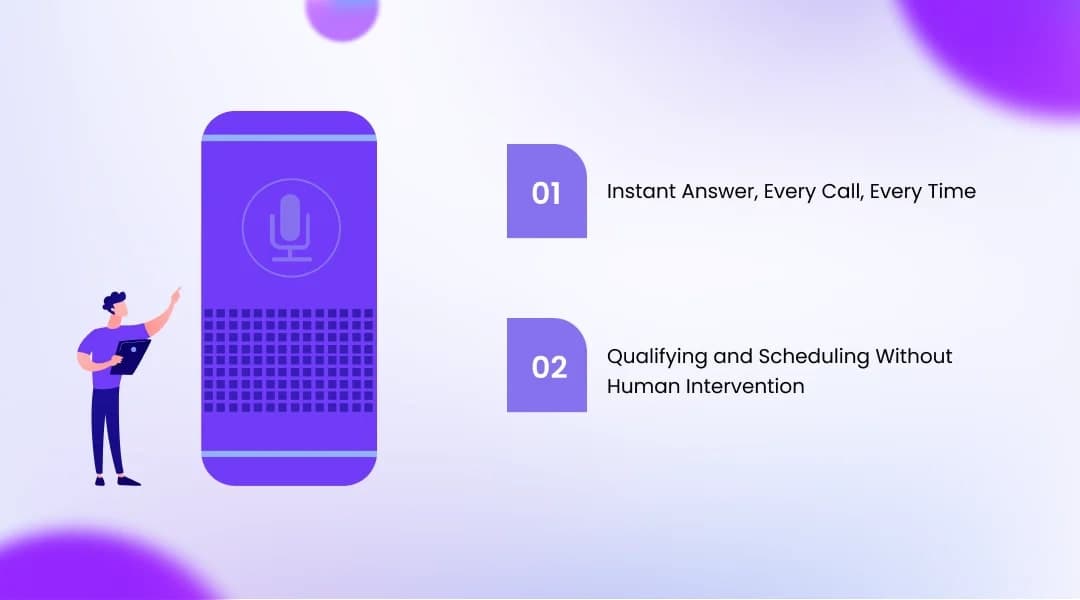
Instant Answer, Every Call, Every Time
A well-built AI voice agent answers every inbound call on the first ring, at any hour, without the caller ever reaching voicemail or an endless menu. Platforms like OnDial are built specifically to deliver this kind of response, with latency under 500 milliseconds so that the conversation feels natural and immediate rather than robotic or delayed. That speed matters because a caller who experiences a natural, responsive conversation is far more likely to stay on the line and complete the interaction than one who hits an awkward pause or a stilted, obviously scripted response.
This is not a simple answering machine with a friendlier voice. A properly deployed AI voice agent can understand the caller's intent, answer common questions accurately, and move the conversation forward toward a specific outcome, whether that outcome is booking an appointment, qualifying a sales lead, or resolving a customer support question without escalation.
Qualifying and Scheduling Without Human Intervention
Answering the call is only half the value. The other half is what happens during the conversation itself. OnDial's AI voice agents are built to handle lead qualification and scoring directly on the call, asking the right follow-up questions to determine whether a caller is a serious prospect before that lead ever reaches a human sales team. This means the human team spends its time on qualified opportunities instead of chasing every inbound call regardless of intent.
Appointment scheduling works the same way. Instead of taking a message and waiting for someone to call back and coordinate a time, the AI agent checks availability and books the appointment directly into the calendar during the live call, which removes the back and forth that so often causes prospects to lose interest or book with a competitor instead.
The Quantified Business Impact of Answering Every Call
Once every call gets answered instead of a meaningful share going unanswered, the financial impact is straightforward to model. If a business was previously missing 20 percent of its 500 monthly calls and now answers effectively all of them, that recovers roughly 100 conversations a month that were previously lost entirely. At a conservative 200-dollar average conversion value, that is 20,000 dollars a month in recovered opportunity, or 240,000 dollars annually, purely from closing the missed call gap.
The impact compounds further because AI voice agents also improve response time, and response time itself is a strong predictor of conversion. Businesses that respond to inbound leads within five minutes convert those leads at meaningfully higher rates than businesses that take even an hour to respond. An AI voice agent that answers on the first ring effectively guarantees the fastest possible response time on every single call, which means the improvement is not just about capturing calls that would otherwise be missed entirely; it is also about converting calls that would previously have gone to a slower competitor.
There is a third layer of impact that is easy to overlook, which is customer experience and retention. Existing customers who call with a question or an issue and reach a live, helpful response immediately are far more likely to remain loyal than customers who hit voicemail and have to wait for a callback. Call sentiment tracking, a capability built into OnDial's analytics, allows businesses to see how these interactions are actually landing with customers, which turns call handling from a guessing game into something that can be measured and improved over time.
How OnDial Delivers Reliable 24/7 Call Coverage
OnDial is built specifically to close the missed call gap for businesses that cannot afford to lose revenue to unanswered phones. The platform deploys AI voice agents that handle both inbound and outbound calls around the clock, so coverage does not depend on shift schedules, sick days, or how busy the front desk happens to be at any given moment.
For businesses operating in India or serving Indian customers, OnDial supports 9 Indian languages with more than 80 Indian voice variations, alongside support for more than 100 languages overall, which means callers can speak in the language they are most comfortable with rather than being forced into English-only support. This matters enormously in markets where customers frequently switch between languages mid-conversation, since a caller who has to repeat themselves or switch to a language they are less fluent in is far more likely to disengage before the call is resolved.
OnDial also handles the two things that determine whether a recovered call actually turns into revenue, which are qualification and scheduling. The platform scores leads during the live conversation and books appointments directly into connected calendars, so the value of answering the call is captured immediately rather than requiring a separate follow-up step that introduces its own risk of drop-off. Every interaction is handled under GDPR and CCPA-compliant data practices, which matters for businesses in regulated industries such as healthcare and financial services where customer data handling is not optional.
What Implementation Actually Looks Like
Business owners considering AI voice agents often assume the rollout will be a long, technical project, but a well-designed platform makes this far simpler than it sounds. OnDial offers both API based deployment for businesses with existing technical infrastructure and no-code deployment for businesses that want to get an AI agent live without engineering resources, which means the right entry point exists whether a business has a dedicated development team or not.
A typical implementation generally follows a clear sequence.
The business defines the specific call scenarios the AI agent needs to handle, such as appointment booking, lead qualification, or order status inquiries.
The AI agent is configured with the business's specific information, including services, pricing structure, availability, and common questions.
The agent is connected to relevant systems such as the calendar for scheduling and the CRM for lead handoff.
A testing phase runs the agent against real call scenarios to confirm accuracy and tone before it goes live.
The agent goes live handling a defined share of calls, often starting with after-hours or overflow coverage before expanding further.
Call sentiment and outcome data are reviewed regularly to refine responses and identify where the agent is performing well or needs adjustment.
This phased approach lets a business see measurable results, such as a reduction in missed calls and an increase in booked appointments, within the first few weeks rather than waiting months for a full-scale rollout to prove itself.
Industry Applications: Where Missed Calls Hurt Most
The cost of missed calls varies significantly by industry, and understanding where the impact is greatest helps clarify where AI voice agents deliver the fastest return.
Healthcare clinics lose appointment revenue every time a patient calls to book and reaches voicemail instead, often resulting in that patient booking elsewhere or simply not seeking care at all.
Real estate agencies lose buyer and renter inquiries constantly, since property seekers browsing listings in the evening expect an immediate response and will move to the next listing if no one answers.
Financial services and insurance firms lose policy inquiries and renewal opportunities when calls go unanswered during busy periods, directly affecting new business and retention numbers.
Automotive dealerships and service centers lose service bookings and sales inquiries when the showroom or service desk is too busy to pick up during peak hours.
Logistics and delivery businesses lose customer trust when calls about shipment status go unanswered, increasing support escalations and damaging repeat business.
Hospitality and travel businesses lose direct bookings to third-party platforms when a traveler calling to check availability cannot get through and books elsewhere instead.
Across every one of these industries, the underlying problem is identical even though the specific call content differs. A caller with intent to buy or book reached out, and the business's ability to capture that intent depended entirely on whether a human happened to be available at that exact moment.
Conclusion
The cost of missed calls for business is not a minor inefficiency; it is a direct and measurable drain on revenue that grows worse as a business scales and call volume becomes harder to manage with a fixed human team. Voicemail and IVR systems fail to convert callers because they treat the call as something to process later rather than resolve immediately, and hiring more staff runs into a hard ceiling on cost and capacity that most growing businesses simply cannot sustain. AI voice agents change this equation entirely by making it possible to answer every call, at any hour, without the constraints that limit human-only teams.
OnDial was built specifically to close this gap for businesses that cannot afford to keep losing revenue to unanswered phones. With response latency under 500 milliseconds, support for more than 100 languages including 9 Indian languages and over 80 Indian voice variations, and the ability to handle inbound and outbound calls 24 hours a day across more than 20 industries, OnDial gives businesses the reliable, always available call coverage that traditional staffing models simply cannot match. Lead qualification, appointment scheduling, and call sentiment analytics are built directly into the platform, so every recovered call turns into a measurable business outcome rather than just another logged interaction.
If missed calls have been quietly costing your business revenue, the fastest way to find out how much is to see the platform in action. Schedule a demo with OnDial today and find out exactly how many of your calls are currently going unanswered, and what capturing them could mean for your bottom line.