I’ve sat in rooms where companies spent millions on automation… and still had customers screaming “AGENT!” into the phone.
I’ve also watched smaller teams buy a low cost AI voice assistant, roll it out in weeks, and quietly outperform giants.
Price, I learned, is a terrible predictor of success.
Clarity is better.
For 15 years I’ve worked with call centers, BPOs, and CX teams trying to modernize without setting money on fire. I’ve seen magical demos collapse in production. I’ve seen “cheap” tools become heroes.
So if you’re worried that budget means bad, breathe.
It doesn’t.
But it does demand you know exactly what to look for.
Let’s build your checklist.
What Is a Low-Cost AI Voice Assistant?
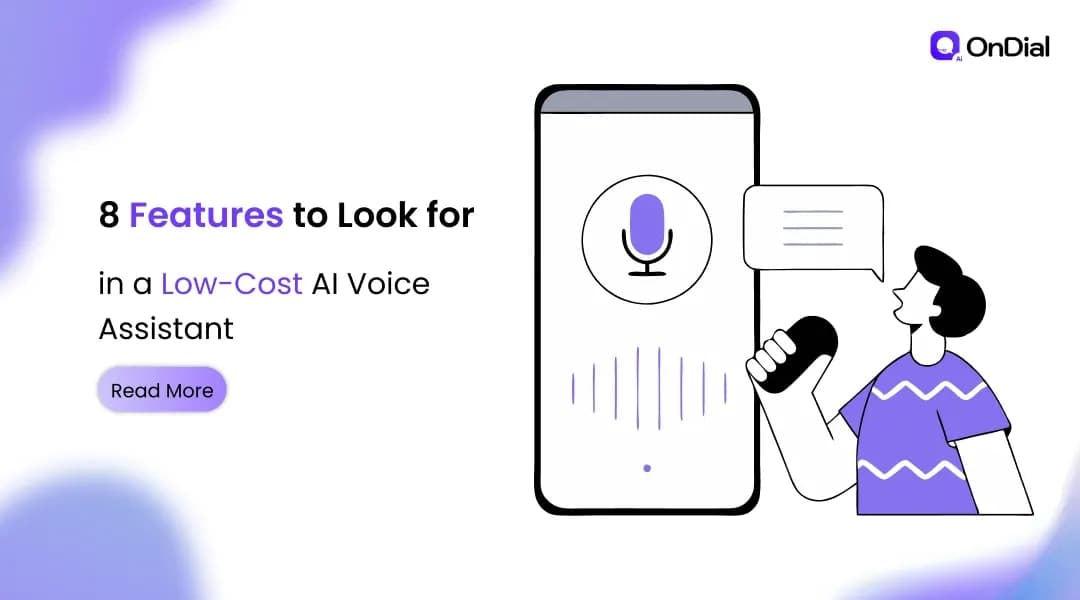
A low cost AI voice assistant is software that handles customer conversations over the phone, without needing a human for every interaction—while keeping pricing accessible for growing businesses.
Think:
answering repetitive queries
routing intelligently
collecting information
booking appointments
making outbound reminders
In other words, doing the heavy lifting of everyday Customer Calls while your human team focuses on exceptions.
Not magic. Not science fiction. Operational relief.
Why Businesses Are Choosing Low-Cost AI Voice Assistants?
Because payroll keeps rising.
Because attrition is brutal.
Because training never ends.
And because customers expect instant responses at 2 a.m.
I remember a support head telling me, “If one more vendor suggests hiring faster, I’ll quit.” (I believed him.)
An affordable AI voice assistant becomes attractive when leaders realize automation isn’t about replacing people; it’s about protecting them from burnout.
Also, let’s be honest, finance likes numbers that go down.
A well-designed AI voice assistant for call centers can reduce handle time, missed calls, and infrastructure load within weeks.
If. It has the right features.
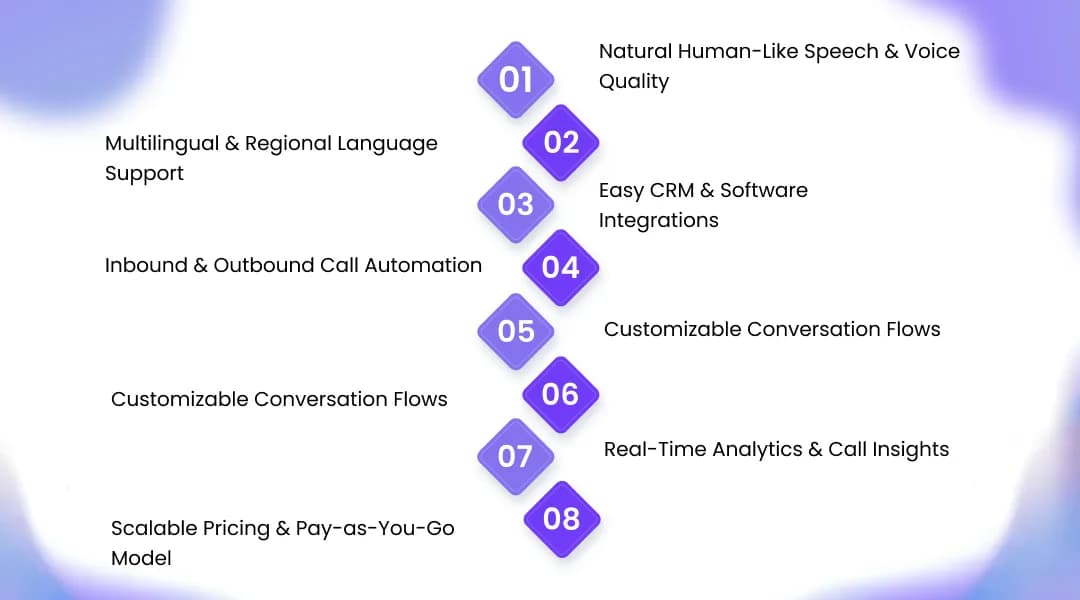
Natural Human-Like Speech & Voice Quality
If the voice sounds robotic, customers mentally check out.
Immediately.
I’ve tested systems where comprehension dropped simply because the pacing felt wrong. Same script. Different voice. Massive difference.
A strong conversational AI voice agent should offer:
natural intonation
interruption handling
emotion-aware responses
minimal latency
Here’s my litmus test: would you tolerate listening to it for eight hours a day?
No?
Your customers won’t either.
Multilingual & Regional Language Support
India alone can humble any product team.
Hindi. Tamil. Marathi. Bengali. Hinglish. Code-switching mid-sentence.
A serious AI voice bot for customer service must understand how real people speak, not how scripts are written.
And it’s not just language. It’s accent, phrasing, cultural rhythm.
If your vendor says, “English works great,” pause.
Ask them to run a live demo with regional slang.
Watch what happens.
Easy CRM & Software Integrations
Your bot without data is just a polite parrot.
For real automation, your AI voice automation software needs to read and write information: orders, tickets, payments, status updates.
I’ve watched teams celebrate a launch only to realize agents still had to retype everything afterward.
Painful.
Look for ready connectors, APIs, webhooks, and proof they’ve integrated with systems like yours before. Not theoretically. Actually.
This is where mature AI Call Assistants separate themselves from experiments.
Inbound & Outbound Call Automation
Many vendors handle inbound beautifully.
Outbound? Suddenly complicated.
But reminders, collections, feedback, verifications, these move the business needle fast.
A capable AI phone answering system should manage both directions, retry logic, scheduling, and escalation.
Otherwise you’re buying half a solution.
And paying full price.
Customizable Conversation Flows
No two operations behave the same.
Your policies. Your approvals. Your edge cases.
If changing a script requires raising a support ticket, you’re stuck.
I prefer platforms where operations teams can modify flows themselves, test, and deploy quickly. Controlled. Auditable. Practical.
Because the best AI IVR alternative is one that evolves with you.
Tell me, how often do your processes change?
Exactly.
Real-Time Analytics & Call Insights
If you can’t see what’s happening, you can’t improve it.
Full stop.
You need dashboards for containment rate, fallback triggers, sentiment, drop-offs, agent transfers, cost per interaction.
Good analytics turn a budget AI voice bot into a performance engine.
Great analytics reveal uncomfortable truths.
(Like discovering customers ask something you never prepared for.)
That moment? Gold.
Scalable Pricing & Pay-as-You-Go Model
Here’s where many leaders get nervous.
“What if success becomes expensive?”
Fair question.
Smart AI voice assistant pricing grows with usage but keeps unit economics attractive. You should clearly understand per-minute or per-call cost and how automation reduces human load.
I once helped a startup triple volume overnight after a campaign went viral. Their platform handled it. No drama. No emergency hiring.
Relief.
That’s what a scalable AI voice solution feels like.
Security, Compliance & Data Privacy
Now we switch tone.
Because this part can end careers.
Your AI call assistant will process personal data, payment information, health records, or identity details depending on your industry.
You want encryption, access control, audit trails, hosting transparency, and regulatory alignment.
If answers are vague, walk away.
Cheap should never mean careless.
How to Choose the Right Low-Cost AI Voice Assistant for Your Business
By now you see the pattern.
The best product isn’t the one with the flashiest demo; it’s the one that survives contact with reality.
Here’s how I advise teams:
First, map your top call drivers. Second, define success metrics. Third, demand proof from similar deployments.
When providers like OnDial position themselves as partners, not just sellers, I pay attention. Experience building real AI Phone Calls across industries matters. It shortens mistakes. It speeds trust.
And if they let you speak to actual customers?
Even better.
Because vendors can promise anything.
Operators tell the truth.
Conclusion
Buying a low cost AI voice assistant isn’t risky.
Buying blindly is.
You now know the difference between affordability and compromise. Between a toy and infrastructure. Between hype and help.
Take this checklist into every demo.
Watch how conversations change.
You’ll evaluate like an insider.
And your future self, the one not firefighting escalations at midnight, will be grateful.