A medical practice loses tens of thousands of dollars a year just from calls nobody answered in time. That single fact reframes the whole conversation. Missed inbound calls are the leading cause of an estimated $150 billion in lost appointment revenue annually across US healthcare, and most of that loss is invisible until someone actually adds it up.
If you're reading this, you're probably staring at your own version of that number. Maybe it's a front desk that can't keep up. Maybe it's a no-show rate that keeps climbing no matter how many reminder texts you send. I get it, because in projects I've worked on with clinics and multi-location practices, this is the exact wall almost everyone hits before they look seriously at automation.
Healthcare AI voice agent software is a conversational AI system that answers, understands, and completes patient phone calls, like scheduling, rescheduling, and routine support questions, without a human picking up the phone. It connects directly to your scheduling system or EHR, holds a natural conversation instead of a button-press menu, and hands off to staff the moment a call needs real judgment.
Here's what you'll learn: what these systems actually automate, whether they're safe for patient data, how to evaluate a vendor without getting sold a demo, and what a sane rollout actually looks like.
Why Patient Calls Are Breaking Down Right Now
Most clinics didn't choose to be bad at phones. They got buried. Call volume went up, staffing didn't, and something had to give.
The Real Cost of a Missed Call
The numbers here are uncomfortable. Average hold times in some healthcare call centers exceed 11 minutes, and call abandonment rates reach as high as 57 percent during peak hours. Patients give up. Staff get buried trying to catch up. Nothing actually improves on its own.
No-shows are the other half of this. Outpatient healthcare averages 23 to 33 percent missed appointments, according to Gnani.ai's 2026 Voice AI in Healthcare guide. That's not a rounding error. That's a quarter to a third of every scheduled day, gone.
A few things compound this:
Front-desk turnover is brutal. Staff who answer phones all day burn out fast, and every new hire needs weeks to learn your scheduling rules.
Peak-hour spikes overwhelm even good teams. Monday mornings and the hour after lunch break most phone systems, AI or not.
Patients don't call back. Once someone hits voicemail or a long hold, a meaningful share simply doesn't try again. That demand doesn't reschedule itself. It disappears.
Why Traditional IVR Systems Make It Worse
Here's an uncomfortable truth: the "press 1 for billing" system your practice installed five years ago to fix this problem is now part of it.
A phone tree can route a call. It can't complete one. A patient who needs to move a Thursday appointment still has to navigate menus, get transferred, and explain themselves twice. The frustration isn't really about waiting. It's about waiting for a system that was never going to finish the job anyway.
This is the actual difference between an IVR and a real voice agent. One sorts calls into buckets. The other holds the conversation and finishes the task, booking, confirming, or escalating, on the spot.
What Healthcare AI Voice Agent Software Actually Automates
This is where vendor marketing tends to blur together, so let's get specific about what these systems do in practice.
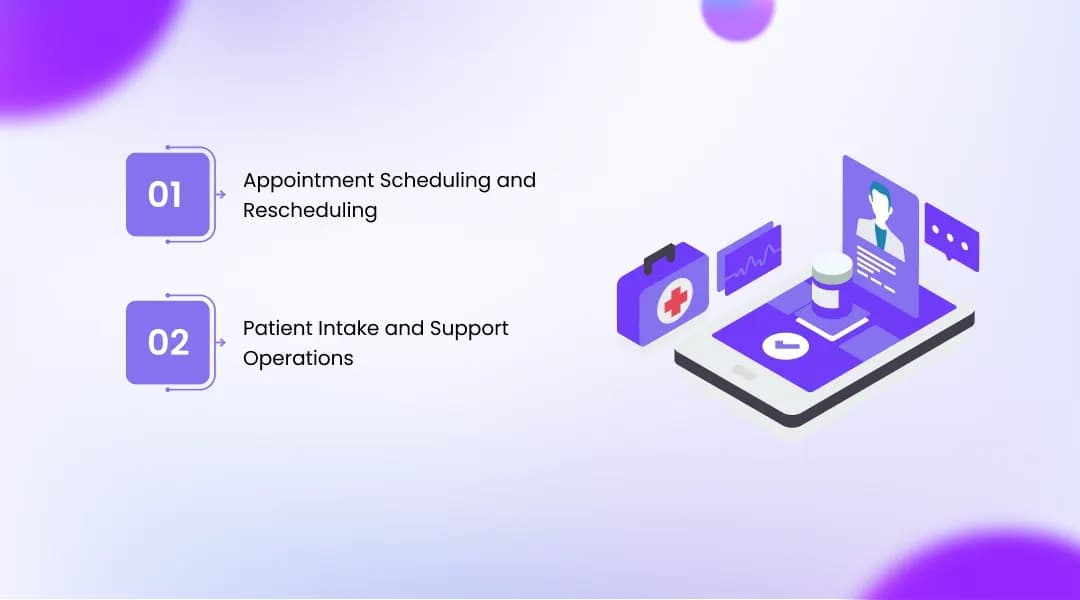
Appointment Scheduling and Rescheduling
Scheduling is the single most common entry point, and for good reason: it's high-volume, repetitive, and follows predictable patterns. A voice agent answers the call, checks real-time availability against your scheduling system, and books, confirms, reschedules, or cancels the visit, all inside one conversation.
A few things separate a good scheduling deployment from a frustrating one:
Real-time calendar access. The agent has to see actual open slots, not a cached snapshot from this morning, or it will book appointments that don't exist.
Two-way rescheduling. A patient saying "I need to move this to next week" should resolve in the same call, not get punted to a callback.
Confirmation follow-through. The best deployments send an automatic text or email confirmation the moment the call ends, closing the loop without staff involvement.
I've seen practices treat this as a simple swap, AI instead of a person, same workflow. It rarely works that way. The conversation design has to account for patients who ramble, change their mind mid-sentence, or ask three questions before getting to the actual request. That's a harder problem than it sounds.
Patient Intake and Support Operations
Beyond scheduling, the bigger opportunity is everything around the appointment: intake, refill requests, billing questions, and basic FAQs that eat up front-desk hours without needing a human's judgment.
A capable AI voice agent for healthcare can collect medical history, insurance details, and visit reason before the patient ever walks in, pushing structured data straight into the chart instead of having a staff member retype it from a sticky note. Picture a parent calling to ask about weekend hours and parking. That request resolves instantly with no human needed, and it's exactly the kind of call that, multiplied by hundreds per week, is quietly draining your front desk.
Common support workflows that get automated well:
Prescription refill requests, verified against the patient record and routed to the pharmacy
Insurance and coverage questions that don't require a judgment call
Post-visit follow-up calls checking on recovery or medication adherence
Office logistics: hours, parking, directions, accepted insurance plans
The honest limitation worth naming here: these systems are built for operational automation, not clinical decision-making. A voice agent should never be making a diagnosis or giving treatment advice. The good ones are explicit about that boundary, and you should be suspicious of any vendor who isn't.
Is It HIPAA Compliant and Safe for Patient Data
This is usually the question that stalls a deal. It shouldn't, but it does, mostly because the answer gets oversimplified in both directions.
Healthcare AI voice agent software can be HIPAA compliant, but compliance depends entirely on the platform's architecture and how it's deployed, not on the technology category itself. A voice agent confirming "Your appointment with Dr. Patel is Thursday at 2pm" is handling protected health information the moment it says that sentence out loud.
What a BAA Actually Covers
The Business Associate Agreement is the contract that legally obligates a vendor to protect patient data under HIPAA the same way your practice is obligated to. Any vendor handling PHI on your behalf needs to sign one. If a vendor hesitates on this, that's your answer.
Here's what a properly built system needs, at minimum:
Encryption in transit and at rest, typically TLS for data moving and AES-256 for data stored
Audit logging that records who accessed what, and when, for every patient interaction
Access controls so only the right systems and staff can touch PHI
A signed BAA before a single patient call ever touches the platform
Security Signals Worth Checking
Beyond the BAA itself, a few credentials separate a serious healthcare vendor from a general-purpose AI tool wearing a healthcare label.
Is an AI voice agent for healthcare HIPAA compliant? It can be, if the vendor signs a BAA, encrypts PHI in transit and at rest, maintains audit logs, and enforces strict access controls. Compliance depends on the deployment, not the category.
Beyond the BAA, ask specifically about SOC 2 Type II certification, which verifies security controls through an independent audit, and whether call recordings are deleted after processing rather than stored indefinitely. General-purpose AI tools without a healthcare add-on, the kind you'd use for drafting an email, do not offer BAAs and should never touch protected health information.
How to Evaluate a Vendor Before You Commit
A confident demo tells you almost nothing about how a system performs at 4:47 on a Friday afternoon with a backed-up queue and a parent trying to reschedule a pediatric appointment. Real evaluation has to go deeper than that.
EHR and Practice Management Integration
An AI voice agent that can't read and write directly to your EHR creates a second system for staff to maintain, which usually means more work, not less. Ask specifically whether the platform has native, bi-directional integration with your EHR, Epic, athenahealth, Cerner, or whatever you run, not just a generic API that requires manual syncing.
This matters more than almost anything else in the evaluation. A voice agent that books a slot in its own dashboard, leaving your team to copy it into the real calendar, has just added a step instead of removing one.
Escalation Logic and Human Handoff
No voice agent should claim to handle everything. A platform that promises 100 percent autonomous handling, with zero human fallback, is either overstating its capability or setting you up for a bad patient experience.
The questions worth asking a vendor directly:
What specific phrases or scenarios trigger an immediate transfer to a human?
Can the system recognize red-flag language, chest pain, difficulty breathing, and escalate instantly?
What does the staff member see when a call gets transferred, just a callback number, or full context?
How is "complex" defined, and can your team adjust that threshold over time?
At OnDial, this is the part we push hardest on with new partners, because a voice AI platform that can't gracefully hand off a confused or distressed caller to a real person isn't actually solving the problem. It's just moving the frustration somewhere less visible.
What Rollout Actually Looks Like
Here's the part most vendor pages skip entirely: how you actually go live without breaking patient trust in week one.
Starting With Low-Risk Workflows
Don't start with your most complicated specialty scheduling logic. Start with the calls that are high-volume and low-clinical-risk, after-hours scheduling, appointment confirmations, basic FAQs. Let the system prove itself on the easy stuff before it touches anything sensitive.
A phased rollout protects you in two ways. It limits the damage if something goes wrong early, and it gives your staff time to trust the tool instead of resenting it. Should I let AI handle patient calls or just use it for scheduling? Most practices that succeed with this start narrow, then expand once the data backs it up.
Getting Staff Buy-In Early
This is the step that gets skipped, and it's usually the reason a deployment stalls. Front-desk staff who feel like the AI was imposed on them will quietly find ways to route around it.
Bring them into the conversation-design process. They know the actual questions patients ask, the actual phrasing people use, the actual edge cases that break every script. The goal of healthcare AI voice agent software is to support staff, not replace their judgment, and that has to be communicated honestly, not as a talking point but as an actual operating principle.
Conclusion
Healthcare AI voice agent software earns its place in a practice for one reason: it finishes the calls your front desk can't get to, without forcing patients through another frustrating phone tree. The three things worth carrying forward: compliance is about deployment, not category, so verify the BAA and security posture directly. Integration with your actual EHR matters more than any demo. And rollout works best when it starts narrow, on low-risk calls, with your staff involved from day one.
If you've made it this far, you're not looking for hype. You're looking for a clear-eyed read on whether this fits your practice, and that's exactly the conversation we have with every team we work with at OnDial. We build voice AI around your actual call patterns, not a generic script, because a tool your staff trusts is the only kind that actually gets used. If you're weighing this for your own front desk, we're glad to walk through what a phased rollout would look like for your specific call volume.
In one sentence: healthcare AI voice agent software works when it's deployed as a partner to your staff, verified for compliance up front, and rolled out on the calls that matter least before it earns the calls that matter most.