AI call automation is changing how businesses manage high-volume phone interactions. Instead of assigning human agents to every routine conversation, businesses can use AI voice agents to answer questions, qualify leads, schedule appointments, send reminders, collect information, and route complex cases to human teams.
The biggest opportunity is not simply reducing the number of people answering phones. It is reducing repetitive work, improving response speed, recovering missed opportunities, and allowing human employees to focus on conversations that require judgment.
This matters across industries where phone calls are frequent, predictable, and connected to business systems. Healthcare, BFSI, retail, real estate, telecommunications, education, and logistics are particularly well suited to this approach.
How AI Call Automation Creates Business Savings
Before looking at individual industries, it helps to understand where the economic value comes from.
1. Lower repetitive workload
Many business calls involve questions or actions that follow predictable patterns. Order status, appointment confirmation, lead qualification, payment reminders, booking requests, and basic account queries can often be handled through predefined conversational workflows.
When an AI voice agent handles these interactions, human agents can spend more time on exceptions and complex customer needs.
2. Fewer missed calls
A missed call can represent a lost lead, delayed appointment, abandoned purchase, or unresolved support issue.
AI voice agents can provide immediate first-line coverage when human teams are unavailable or overloaded. This is particularly useful outside normal business hours and during seasonal demand spikes.
3. Better use of existing employees
Automation does not have to mean replacing an entire call team.
A stronger operating model is to let AI handle repetitive conversations while human employees handle escalations, negotiations, complaints, complex sales discussions, and situations where empathy or judgment is essential.
4. More scalable operations
Hiring additional employees takes time. Training them takes longer, and maintaining service quality across shifts can be difficult.
AI call automation provides another way to absorb changes in call volume without increasing staffing at the same rate.
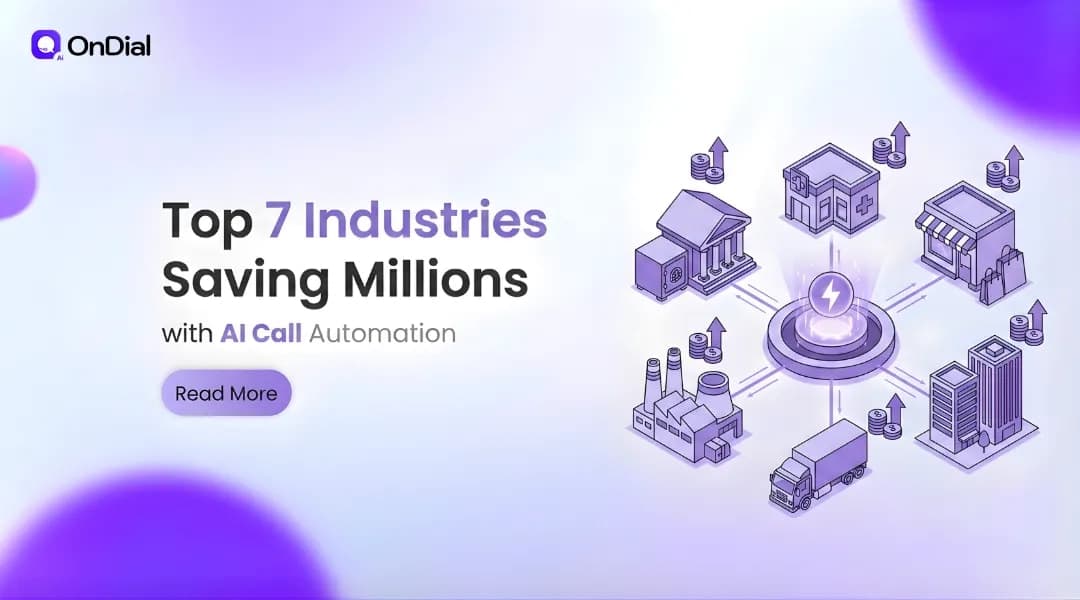
7 Industries Where AI Call Automation Can Deliver Strong ROI
The strongest opportunities are not necessarily determined by company size. They are determined by call volume, repetition, workflow clarity, and the value of each successful interaction.
1. Retail and E-commerce
Retail and e-commerce businesses receive large numbers of calls about orders, deliveries, returns, refunds, product availability, loyalty programs, and promotions.
These conversations often involve information already stored in an order management or CRM system. That makes them suitable for conversational automation.
An AI voice agent can answer questions such as:
Where is my order?
When will my delivery arrive?
How can I start a return?
What is the status of my refund?
Is a product available?
How can I use my loyalty points?
The business benefit goes beyond reducing support workload. Faster answers can also reduce customer frustration and prevent customers from repeatedly contacting support.
For a deeper look at this use case, see AI voice agents for retail and e-commerce.
2. Banking, Financial Services, and Insurance
BFSI organizations manage large volumes of customer communication.
Common workflows include payment reminders, loan status updates, policy renewal reminders, application follow-ups, verification steps, and customer service inquiries.
AI calling can automate structured outbound campaigns while also handling inbound questions. The system can collect information, provide approved responses, update connected workflows, and escalate situations that require human intervention.
The key consideration in BFSI is not simply automation volume. Compliance, authentication, consent, data security, and escalation rules must be designed into the workflow.
This makes AI call automation particularly valuable when organizations have large repetitive workloads but cannot compromise on process control.
3. Healthcare
Healthcare providers spend substantial staff time managing phone-based administrative work.
Patients may call to book an appointment, reschedule a visit, confirm appointment details, ask about availability, or request basic information.
An AI voice agent can automate suitable parts of this process while routing sensitive or complex conversations to staff.
Appointment reminders are another strong use case. Instead of relying entirely on staff to make reminder calls, an automated system can contact patients, confirm attendance, capture rescheduling requests, and update the appropriate workflow.
The objective is not to automate clinical judgment. It is to reduce administrative phone work so healthcare staff can spend more time on patients.
4. Real Estate
Real estate companies often generate large volumes of inquiries, but not every inquiry represents a serious buying opportunity.
Sales teams can spend significant time calling leads, collecting basic requirements, answering initial questions, and trying to schedule property visits.
AI voice agents can handle the early stage of this process.
They can ask about location preferences, budget range, property type, timeline, and other qualification criteria. Qualified prospects can then be routed to sales representatives or offered an appointment.
This creates a practical division of work. AI handles repetitive qualification while salespeople focus on conversations that are more likely to result in a site visit or transaction.
5. Telecommunications
Telecom companies deal with extremely high call volumes.
Customers may contact support about billing, plan information, recharge issues, service problems, account questions, or network-related concerns.
Many of these interactions follow defined workflows and can be connected to customer records.
AI voice agents can provide first-line assistance, collect relevant information, answer approved questions, and route complex technical or account issues to human teams.
The value becomes especially visible when call volumes suddenly increase. Instead of building a permanent workforce around the highest possible demand, companies can use automation to absorb predictable spikes.
6. Education and EdTech
Educational institutions, coaching companies, universities, and EdTech businesses often experience significant inquiry spikes around admissions, enrollment periods, examinations, and new course launches.
Sales and admissions teams may receive questions about courses, schedules, fees, eligibility, batches, documentation, and enrollment procedures.
AI calling can qualify these inquiries and identify which prospects need immediate human attention.
For example, an AI agent can ask a prospective student about the course they are interested in, preferred schedule, location, and enrollment timeline. The resulting information can then be passed to an admissions representative.
This reduces repetitive calling work while helping teams respond faster when demand is high.
7. Logistics and Delivery
Logistics businesses deal with a constant flow of customer and delivery communication.
Typical conversations include delivery status, estimated arrival times, failed delivery attempts, address confirmation, rescheduling, and delivery instructions.
These interactions are often time-sensitive but relatively structured.
An AI voice agent connected to shipment or customer systems can provide updates without requiring an employee to manually answer every call.
Outbound calls can also be used for delivery confirmations, rescheduling, and notifications.
The result is a more responsive customer communication layer without requiring support teams to manually manage every routine interaction.
What Makes an AI Call Automation Use Case Profitable?
Not every phone workflow should be automated.
The best candidates usually share several characteristics.
High call volume
If a business receives only a handful of calls each day, automation may not create enough operational value to justify implementation.
High-volume environments provide more opportunities to reduce repetitive workload.
Predictable conversations
AI performs best when the business understands the common questions, possible responses, required actions, and escalation conditions.
A workflow such as appointment confirmation is easier to automate than an unpredictable negotiation.
Clear business outcomes
A good automation project should have a measurable objective.
That could be reducing abandoned calls, increasing appointment confirmations, qualifying more leads, reducing repetitive support workload, or improving response time.
Access to business systems
AI becomes considerably more useful when it can work with the systems that contain customer and operational information.
Connecting calling workflows with CRM, calendar, order, booking, or other business systems allows the conversation to result in an actual action rather than just an answer.
AI Call Automation vs Human Agents
The most effective approach is usually not AI versus humans.
It is AI plus humans, with each handling the type of work they are best suited for.
AI is well suited to repetitive, high-volume, structured conversations. Humans remain essential for complex complaints, sensitive situations, negotiations, exceptions, relationship management, and decisions that require judgment.
A practical model looks like this:
AI handles: routine questions, qualification, reminders, confirmations, scheduling, status updates, basic follow-ups, and information collection.
Humans handle: escalations, complex support cases, negotiations, sensitive conversations, exceptions, and high-value relationship management.
This approach can reduce operational pressure without removing the human layer customers need.
How to Calculate the Potential ROI
Businesses should avoid starting with a vague question such as, "How much can AI save us?"
Instead, calculate the economics of one specific workflow.
Start with the number of calls handled each month.
Then determine how many are repetitive enough to automate. Estimate the current cost of handling those conversations, including employee time, management overhead, infrastructure, and the opportunity cost of work that agents cannot complete while handling routine calls.
Next, calculate the value of missed opportunities.
For sales teams, that could mean unqualified leads consuming representative time. For healthcare, it could mean missed appointments. For retail, it could mean unresolved customer issues or abandoned purchases. For logistics, it could mean repeated support contacts.
Finally, compare the expected savings and recovered value against the cost of deploying and operating the AI system.
The goal is not to produce an impressive percentage. The goal is to determine whether one clearly defined workflow generates enough measurable value to justify automation.
How Businesses Should Start With AI Call Automation
The strongest implementations usually begin with a narrow workflow rather than attempting to automate every call immediately.
Step 1: Identify the repetitive call type
Review call recordings, dispositions, transcripts, and support data.
Find the conversations that occur frequently and follow predictable patterns.
Step 2: Define the desired outcome
Decide exactly what the AI should accomplish.
It could be booking an appointment, qualifying a lead, providing an order update, collecting information, confirming a payment reminder, or routing a caller.
Step 3: Define escalation rules
Determine when the AI should stop and involve a human.
This is essential for customer experience and operational control.
Step 4: Connect the necessary systems
An AI voice agent becomes more useful when it can access the information required to complete the workflow.
CRM, calendar, order management, booking, and communication systems may all play a role depending on the use case.
Step 5: Measure the outcome
Track metrics that connect automation to business value.
Useful measures include automation rate, first contact resolution, transfer rate, response time, appointment completion, lead qualification rate, missed calls, customer satisfaction, and cost per resolved interaction.
Businesses can then expand automation based on evidence rather than assumptions.
The Future of AI Call Automation Is Hybrid
AI call automation is moving beyond simple call answering.
The more valuable systems connect conversation with business action. Instead of simply telling a customer where an order is, the system can retrieve the information and communicate it. Instead of only collecting a lead, it can qualify the lead and schedule the next step.
This shift makes voice AI relevant to more than customer support.
Sales, operations, collections, healthcare administration, logistics, education, and customer retention can all benefit when phone conversations are connected to the underlying business workflow.
For companies evaluating this transition, the important question is not whether AI can make a phone call.
It can.
The more useful question is which conversations should be automated, what business action should happen after the conversation, and where human expertise should remain involved.
That is where the strongest economic opportunity exists.
Businesses evaluating AI voice automation can explore how OnDial's AI voice agent platform can fit into their existing calling workflows, customer operations, and automation strategy.
Conclusion
AI call automation can create meaningful savings when it is applied to the right conversations.
Retail and e-commerce can automate order and return queries. BFSI can streamline structured customer and reminder workflows. Healthcare can reduce administrative calling. Real estate can automate lead qualification. Telecom can manage repetitive support requests. Education can handle inquiry spikes, while logistics can automate delivery communication.
The common factor is not the industry itself.
It is the presence of high-volume conversations that are repetitive, measurable, and connected to clear business outcomes.
The best starting point is therefore simple: identify one expensive and repetitive call workflow, automate it carefully, measure the result, and expand from there.
AI does not need to replace the human call center to create value. It needs to remove the repetitive work that prevents human teams from doing their most valuable work.