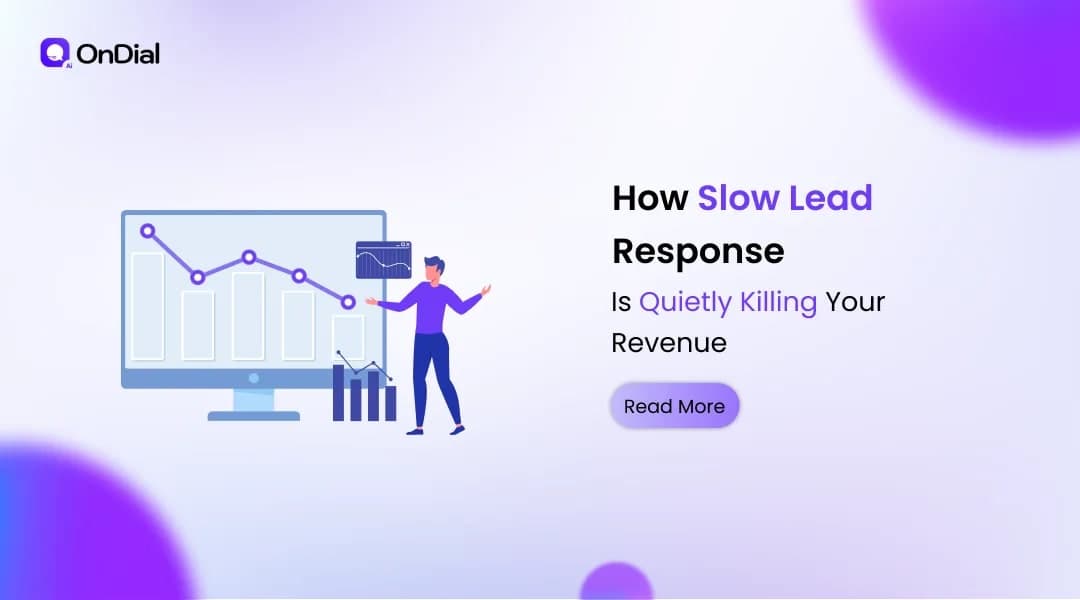
Every minute a new lead sits untouched in your CRM, your chance of closing that deal is shrinking. Not gradually, and not slightly. Research tracking hundreds of B2B companies found that the average business takes 47 hours to respond to an inbound inquiry. In that same window, the lead's purchase intent has cooled, they have spoken to at least two competitors, and 63% of them have already made a decision. The revenue impact of this single operational gap is enormous, and most businesses are sitting inside it right now without realising how much it costs them.
Lead response time and AI voice agents are inseparable topics in 2025 and beyond, because the only practical way to solve a response time problem at scale is automation that never sleeps. A human sales team, no matter how motivated, cannot respond to every inbound lead within five minutes during business hours and simultaneously handle leads that arrive at 11pm on a Sunday. An AI voice agent can. This blog examines the full business cost of slow lead response and missed calls, why traditional approaches consistently fail to solve it, and how AI voice agents deliver instant, always-on lead engagement that converts at materially higher rates. You will come away with a clear picture of the real numbers behind lead response decay, the ROI of AI-powered 24/7 lead qualification, and what implementation actually involves.
The Revenue Your Business Loses Every Day to Slow Response

Responding to leads within five minutes increases conversion rates by up to 100 times compared to responding after 30 minutes. That figure, widely cited from InsideSales and Harvard Business Review research, is not a marginal improvement. It is the difference between building a pipeline and watching it leak. When response time slips from five minutes to one hour, qualification rates fall by a factor of nine. When it extends to 24 hours, which is where 42% of companies actually operate, close rates drop to 12%, compared to 32% for businesses that respond within five minutes.
The financial picture becomes even clearer when you look at what missed calls and slow follow-up cost in direct revenue terms. Studies consistently find that small and medium businesses lose an average of $126,000 per year from unanswered calls alone, because 85% of callers who reach voicemail never call back, and 62% contact a competitor instead. The economics are brutal: every lead you pay to generate through marketing spend that does not get a timely response is money that flows directly to whoever answers faster. Research from Invoca found that home services businesses miss around 27% of their inbound calls, with each missed call costing approximately $1,200 in lost revenue when you account for average job value.
The After-Hours Gap Nobody Talks About
The problem compounds significantly outside business hours. Studies show that 35% to 52% of all inbound lead submissions arrive outside the 9-to-5 window, when sales teams are unavailable. Companies with 24-hour response capability convert at 2.5 times the rate of businesses that only operate during standard hours. After-hours leads that receive a same-night response achieve contact rates of 85%, compared to just 35% for leads followed up the next morning. The practical meaning of this is that if your business closes at 6pm, you are handing roughly half your pipeline to competitors who can reach those leads while they are still hot.
The after-hours gap is not a niche problem for businesses that attract late-night inquiries. It affects every business category. A law firm that receives an inquiry from someone involved in an accident at 8pm is competing against every other firm the prospect finds in a Google search. The first one to make contact wins the engagement. A real estate agency that cannot respond to a property inquiry submitted on a Saturday afternoon loses that buyer to an agent who can. A financial services company that misses a callback request submitted during a lunch break loses a prospect who was ready to open an account.
Why Most Businesses Do Not Know How Bad It Really Is
The majority of businesses significantly underestimate their missed opportunity rate because they measure what they catch, not what they lose. A business with a functioning CRM knows how many leads converted. It rarely knows how many leads came in at 10pm, how many went to voicemail and were never called back, or how many competitors the prospect contacted in parallel before finally choosing someone. The invisible nature of lost leads makes this one of the most underestimated revenue problems in business operations today.
Why Hiring More Sales Staff Does Not Solve This Problem
The instinctive response to a lead response problem is to hire more people. If leads are not being followed up fast enough, add more reps. If the phones are being missed, hire a receptionist. This logic is understandable but structurally flawed, and the failure mode shows up in every company that tries it.
Human salespeople have fundamental capacity constraints that additional hiring cannot fully overcome. A skilled human SDR makes between 40 and 60 outbound calls per day. They need sleep, take breaks, call in sick, and go on leave. They cannot simultaneously handle a live call and respond to three new inbound leads that just arrived. During peak periods, calls get missed. During off-hours, nobody is there. The moment you succeed in generating more leads through marketing, you hit the capacity ceiling again and the problem returns.
The Cost Arithmetic of Human Coverage
Building a human team capable of achieving genuinely fast lead response at scale costs more than most businesses account for. A single full-time sales development representative in the UK or Australia costs between £40,000 and £65,000 per year inclusive of salary and benefits. In India, a competent inside sales executive handling outbound calling costs between INR 4 and 9 lakhs per year. Neither is available 24 hours a day, and neither can handle multiple simultaneous conversations. Genuine 24/7 coverage requires a multi-shift operation with the associated management overhead, training costs, and attrition risk.
Sales team attrition compounds the problem significantly. Research found that the median SDR stays 14 to 18 months, with 32% annual turnover, a three-month ramp period, and replacement costs exceeding $115,000 per departure when all indirect costs are included. A business that builds a lead response team spends a significant portion of its ongoing operational budget replacing and retraining people who leave before fully paying back their onboarding investment.
The Quality Consistency Problem
Beyond cost and coverage, human-led lead response has a consistency problem that is often overlooked. Response quality varies significantly based on the individual handling the call, their energy level at that point in the day, how many calls they have already made, and whether they are following the qualification script precisely. A lead called at 9am on a Tuesday by a motivated, well-rested rep gets a different quality of interaction than a lead called at 4:30pm on a Friday by someone tired and mentally checked out. This variation directly affects lead qualification accuracy and downstream conversion rates.
How AI Voice Agents Solve the Lead Response Problem Systematically
An AI voice agent approaches the lead response problem from a fundamentally different architecture than a human team. It does not have shifts, capacity limits, or concentration dips. It can initiate an outbound qualification call within 30 to 60 seconds of a lead form submission, at any time of day or night, and it delivers exactly the same quality of interaction on the 500th call of the day as it does on the first.
When a new inbound lead arrives, an AI voice agent built for lead qualification does the following without human intervention: it calls the lead immediately, introduces itself in a natural, conversational tone, asks the qualification questions that matter for your specific sales context, listens to and processes the responses in real time, scores the lead against your qualification criteria, and routes hot leads directly to a human sales representative with a full context summary. The entire process happens in under five minutes from lead submission, regardless of when the lead arrived.
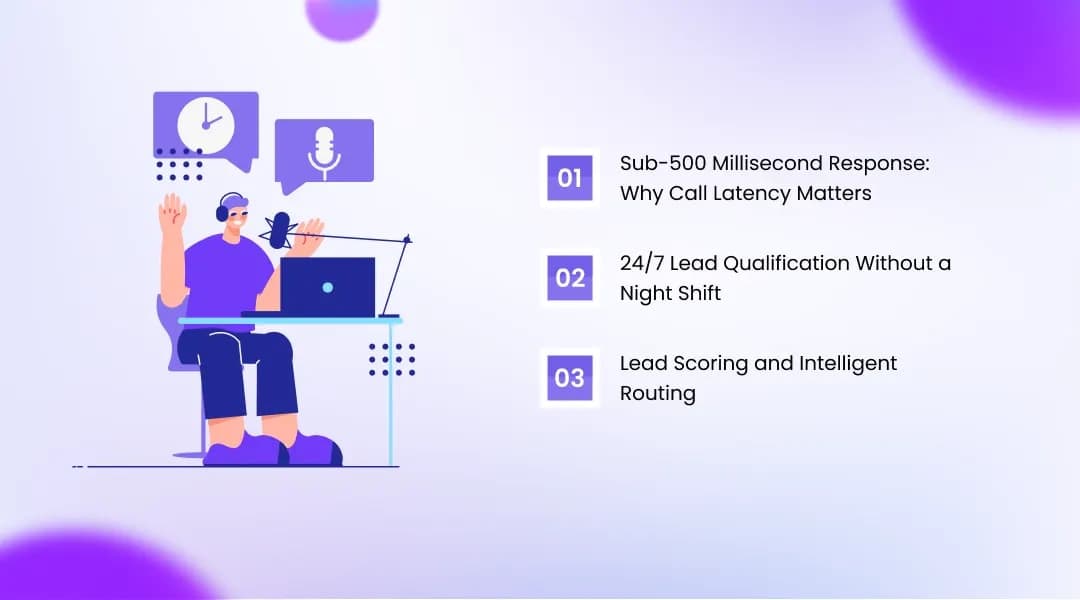
Sub-500 Millisecond Response: Why Call Latency Matters
The naturalness of a voice conversation is heavily dependent on response latency, the gap between when a caller finishes speaking and when the AI responds. Industry research shows that conversations feel unnatural and mechanical when latency exceeds 800 milliseconds, leading to higher call abandonment and lower engagement rates. Only approximately 30% of AI voice deployments achieve what is considered conversational latency in production conditions.
Platforms like OnDial are engineered specifically around this constraint, delivering sub-500 millisecond response latency in live calls. This means the AI responds to what a caller says within half a second, producing a conversation rhythm that feels natural rather than robotic. The commercial importance of this is not merely cosmetic: research tracking AI call campaigns found that agents handling interruptions gracefully and maintaining conversational pace see 31% longer call durations and 18% higher conversion rates compared to agents with noticeable response lag. When you are running high-volume lead qualification campaigns, an 18% difference in conversion rate across thousands of calls is a material revenue number.
24/7 Lead Qualification Without a Night Shift
The single most commercially significant capability of AI voice agents for lead qualification is not their cost efficiency or their quality consistency, although both matter. It is their availability. An AI voice agent deployed for inbound and outbound lead qualification operates continuously, every hour of every day, without any structural penalty for timing. A lead submitted at 11:30pm receives the same quality of immediate response as a lead submitted at 10am on a weekday morning.
OnDial's platform handles both inbound call answering and outbound dialling in this continuous mode, which means businesses using it capture the after-hours leads that their human teams would otherwise lose entirely. For businesses in high-intent categories, where a prospect is comparing multiple vendors simultaneously and will choose the first to make meaningful contact, this 24/7 availability is not a convenience feature. It is the primary competitive advantage.
Lead Scoring and Intelligent Routing
AI voice agents do not simply make calls. They qualify leads against your specific criteria and score each interaction in a structured way that human SDRs often fail to do consistently. During a qualification call, the AI gathers information about the lead's budget range, decision timeline, key requirements, and purchase intent. It then scores this information against your predefined qualification framework and routes the lead appropriately: high-scoring leads go directly to a senior sales representative as a live transfer or urgent follow-up task with full context, while leads that need nurturing are enrolled in an appropriate sequence.
The result is that your human sales team spends its time on conversations that are already qualified. Research tracking automated lead qualification programs found that AI-powered qualification delivered a 56% reduction in unqualified leads passed to sales teams and a 47% reduction in manual qualification time, freeing human capacity for higher-value closing activities.
The Business Case: What the Numbers Actually Look Like
The ROI of AI voice agents for lead response and qualification is one of the clearest economic cases in the current technology landscape, because the problem it solves is precisely quantifiable and the baseline metrics are well-established.
Consider a services business that generates 200 inbound leads per month through a combination of paid search, organic traffic, and referrals. If the business currently has a 40% contact rate on those leads, it is actively engaging with approximately 80 per month and losing 120 to voicemail, late follow-up, and after-hours gaps. At a 20% conversion rate on contacted leads, it closes 16 deals per month. The average deal value in this scenario is £3,000. Monthly revenue from this pipeline: £48,000.
An AI voice agent achieves contact rates of 30% to 40% even on outbound campaigns targeting cold lists, and materially higher rates on inbound leads where the prospect has already expressed interest. If the same business uses an AI voice agent to achieve a 75% contact rate on those 200 leads and maintains the same 20% conversion rate, it closes 30 deals per month. At £3,000 average deal value, that is £90,000 per month, an improvement of £42,000 against a platform investment that typically ranges from $200 to $800 per month depending on call volume. The payback period in this scenario is measured in days, not months.
Industry-Level ROI Evidence
The numbers from real implementations confirm this theoretical case. A regional law firm case study documented by Dialzara reduced missed calls from 40% to 5% and increased monthly qualified appointments from 30 to 72, producing a revenue jump from $37,500 to $80,000 against a $5,200 annual investment, delivering an 8.2 times return on investment. Voice AI deployments tracked in a 2025 industry survey showed 82% of companies reporting positive ROI within the first 12 months, with an average return of 240% across the tracked cohort.
The economic case for outbound AI calling is equally compelling. AI voice agents calling outbound lead lists achieve a cost per call of roughly $0.07 to $0.10, compared to $2.00 or more per call for human representatives when fully loaded employment costs are accounted for. For businesses running high-volume outbound qualification or reactivation campaigns, this cost differential alone makes the investment straightforward. Gartner projects $80 billion in global labour cost savings from AI in customer-facing roles by 2026, reflecting the scale at which this technology is already displacing expensive manual processes.
What AI Voice Agent Lead Response Looks Like Across Industries
The specific mechanics of how AI voice agents address lead response problems varies by industry, though the underlying principle is consistent: respond immediately, qualify systematically, and route intelligently. The speed advantage that matters in real estate, where a Saturday inquiry needs a Saturday response, is the same speed advantage that matters in financial services, healthcare, and high-volume sales operations. What changes is the specific qualification criteria, the integration with industry-specific scheduling or CRM systems, and the language and tone the agent uses to match the caller's context.
In real estate and property management: An AI voice agent responds to property inquiry forms within 60 seconds, asks the prospect about their budget, preferred location, property type, and purchase or rental timeline, qualifies them against the agency's buyer or tenant profile, and either books a viewing into the agent's calendar or flags the lead for urgent follow-up. Prospects no longer wait until Monday morning to hear from an agency they contacted on Saturday afternoon.
In financial services and insurance: An AI voice agent handles inbound policy inquiries and callback requests at any hour, gathers the relevant information from the prospect, and routes genuinely interested callers to a licenced adviser. For outbound campaigns, the AI contacts policyholders proactively before renewal dates, confirms their intention to renew, and flags complex cases for human review.
In healthcare and wellness: An AI voice agent handles appointment booking, new patient intake queries, and follow-up reminders continuously, ensuring that missed calls during busy clinic periods do not translate to lost patients. Inquiries arriving after clinic hours are captured, qualified, and booked for confirmation the following morning.
In sales and lead generation operations, AI calling for sales has fundamentally changed what a lean inside sales team can accomplish. AI voice agents run outbound qualification campaigns at volumes no human team can match, contacting hundreds of leads per hour with consistent quality and delivering only qualified prospects to the sales team. The outbound AI voice agent ROI is especially pronounced for reactivation campaigns on dormant leads, where the cost per contacted lead drops to a fraction of human outbound calling costs. OnDial deploys this model across multiple industries, supporting both API integration and a no-code deployment route for teams without technical resources.
How OnDial Delivers This in Production
OnDial is a platform specifically built for deploying production-grade AI voice agents at the scale and reliability that real business operations require. What distinguishes a production deployment from a demo or pilot is the combination of technical performance, language capability, and integration depth that determines whether the system works at volume in real conditions.
OnDial's sub-500 millisecond response latency ensures that the conversations its agents conduct feel natural rather than robotic, which directly affects engagement rates and lead quality. The platform handles both inbound call answering and outbound campaign dialling, addressing the full spectrum of the lead response problem: capturing leads that call in and pursuing leads that submitted a form without calling.
OnDial supports more than 100 languages, including 9 Indian languages with over 80 Indian voice variations, which matters enormously for businesses operating in markets where callers expect to be served in their regional language. A business with customers across Hindi, Tamil, Bengali, and Marathi-speaking regions cannot deploy a single-language AI agent and expect genuine coverage. OnDial's language architecture means a prospect in Chennai and a prospect in Jaipur both receive a qualification call in their preferred language, directly affecting both contact rates and conversation quality.
The platform integrates with CRM systems and calendar tools, meaning qualification data gathered during each AI call flows directly into your existing sales infrastructure. Lead scores, qualification notes, and booked appointments appear in your CRM in real time, without manual data entry. OnDial is GDPR and CCPA compliant, ensuring that call data, qualification notes, and recordings are managed according to data protection standards across every market the platform serves.
Conclusion
The three most important things to take from this piece are these. First, the cost of slow lead response is not abstract or theoretical. It is measurable, it is significant, and it compounds daily. Businesses that take 47 hours to respond to inbound leads are not just missing a best practice benchmark. They are systematically converting a fraction of the pipeline they have already paid to generate. Second, hiring more people does not structurally solve this problem, because the problem is not one of effort or motivation. It is one of availability architecture. A team of humans cannot be available every hour of every day at the cost and quality consistency that the problem requires. Third, AI voice agents built for production deployment solve this problem at the architectural level rather than patching it at the margin.
OnDial is built specifically for businesses that need AI voice agents to work in real conditions, not in a demonstration environment. With sub-500 millisecond response latency, 100-plus language support, including 9 Indian languages with 80-plus regional voice variations, 24/7 inbound and outbound call handling, lead qualification and scoring, CRM integration, smart analytics, and both API and no-code deployment options, OnDial delivers the infrastructure for genuine always-on lead response that most businesses simply cannot achieve with human teams alone.
If your business is generating leads but losing a significant portion of them to slow follow-up, voicemail, and after-hours gaps, the solution is available and the economics are clear. Schedule a demo with OnDial to see exactly how the platform would work for your specific lead volumes, industry context, and qualification requirements.