I’ve walked into call centers where the tension was thick enough to cut with a knife.
Agents juggling five screens. Supervisors firefighting escalations. Customers waiting. And waiting. And waiting.
And somewhere in the boardroom? A spreadsheet screaming about rising support costs.
This is where conversations about AI agents for customer support usually begin. Not with excitement. With pain.
If you’re a CEO, a CX leader, or an operations head, you’re probably asking yourself a quiet question:
Can AI actually fix this? Or is this just another vendor promise?
Let’s strip the hype away.
What Are AI Agents for Customer Support?
When I talk about AI customer support agents, I’m not talking about glorified decision trees.
I’m talking about systems that can understand intent, process context, access backend systems, and respond naturally, across voice and chat.
Modern AI-powered customer support solutions combine:
Natural Language Understanding (NLU)
Speech recognition (for AI voice agents for customer support)
CRM and ticketing integrations
Workflow automation
Real-time analytics
The result? An intelligent virtual agent that doesn’t just answer questions. It resolves them.
These conversational AI agents for support can handle order tracking, appointment scheduling, password resets, KYC verification, refund processing, and even complex multi-step flows.
And yes, they can manage both chat and Customer Calls.
But here’s the key.
The goal isn’t to replace humans.
It’s to redesign customer service automation so humans focus on nuance, empathy, and judgment.
AI Agents vs Traditional Chatbots: What’s the Difference?
Let me be blunt.
Most early chatbots were frustrating.
They matched keywords. They failed under pressure. They escalated everything.
That’s why the debate around AI agents vs chatbots still matters.
Traditional Chatbots:
Script-based
Limited memory
Poor contextual understanding
Often siloed
AI Support Agents:
Context-aware
Connected to backend systems
Capable of voice and chat
Continuously learning
An AI chat agent can understand, “My order hasn’t arrived,” even if the customer types it five different ways.
An advanced AI voice agent for customer support can handle AI Phone Calls, authenticate users, check order status, and update records without human intervention.
Big difference.
(And if you’ve ever yelled “Representative!” into a phone, you know exactly why this matters.)
Key Benefits of AI Agents in Customer Support
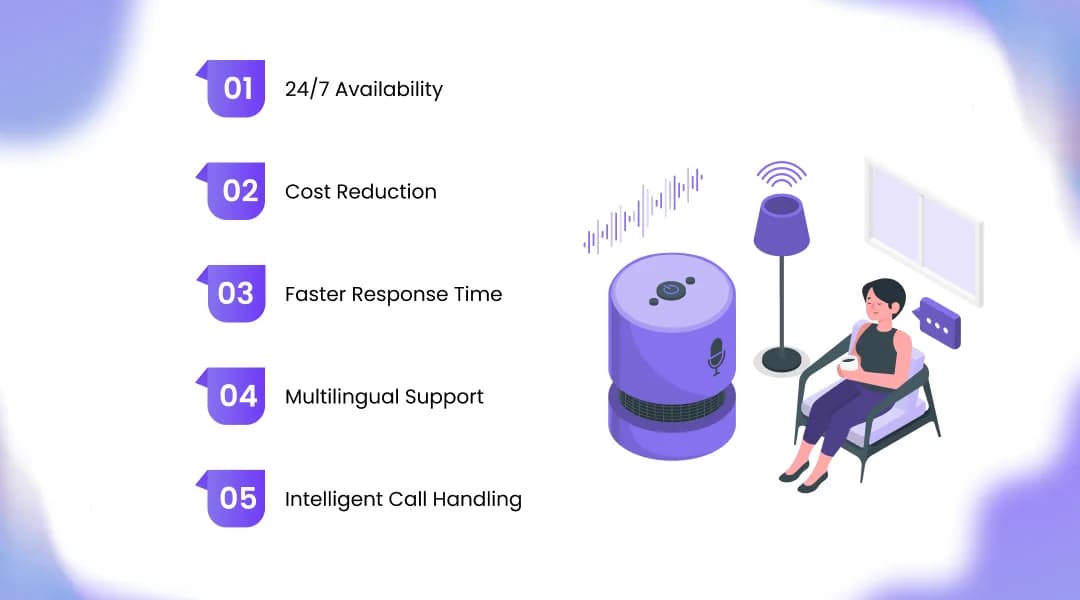
24/7 Availability
Your customers don’t operate on your office hours.
A 24/7 AI support system ensures someone—or something intelligent—is always available.
I’ve seen e-commerce brands reduce cart abandonment simply because their AI support bots answered delivery queries at 2 AM.
Sleep is optional. For machines.
Cost Reduction
Let’s talk numbers.
Support salaries, training, infrastructure, attrition—it adds up fast.
When implemented correctly, customer support automation with AI can reduce tier-1 ticket volume by 40–70%.
That’s how you truly reduce support costs with AI.
Not by firing everyone. By reallocating humans to high-value interactions.
Faster Response Time
Speed is perception.
An AI agent replies instantly. No queue. No hold music.
And when integrated properly into AI customer service software, it pulls real-time data from CRMs, ERPs, or payment systems.
Response time drops. CSAT climbs.
Simple math.
Multilingual Support
Hiring multilingual agents is expensive.
Training them consistently? Even harder.
AI doesn’t struggle with language switching. A single omnichannel AI support system can support English, Hindi, Spanish, Arabic, whatever your customer base needs.
That's a global scale without global payroll.
Intelligent Call Handling
The voice is different.
It’s emotional. Immediate. Personal.
Modern AI call center solutions can triage calls, authenticate users, detect urgency, and route intelligently.
The Role of AI Call Agents isn’t to create robotic conversations. It’s to remove friction.
And the best AI Voice Assistants today? They sound surprisingly human.
Scary? Maybe. Impressive? Definitely.
How AI Voice Agents Are Transforming Call Centers
I’ve overseen deployments where 60% of inbound AI Phone Calls were resolved without human escalation.
Not theoretical. Operational.
With the right Best AI Voice Agent Platform, call centers can:
Automate appointment confirmations
Handle balance inquiries
Manage KYC processes
Provide policy details
Capture structured data
For BPOs, this is survival.
For enterprises, it's a strategic advantage.
And when you Hire AI Voice Agents thoughtfully, designed around real call flows, not marketing slides, the results compound fast.
Real-World Use Cases of AI Agents Across Industries
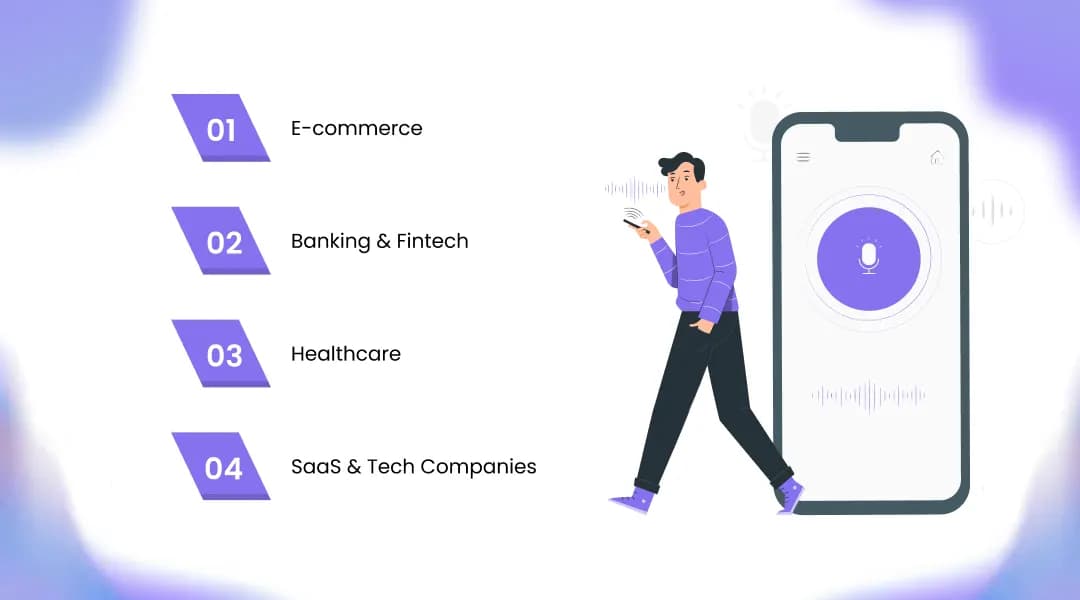
E-commerce
Order tracking. Refund requests. Delivery updates.
An AI support for e-commerce system handles repetitive queries while humans focus on escalations and VIP customers.
Peak season? No panic hiring.
Banking & Fintech
Compliance matters.
AI agents authenticate users, handle transaction queries, and escalate sensitive cases.
Are AI customer support agents secure and compliant for banking and healthcare?
They can be, if built correctly. Encryption, audit logs, role-based access, data governance.
This is where working with a seasoned partner matters. (Transparency isn’t optional in fintech.)
Healthcare
Appointment scheduling. Prescription reminders. Insurance queries.
An intelligent Voice Assistant reduces call congestion and ensures patients get timely information.
Missed appointment rates drop. Staff burnout decreases.
That’s operational relief.
SaaS & Tech Companies
SaaS businesses drown in tickets.
Password resets. Onboarding queries. Billing clarifications.
AI-driven customer experience systems automate the predictable and escalate the complex.
And if you’re scaling globally? Conversational AI for enterprises becomes infrastructure—not an experiment.
How to Implement AI Agents in Your Customer Support System
Here’s where most companies stumble.
They buy software. They don’t design systems.
Step 1: Map your top 20 repetitive queries. Step 2: Define resolution workflows. Step 3: Integrate CRM, ticketing, and backend APIs. Step 4: Pilot with limited scope. Step 5: Measure containment rate, CSAT, and cost per ticket.
Want to know how to implement AI voice agents in a call center successfully?
Start small. Prove value. Expand.
And please, choose a partner that behaves like a collaborator, not a vendor. Companies like OnDial, known as a Best AI Development Company in voice AI, focus on tailored deployments instead of generic templates.
That difference shows up in outcomes.
Common Challenges & How to Overcome Them
Poor training data
Lack of backend integration
Over-automation
Employee resistance
Let me pause here.
Your agents are not your enemy. They’re your insight source.
Involve them in design. Ask what questions they answer repeatedly.
(You’d be shocked how much wisdom sits on your frontline.)
The Future of AI Agents in Customer Experience
We’re moving toward proactive support.
AI won’t just react. It will be anticipated.
Imagine your system detecting delayed shipment data and notifying the customer before they even ask.
That’s where call center AI automation is heading.
The winners won’t be the companies with the flashiest bots.
They’ll be the ones who combine intelligence with empathy.
Technology with intention.
Conclusion
If you’re still skeptical, I get it.
I was, too.
But after 15 years building and auditing automation systems, I’ve learned this:
AI agents for customer support aren’t about replacing people.
They’re about redesigning experience.
When executed thoughtfully, especially with voice-first expertise like OnDial brings, they create clarity. Scale. Stability.
And maybe, just maybe…
They let your support team breathe again.