Voice AI costs roughly $0.40 per call. A human agent handling the same call costs between $7 and $12. That gap, a 90 to 95 percent cost reduction per interaction, documented by CX Today, tells you exactly why businesses are moving quickly toward AI call center software. Not because it's trendy. Because the economics are undeniable.
But here's what the headlines miss. The real story isn't the cost difference. It's the capability difference. The AI call center software category has moved far beyond scripted bots and rigid menu trees. Today, it includes conversational AI that understands natural language, sentiment analysis that detects frustration in real time, and voice AI platforms that can handle complex, multi-turn customer conversations end to end without a single human agent on the line.
If you're a business leader evaluating this space, you're probably somewhere between curious and overwhelmed. You've seen the vendor promises. You've heard that AI will "transform" your contact center. What you actually want to know is: what does this technology do, does it work in the real world, and how do you choose the right solution for your specific situation?
That's exactly what this guide covers. You'll learn how AI call center software works under the hood, the specific capabilities that drive real ROI, the critical gap between adoption and actual integration that most businesses fall into, and the practical framework for selecting a voice AI platform that fits your operation.
What AI Call Center Software Actually Is (and Isn't)
AI call center software is a category of technology that uses machine learning, natural language processing (NLP), speech recognition, and predictive analytics to automate, assist, and improve customer support interactions across voice and digital channels.
That definition is clean and quotable. But the more useful framing is this: AI call center software is what happens when you replace a rigid phone tree "press 1 for billing, press 2 for support" with a system that can listen, understand intent, and take action based on what a customer actually says.
The category breaks into two distinct modes, and confusing them is one of the most common and costly mistakes businesses make:
Agent-assist AI sits alongside your human agents and helps them work faster. It transcribes calls in real time, surfaces relevant knowledge articles, suggests next-best responses, and auto-generates call summaries after the conversation ends. The human is still on the call. AI is the co-pilot.
Autonomous voice AI handles calls independently. It answers, understands the customer's request, retrieves data from integrated systems, resolves the issue, and closes the call without a human ever picking up. When complexity exceeds its capability, it transfers to a live agent with full context attached.
Both modes belong in a mature AI contact center strategy. The mistake is deploying one when you needed the other.
What AI Voice Assistants Actually Do in a Call Center
Handling Routine Calls Without a Human Agent
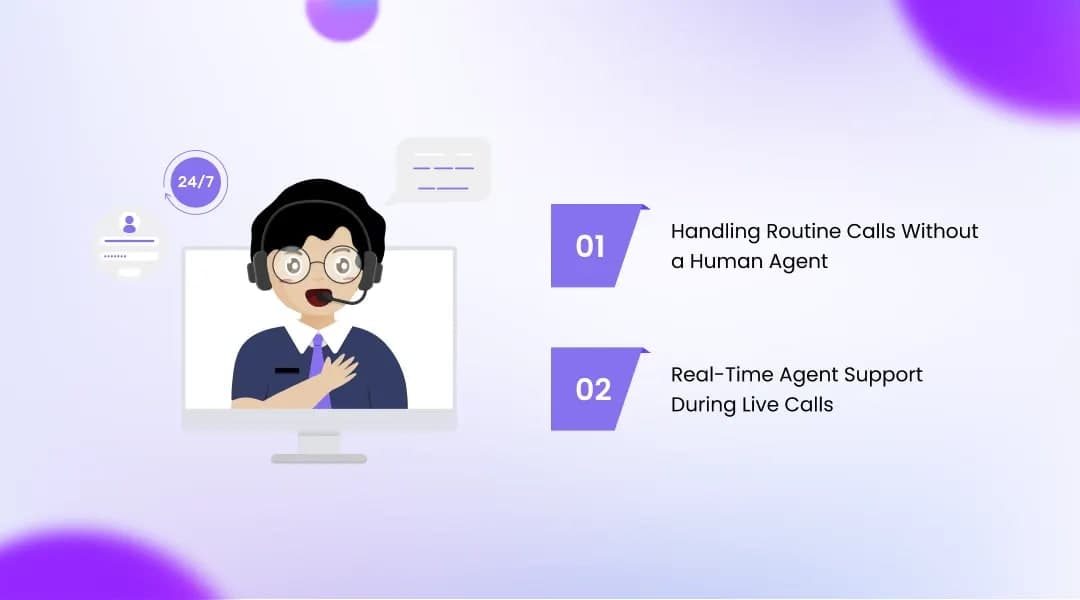
Think about the actual call mix in a typical support center. A large share of inbound calls estimates range from 40 to 70 percent, depending on the industry, and are routine: order status checks, appointment scheduling, password resets, account balance inquiries, FAQs, and refund status updates. These calls are repetitive, time-consuming, and deeply unsatisfying for experienced agents to handle at scale.
AI voice assistants are built specifically for this tier. They pick up instantly (no hold time), understand the customer's request in natural language, retrieve the relevant information from your CRM or backend systems, and close the call. IBM reports that organizations can contain up to 70 percent of calls without any human interaction using AI-powered virtual agents, saving an estimated $5.50 per contained call.
I've seen this pattern play out across projects at OnDial. The businesses that see the fastest ROI are those that first map their actual call volume by type, identify the highest-frequency low-complexity calls, and deploy AI voice agents specifically against that segment. It's a focused approach, not "AI everywhere," but "AI where it generates the clearest return."
Real-Time Agent Support During Live Calls
For calls that do reach a human agent, AI doesn't clock out. Real-time agent assist tools listen to the conversation as it happens and provide live coaching cues: suggested responses, compliance reminders, knowledge base excerpts, and sentiment alerts when a customer's tone shifts toward frustration.
The performance gains from this layer are documented and consistent. Research from the National Bureau of Economic Research shows customer service teams using AI agents see productivity rise by an average of 14 percent. AI-assisted contact centers also report a 9 percent reduction in average handle time (AHT) and a 14 percent increase in issues resolved per hour, according to Zoom's published deployment data.
Post-call, AI takes over the administrative work that consumes agent time: auto-generating call summaries, logging dispositions, and updating CRM records. This is the unglamorous part of AI in call centers, and it's often the part that drives the most immediate agent satisfaction improvement.
How Conversational AI Transforms the Customer Experience
From IVR Phone Trees to Actual Conversations
Here's a counterintuitive truth: the thing customers hate most about calling customer support isn't the wait time. It's the feeling that the system isn't listening to them.
Legacy IVR (Interactive Voice Response) systems route based on keyword detection and rigid decision trees. A customer says, "I need help with my bill." The system catches "bill," routes to billing, and drops them into another queue. If they say "I'm really frustrated about my account," the system catches nothing meaningful and either loops back or transfers blindly.
Conversational AI, built on large language models (LLMs) and NLP, processes the full semantic content of what a customer says. It extracts intent, entities, and emotional tone simultaneously. When a caller says, "I've been waiting three days for my refund, and I'm frustrated," a conversational AI system extracts intent (refund status check), entity (3-day timeframe), and sentiment (negative, frustrated) and adjusts its response accordingly. That's the difference between keyword matching and actual understanding.
This shift is not incremental. It's structural. And it's why Gartner defines voice AI as a subset of conversational AI that transforms voice into a dynamic customer experience channel, not just a routing mechanism.
The Emotional Intelligence Layer Most People Miss
Can AI actually handle emotional calls? This is the question I hear most often from business leaders who are otherwise convinced by the efficiency case.
The honest answer: modern voice AI is considerably better at this than most people expect, and still not perfect. The best platforms include sentiment detection that monitors shifts in tone in real time. When frustration or distress signals are detected, the system can adjust pacing, soften language, and escalate critically to a human agent with full conversation context already transferred, so the customer never has to repeat themselves.
According to Boston Consulting Group, 43 percent of customers say they're genuinely excited about AI, and of those who've already interacted with call center AI, 75 percent believe it will positively improve their future customer service experiences. The fear of robotic, impersonal interactions is real and valid. The data suggests it's also declining as the technology improves.
What matters practically: the best AI call center software doesn't try to fake human empathy. It handles what it's built to handle, and transfers gracefully when it shouldn't. Smooth escalation, not zero escalation, is the actual benchmark.
The Real Business Benefits of AI Call Center Software

Cost Reduction That Shows Up on the P&L
Gartner predicts conversational AI will reduce contact center labor costs by $80 billion in 2026. That's the headline figure, and it's important to understand why the number is that large.
It's not because AI is replacing entire customer service departments. It's because the economics of scaling support without AI are brutal. Annual employee turnover in call centers runs at 40 to 45 percent, nearly three times the average for other industries (Digital Minds BPO, 2026). Hiring, training, and replacing agents is a constant and expensive operational drag. AI contains calls that would otherwise require staffed headcount, which means that as call volume grows, your cost per interaction falls rather than rises.
NIB Health Insurance offers a sharp real-world example: by deploying AI-driven digital assistants, the company saved $22 million through a 60 percent reduction in customer service costs and a 15 percent decrease in agent-handled phone calls. That's a measurable, audited outcome, not a vendor promise.
Scale Without Headcount: The Asymmetry AI Creates
This is the benefit that most articles understate, and it deserves its own section.
Traditional call centers scale linearly. More calls mean more agents. Peak periods mean overstaffing. A sudden volume spike, a product recall, a flight cancellation event, or a billing system outage means calls go unanswered or wait times explode.
AI call center software creates asymmetric scale. An airline dealing with mass flight cancellations can instantly deploy voice AI to handle 50,000 concurrent callers without overstaffing for a scenario that may happen twice a year (Computer Weekly, 2026). The system handles the volume. Costs don't spike in proportion.
For businesses in growth mode, particularly those scaling cross-border, managing multilingual customer bases, or serving markets across time zones, this asymmetry is not just operationally useful. It's strategically essential. At OnDial, many of the businesses we work with are India-based companies serving global customers, or international businesses expanding into Indian markets. The ability to deploy a voice AI platform that handles calls in multiple languages, across time zones, without building out parallel human teams in each region, that's where the real competitive leverage sits.
The Gap Between Adoption and Resolution: Where Most Businesses Get Stuck
Why 88% Adoption Doesn't Equal 88% Success
Here's the stat that changes how you should think about this entire category: 88 percent of contact centers report using some form of AI. But only 25 percent have fully integrated AI automation into daily operations (multiple corroborating sources, including IBM and Lorikeet CX research, 2026).
That gap, 88 percent deployment, 25 percent integration, is the most important story in AI call center software right now. And it explains why so many businesses say they've "tried AI" without seeing meaningful results.
Adoption is easy. You can deploy a chatbot in an afternoon. Integration is hard. It requires connecting your AI layer to your CRM, your ticketing system, your knowledge base, and your escalation workflows. It requires defining what "success" looks like at each interaction tier. It requires training your human agents to work alongside AI, not against it.
The Puzzle State of Contact Centres 2026 report found that only 3 percent of contact centers operate on a single unified platform, while the average organization manages 3.9 different contact center technologies. That fragmentation is a structural drag on AI performance; the AI can only be as good as the data and systems it can access.
What Genuine Integration Actually Looks Like
Real integration means your AI call center software can do three things simultaneously. First, it handles customer-facing interactions, answering calls, resolving common requests, and managing self-service flows. Second, it supports human agents in real-time surfacing context, suggesting responses, and flagging sentiment shifts. Third, it analyzes 100 percent of interactions for operational intelligence, identifying recurring complaint patterns, coaching opportunities, and performance gaps.
When all three layers operate together, the contact center becomes what one Invoca analysis aptly describes as "a data-driven engine for stronger customer experiences and better business outcomes." It's no longer a cost center you manage. It becomes a function that generates insight.
That's a genuinely different way of running customer support. And it's not achieved by deploying a single tool. It's achieved by making AI the connective tissue of your entire support operation.
How to Choose the Right Voice AI Platform for Your Business
Questions to Ask Before You Commit
Before you evaluate a single vendor, answer these questions about your own operation:
What does your call mix actually look like? If 40 percent or more of your inbound calls are routine confirmations, FAQs, or appointment scheduling, autonomous voice AI is worth evaluating seriously. If most calls are complex and emotionally driven, agent-assist AI delivers a better return.
What systems does your AI need to connect to? Your CRM, ticketing platform, and knowledge base are non-negotiable integration targets. A voice AI platform that can't read your customer history in real time is just a sophisticated phone tree.
What are your compliance requirements? Healthcare needs HIPAA compliance with a BAA. Financial services need SOC 2 and data residency controls. These should be in the base product, not a premium tier add-on.
What does the handoff look like? Seamless escalation from AI to human with full context transferred is the single most important experience quality indicator. Test this in any trial before you make a decision.
What's the latency? For voice AI, conversation feels natural when end-to-end latency is under 700 milliseconds. Above that, callers notice the pause. Ask vendors for documented latency across real production deployments, not lab conditions.
Red Flags That Signal a Poor Fit
There are vendors in this market who are deploying yesterday's IVR logic with a new AI coat of paint. The tell is in the trial experience: if the system breaks when a caller interrupts, changes topics, or uses informal language, the natural language understanding is superficial.
A few specific red flags to watch for: vendors who can't provide documented containment rates from real deployments; platforms that charge compliance certifications as separate enterprise SKUs; solutions that require an 8-to-16 week implementation before you can take a single live call; and any demo that uses only pre-scripted, perfectly phrased customer inputs. Real calls are messy. Your AI needs to handle a mess.
The EZY Calls benchmark for this is straightforward: during your trial, throw the hardest calls at it. Confused customers, complex questions, frustrated callers. Good AI feels natural and solves problems. Bad AI frustrates everyone, and agents work around it.
At OnDial, our approach to this evaluation has always been grounded in one principle: the technology should solve a real communication challenge, not create a new one. A voice AI platform that costs less but generates more escalations isn't saving you money. It's redistributing cost while adding friction.
Conclusion
AI call center software is not a future investment. It is a present-tense operational decision. The cost case is clear: voice AI runs at $0.40 per interaction versus $7 to $12 for a human agent. The capability case is equally clear: modern conversational AI handles routine calls end to end, supports human agents in real time, and converts every interaction into actionable operational intelligence.
The businesses that see results are not the ones that deployed AI first. They're the ones who integrated it properly: connecting their voice AI platform to live systems, defining clear escalation paths, and treating AI and human agents as a unified workforce rather than competing models.
If you're evaluating AI call center software for the first time or trying to understand why a previous deployment didn't deliver, the place to start is with your call mix, your integration requirements, and an honest assessment of what your current operation can actually absorb.
At OnDial, we build voice AI solutions for businesses that want to scale smarter without sacrificing the human quality that customers still expect from meaningful interactions. If you're ready to see what a tailored, production-ready voice AI deployment looks like for your specific support operation, we'd welcome a direct conversation about what you're trying to solve.