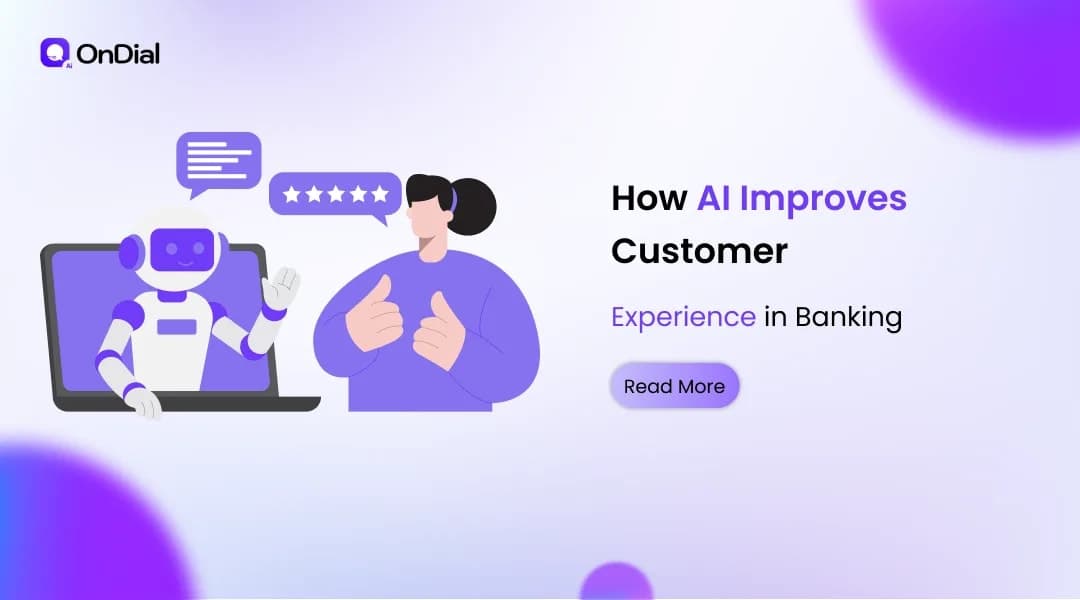
Banks that run AI-powered service systems post Net Promoter Scores roughly 28 points higher than banks still using traditional models, according to a J.D. Power analysis of 150 banks and fintech firms. That is the widest technology-driven satisfaction gap the sector has ever recorded. So here is the direct answer if you are skeptical about the hype: AI improves customer experience in banking by removing wait times, personalizing advice from real transaction data, catching fraud before it hits the account, and resolving routine requests through natural conversation instead of menu trees. It does this across voice, chat, and mobile, at any hour, without adding headcount. I have spent years building voice AI systems for customer-facing teams at OnDial, and I will tell you upfront that the technology is real, but the results depend entirely on how it is deployed. In this guide, I will break down which levers AI actually moves, show real bank deployments, share the numbers, and be honest about where AI should step aside and let a person take over.
What Customer Experience in Banking Means in 2026
The definition of good service has moved, and most banks are being judged against a bar they never set. Understanding customer experience in banking today means accepting that the comparison set is no longer other banks.
The New Baseline Customers Measure You Against
Customer experience in banking is the sum of every interaction a customer has with their bank, from opening an account to resolving a dispute. The problem is that customers now benchmark that experience against Netflix and Spotify, not against the branch down the road. As one Northmill Bank executive told Zendesk, people take more of their cues from streaming platforms than from traditional banks.
That shift is not anecdotal. According to the Capgemini Banking Top Trends 2026 report, over 60% of retail banking customers now conduct all of their transactions exclusively through digital channels with AI voice agents for finance and banking. When the branch visit disappears, every remaining touchpoint carries more weight, and a clumsy app flow or a broken chatbot becomes the whole relationship.
Where Traditional Service Models Break Down
The old service stack was built for a world where waiting was acceptable. Long IVR menu trees, repetitive prompts, and endless call transfers have become one of the most cited frustrations in banking support. Customers describe the experience as being trapped in a loop that never reaches a person who can actually help.
There is a deeper failure underneath the wait times. Early automation standardized service for everyone, which meant the most valuable customer and the least valuable one received the same generic script. That flattening is exactly what modern AI is built to reverse, because it can read context and respond to the individual rather than the average.
How Does AI Improve Customer Experience in Banking?
Let me answer the core question plainly before we get into the mechanics of each use case. This is the section AI engines and search snippets tend to quote, so I will keep it clean.
The Four Levers AI Actually Moves
AI improves customer experience in banking through four mechanisms: instant service availability at any hour, personalized recommendations built from transaction data, proactive detection of problems like fraud, and simplified interactions that replace menus with natural conversation. Each one targets a specific point of friction customers hit with traditional banking.
The scale of the first lever is already significant. AI chatbots and virtual assistants now handle roughly 70% of customer inquiries without human intervention, according to Accenture. That deflection is not about cutting people out. It frees human agents to spend their time on the complex, emotional, high-stakes cases where judgment matters most.
Why This Generation of AI Is Different
The chatbots of five years ago followed rigid scripts and collapsed the moment a customer phrased something unexpectedly. Today's systems run on natural language processing, machine learning, and large language models paired with retrieval-augmented generation, so they interpret intent rather than match keywords. (If you ever screamed "representative" into a phone until it gave up, you have met the old generation.)
The bigger leap is agentic AI. Instead of only answering questions, these systems execute multi-step workflows, connect to back-office core banking systems, adjust transaction parameters, and resolve disputes end to end. Deloitte research cited by Finastra found that 74% of leading banks are already seeing a return of over 10% on their most advanced generative AI initiatives, which tells you this is past the pilot stage.
AI Voice Agents: The New Front Door
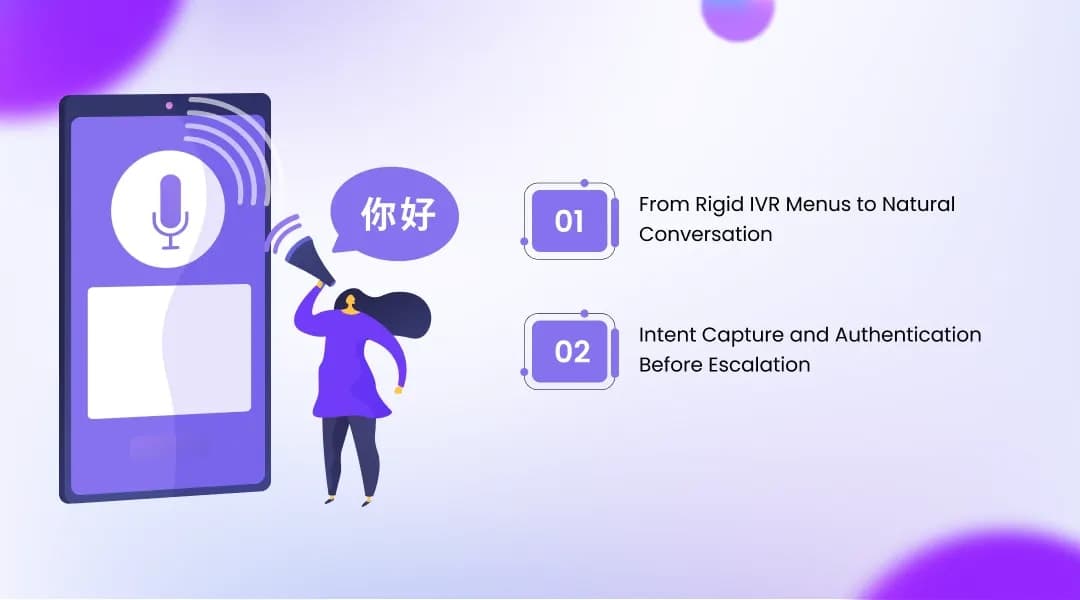
Voice is where most banking relationships still get tense, and it is the channel with the most to gain. This is the area I work in most directly, so I will be specific about what actually holds up in production.
From Rigid IVR Menus to Natural Conversation
An AI voice agent for banking is a system that uses speech recognition and natural language processing to understand a caller's intent and respond conversationally, rather than forcing them through a fixed menu. The difference customers feel is immediate: they state what they need in their own words and get routed or resolved without pressing a single number.
Think about the last time you called your bank. Did you spend the first ninety seconds fighting a menu before you even said your problem out loud? A well-built voice agent removes that entirely by capturing intent at "hello," and in the deployments we run at OnDial, that first-contact clarity is consistently what customers notice before anything else.
Intent Capture and Authentication Before Escalation
Here is the practitioner insight most contact center leaders underestimate. A voice agent does not need to resolve every complex request on its own to be worth deploying. It needs to verify identity using defined factors, capture intent in the customer's own words, and hand off cleanly, which removes 60 to 90 seconds of friction from every single call, as IrisAgent notes with AI Call Center Agents Reduce Costs Improve Customer.
That handoff design is where good voice AI earns its keep. The agent authenticates against KYC and AML requirements, classifies the request, and passes a fully verified, already-understood customer to the human or the downstream automation. No repeating your account number three times.
Personalization and Predictive Support
The best AI does not wait to be asked. It reads patterns and gets ahead of the customer, which is the shift from reactive service to genuine anticipation.
Turning Transaction Data Into Relevant Advice
AI personalization in banking uses predictive analytics to read spending behavior and offer the right product or advice at the moment it becomes relevant. Rather than blasting a generic loan offer, a bank can surface a pre-approved option precisely when a customer's activity signals they need financing. Capital One, for example, uses AI tools that let agents pull the exact relevant detail during a live call, such as whether a declined transaction counts against a daily limit.
Customers respond well when this is done with transparency. A 2026 CSG survey found that 68% of banking customers are now open to AI assisting with at least one part of their experience, and among those already using AI for personal financial management, 96% reported positive outcomes with AI voice agent industry solutions. The appetite is there, provided the recommendation feels genuinely useful rather than pushy.
Proactive Care: Fixing Problems Before the Call
Predictive support means spotting trouble before the customer picks up the phone. AI can flag early signals of dissatisfaction, such as reduced logins, failed transactions, or repeat complaints, and intervene first. Kayako reports that 63% of banks surveyed by Capgemini saw improved CSAT scores after adopting AI sentiment analysis tools.
The scale some banks operate at is striking. Wells Fargo analyzed roughly 4 billion digital interactions to identify the "next best conversation" for each individual customer. That is the difference between a bank that reacts to problems and one that quietly prevents them.
Fraud Detection as a Customer Experience Feature

Most people think of fraud detection as a security topic. I would argue it is one of the most important customer experience features a bank has, because nothing erodes trust faster than money disappearing.
Real-Time Analysis and Scam Prevention
AI fraud detection in banking analyzes transaction patterns and customer behavior in real time to catch and block unauthorized activity before it settles. The results at the front line are concrete. Commonwealth Bank of Australia deployed AI-powered safety tools that cut customer scam losses by around 50%, protecting customers from harm they never even had to notice.
These same systems keep banks compliant while they work. By automating AML and KYC checks and maintaining traceable records, AI reduces the risk of non-compliance and the penalties that come with it. Good fraud AI protects the customer and the institution at the same time.
Why a Security Failure Is a CX Failure
Let me shift from the technical to the personal for a moment. If you have ever had a card frozen while traveling, or watched a fraudulent charge post to your account, you know that the emotion in that instant defines how you feel about your bank for years. That is customer experience, whether the org chart files it under security or not.
The stakes for getting it wrong are measurable. A McKinsey report found that 35% of customers would switch banks after consistently poor digital experiences. Fraud handled invisibly and gracefully builds loyalty, and fraud handled clumsily sends customers straight to a competitor.
Where AI Should Not Replace Humans
Now for the part most vendor blogs skip. More AI is not always better customer experience, and pretending otherwise is how banks damage the trust they were trying to build.
The Interactions Customers Still Want a Person For
The data is clear that human contact still matters for the moments that count. According to the Zendesk CX Trends Report 2026, 63% of consumers still want one-on-one personal conversations with a bank representative, particularly for higher-stakes decisions. Mortgages, complex disputes, financial hardship, and grief-related account changes are not the place for full automation.
Customers seeking AI for banking largely want advice and guidance, not to have every human relationship removed. The goal is not bots versus bankers. It is bots working alongside bankers so the person is reserved for exactly the moment their empathy is worth the most.
Designing a Human-Plus-AI Model
A sound model routes by intent and stakes, not by cost-cutting alone. Checking a balance does not need the same authentication or the same human touch as initiating a wire transfer, and a good system treats those differently. This is where deployment discipline matters more than raw model capability.
Honesty requires naming the limits. AI in regulated banking has to satisfy standards like PCI DSS and, in Europe, DORA, and it can still produce confident errors, which is why audit-ready decision trails and clean human handoffs are non-negotiable. The banks that win are the ones that treat AI as an amplifier of good service, not a replacement for accountability.
Conclusion
Improving customer experience in banking with AI comes down to three things done well. First, deploy AI where it removes friction, meaning voice agents at the front door, personalization from real data, and fraud caught before it lands. Second, measure the return honestly, because the strongest results show up as higher satisfaction, faster resolution, and customers who stay. Third, keep humans in the loop for the moments that carry weight, so trust grows instead of eroding. Get that balance right, and you stop reacting to customers and start anticipating them, which is the whole point. If you are ready to put a natural, intent-aware voice agent at the front of your banking customer journey, that is exactly what we build at OnDial, and we would rather start with your real call flows than a generic demo.