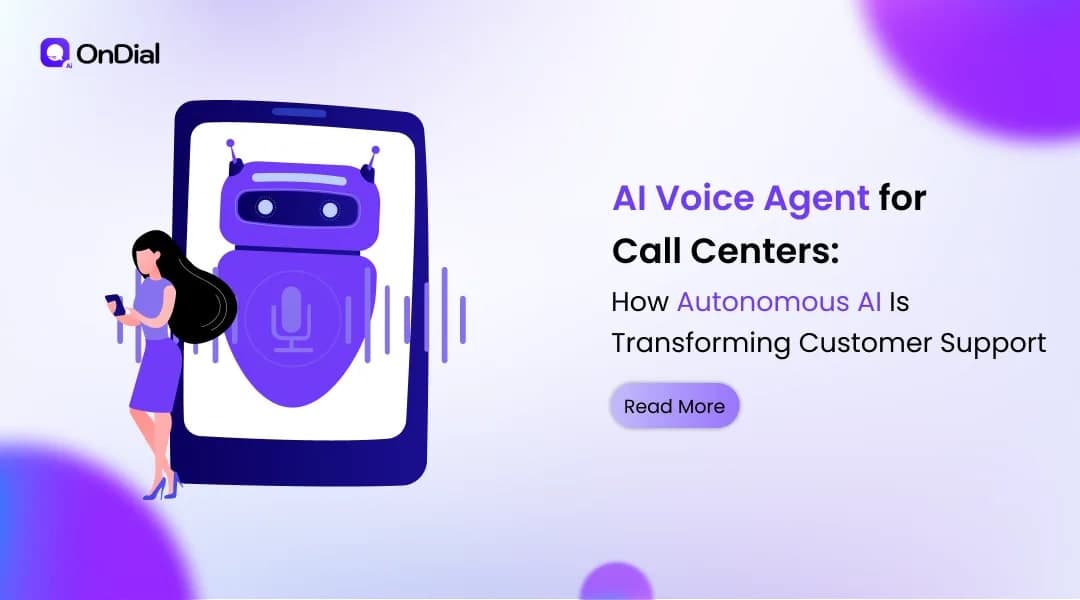
Here is the number that stops every contact center leader mid-sentence. An AI-handled call resolution costs roughly $0.62, while the same call handled by a human costs about $7.40, according to McKinsey's 2026 AI in Customer Service analysis. Yet in the same market, close to four out of five customers still say they would rather speak to a person, per SurveyMonkey. Both facts are true at once, and that tension is exactly why an AI voice agent for call centers is so widely misunderstood. An AI voice agent for call centers is an autonomous system that listens, understands natural speech, holds a real conversation, and completes tasks like checking an order or booking an appointment without a menu tree or a human picking up.
If you are weighing whether this technology is real or just louder marketing, that skepticism is healthy. I have spent years building voice AI at OnDial, and I have watched it both succeed and fail in production. This guide walks through how it actually works, how it differs from legacy IVR, what the economics truly are, the India-specific compliance reality most vendors skip, and the exact point where a human still wins. By the end, you will know which calls to automate first.
What Is an AI Voice Agent for Call Centers?
An AI voice agent for call centers is software that answers phone calls, understands what a caller means in plain language, and resolves the request end to end. It is the core of what people now call autonomous AI customer support. Unlike a recorded menu, it does not route and hope. It resolves.
The technology stack behind autonomous AI customer support
Underneath the natural conversation sits a specific chain of components, and knowing them helps you judge any vendor honestly.
ASR (Automatic Speech Recognition): converts the caller's speech into text in real time, even over a noisy mobile line.
NLU (Natural Language Understanding): figures out intent, so "I want to change the address on my order" becomes a structured action, not a keyword guess.
LLM (Large Language Model): drives the reasoning and the reply, deciding what to say and which system to check next.
TTS (Text-to-Speech): turns the response back into a natural voice the caller hears.
SIP trunking and CRM integration: connect the agent to your existing phone numbers and customer records so it can actually complete tasks.
The quality of a voice agent lives in how tightly these pieces work together, especially latency. Production-grade systems answer within roughly 600 to 900 milliseconds of the caller finishing a sentence. Below 400ms feels eerily human, and above 1.2 seconds the call starts to feel broken. That single number separates a demo that impresses from a deployment customers trust.
Autonomous resolution versus simple call deflection
Here is a distinction most buyers miss, and it costs them. Deflection means pushing a caller off the phone line. Resolution means solving their problem on that call.
Many early systems were measured on deflection, which rewarded getting people to hang up rather than helping them. A real autonomous AI customer support system is measured on first-call resolution and average handle time instead. In practice, a well-configured voice agent can resolve a defined request such as order status, balance checks, or appointment booking without a single human touch. That shift, from deflect to resolve, is the whole story of why this technology matters now.
AI Voice Agent vs IVR: Why the Old Phone Tree Is Finally Dying
The clearest way to understand an AI voice agent vs IVR is to remember your own worst hold experience. A T-Mobile survey once found that 40% of customers would rather clean a toilet than deal with an IVR. That is not a technology being tolerated. That is a technology being endured.
Featured answer: The difference between an AI voice agent and IVR is that IVR routes calls through fixed keypad menus and fails the moment a caller says something unexpected, while an AI voice agent understands natural speech, interprets intent, and resolves the request conversationally. IVR deflects. An AI voice agent resolves. Voice AI resolves around 55% of calls without a transfer, compared with roughly 25% for legacy systems.
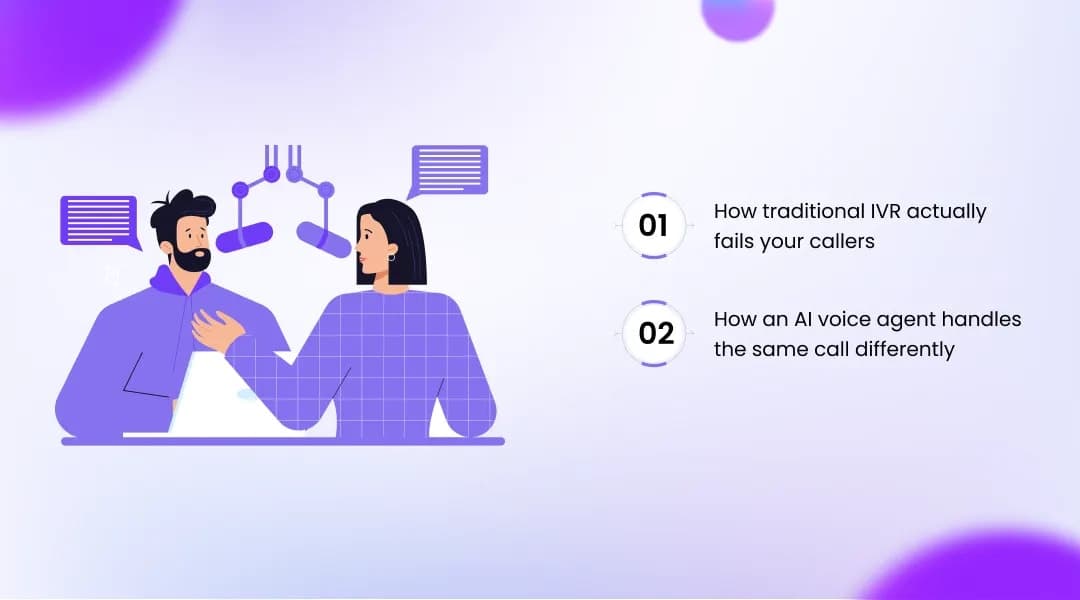
How traditional IVR actually fails your callers
IVR was built for a world of low call volumes and simple routing, and it breaks under modern demand. The failure points are structural, not cosmetic.
The menu never fits: 65% of callers say the reason they are calling is not even listed as an option, and 63% resent being forced through irrelevant menu prompts.
No memory: every menu step treats the caller as a blank slate, forcing them to repeat account numbers again and again.
It cannot act: classic IVR can route a call, but it cannot look up an order, update a record, or process a payment on its own.
Phone calls still make up nearly 70% of contact center volume, and cost per call recently hit a five-year high. When your most expensive channel runs on your most frustrating technology, the math eventually forces a change.
How an AI voice agent handles the same call differently
Picture a caller who says, "I need to check my last payment and update my mailing address." An IVR cannot parse that. An AI voice agent interprets both intents, executes them in sequence, confirms the outcome, and does it in one continuous conversation. Many organizations replacing legacy phone trees start by comparing conversational AI with traditional IVR to understand how modern voice agents improve customer interactions.
That is the practical meaning of call center automation done right. The caller never learns a menu or presses a number. They simply explain the problem the way they would to a person, and the system understands, acts, and closes the loop. In deployments I have seen at OnDial, this is the moment skeptical operations leaders change their minds, because the call sounds like help rather than a maze.
How Does an AI Voice Agent Work in a Call Center?
When people ask how an AI voice agent works in a call center, they usually expect something mysterious. The reality is a clean, repeatable loop that runs several times per second.
Featured answer: An AI voice agent works by transcribing the caller's speech with ASR, interpreting intent with NLU and an LLM, retrieving or updating data through CRM and API connections, and responding in a natural voice through TTS. It maintains context across the whole conversation and escalates to a human when the request falls outside its scope.
A real inbound call, step by step
Walking through one call makes the flow concrete. Here is a typical order-status inquiry.
Answer and greet: the agent picks up instantly, with no hold queue, and states who it is and that the call may be recorded.
Understand: the caller speaks naturally, and ASR plus NLU convert that into a clear intent.
Act: through a CRM or order-system integration, the agent looks up the live record and confirms the details back to the caller.
Confirm and close: the agent verifies the caller is satisfied and logs a structured summary of the interaction.
Every step generates data your team can review later, which is a quiet advantage. Instead of sampling a handful of calls for quality, you get a full transcript and outcome record for every single conversation.
The human handoff that makes or breaks trust
This is the part that separates a system customers trust from one they resent. The handoff to a human has to be clean.
Customers do not hate AI on routine tasks. They hate being trapped with AI on a hard problem with no way out, as the customer service doom loop shows. A good voice agent detects when a request needs judgment, empathy, or an exception, and transfers the caller to a person with the full conversation context attached. This type of intelligent handoff becomes even more effective when AI can recognize customer emotions and frustration levels before deciding whether to escalate the conversation. The customer never repeats themselves, and the human picks up mid-flight. Build that escape hatch first, because a caller who cannot reach a human becomes a churn event.
The Business Case: Cost, Resolution, and What the Numbers Actually Say
The AI voice agent cost conversation gets distorted by both hype and fear, so let me ground it in sourced numbers. The demand is real: 91% of customer service leaders report executive pressure to implement AI in 2026, according to Fin.
The cost-per-call math behind call center automation
The economics are the reason adoption moved from pilot to production. The gap between human and automated cost per resolution is large enough to reshape a support budget.
Cost per resolution: roughly $0.62 for AI versus about $7.40 for a human agent (McKinsey, 2026).
Labor savings at scale: Gartner projects conversational AI will save contact centers around $80 billion in labor costs in 2026.
Payback: Forrester places the payback period for voice AI deployments at under six months.
Adoption curve: Forrester's Wave research puts voice AI at 19% of inbound contact-center volume in 2026, up from just 6% in 2024.
Production voice AI deployments grew about 340% year over year across more than 500 organizations, per industry tracking compiled by IrisAgent. This is not a future bet. It is a current line item.
Where the ROI is real and where it gets oversold
Now the counter-intuitive part. The biggest mistake I see is treating a voice agent as a pure cost-cutting tool, because the teams that do usually get the worst results.
The returns are strongest on high-volume, well-defined calls: order status, appointment booking, balance checks, and reminders. They are weakest on nuanced complaints, which rarely automate cleanly past 25%. Gartner also notes that only 27% of enterprises had at least one channel in full production in 2026, so adoption is broad but real integration is still the hard part. Anyone promising 100% automation on day one is selling you the demo, not the deployment. Honest ROI comes from starting at 20 to 30% of a queue, measuring, and ramping.
AI Voice Agents in India: Compliance and Language Are the Real Battleground
Most global platforms treat India as an afterthought, and that is precisely where an AI voice agent India buyer gets burned. Here, a phone call carries more regulatory weight than almost anywhere else, and language is not a feature you switch on.
The compliance stack no global platform ships by default
India layers several frameworks on top of a single outbound call, and missing any one of them can stall an entire rollout. This is where local architecture beats imported software.
TRAI DLT: commercial calling requires registered senders, headers, and templates plus DND scrubbing, and TRAI's detection systems disconnected more than 47,000 numbers in the first quarter of 2026 alone.
DPDP Act 2023: every call processes personal data, demanding consent, purpose limitation, and erasure rights, with penalties reaching up to 250 crore rupees.
RBI Fair Practices Code: for lenders and BFSI, this governs calling hours, identity disclosure, and mandatory human escalation.
IRDAI: insurance calls carry sectoral rules on disclosure and mis-selling with recorded consent.
A voice agent that cannot produce a clean audit trail of consent, recordings, retention, and DLT headers is simply not deployable in a regulated Indian sector. At OnDial, we treat this as baseline platform behavior rather than a bolt-on, because for a bank or insurer it is the difference between a two-week procurement and a six-month legal review.
Why Hinglish and Indian-accent audio break generic models
Language is the second wall, and it is taller than most vendors admit. Have you ever heard a global bot try to parse "mujhe apna EMI reschedule karna hai" and collapse halfway through the sentence?
Indian callers code-switch constantly, mixing Hindi and English inside a single sentence, and code-switching happens within 200 to 500 milliseconds. Systems that route audio through a language detector before transcription simply cannot keep up. On top of that, US-trained speech recognition models lose an estimated 15 to 25% accuracy on Indian-accented English because of distinct phonetic patterns. Real Indian deployment needs models trained on mixed-language, telephony-grade audio, not a monolingual engine with a detector bolted in front. This is exactly the human-centric, India-first problem OnDial was built to solve.
The Future of Customer Support Is Hybrid, Not Fully Autonomous
The honest destination is not a call center with zero people. It is a call center where humans and AI each do what they are best at.
Will AI voice agents replace call center agents?
The short answer is no, and the data supports it rather than the marketing. AI voice agents replace repetitive, high-volume calls, not the human judgment behind the hard ones.
Contact center attrition already runs at 30 to 45% annually, per NICE and QATC, so most teams cannot hire and retain enough people as it is. The realistic outcome is redeployment, where agents move from clearing routine queues to handling complex, emotional, and high-value conversations. That is where humans create loyalty. The role shifts from queue-clearing to judgment, and that is a promotion, not a pink slip.
How to roll out autonomous AI customer support without losing trust
Getting this right is more about sequencing than technology. The teams that succeed follow a familiar pattern.
Automate the boring first: start with order status, reminders, and confirmations where intent is clear, and volume is high.
Design the human exit early: make escalation obvious and context-rich so no caller ever feels trapped.
Measure resolution, not deflection: track first-call resolution and CSAT, because 84% of callers say wait time is their biggest frustration regardless of who answers.
Ramp deliberately: begin at 20 to 30% of a queue, review weekly, and expand as the numbers hold.
Do this, and the technology becomes invisible in the best way. Customers just get help faster, and your team gets its attention back for the calls that actually need a person.
Conclusion
An AI voice agent for call centers is no longer a future promise. It resolves routine calls autonomously at a fraction of human cost, it replaces the frustrating IVR menu with real conversation, and it works best when paired with a clean human handoff for the hard calls. The winning approach is AI-first with a human safety net, sequenced carefully and measured on resolution rather than deflection. If you serve Indian customers, remember that compliance and vernacular language are the real battleground, not voice quality alone.
You do not have to guess your way through this. At OnDial, we build India-first, compliance-aware voice AI trained for Hinglish and regional languages, and we would rather show you a real production call than a polished demo. If you are ready to map which of your calls to automate first, that honest conversation is where we like to start.