It is 7:42 in the evening, and a prospective client just finished reading reviews for three personal injury attorneys in their city. They call the first number on the list. It rings four times, goes to a generic voicemail box, and the caller hangs up without leaving a message. They call the second firm. Same result. By the time they reach the third firm, which happens to answer, that attorney has just won a client who would have gone to a competitor purely because someone picked up the phone. This is not a hypothetical scenario. It is the daily reality inside thousands of law firms, and it is the single biggest reason AI voice agents for law firms have become one of the fastest-growing categories of legal technology adoption in the past two years.
Legal client intake is unlike almost any other sales process because the moment of intent is so narrow and so urgent. Someone searching for a divorce attorney, a criminal defense lawyer, or a personal injury firm is usually calling because something has gone wrong in their life right now, and they are calling multiple firms in the same hour to see who responds first. A firm that misses that call does not just lose a phone conversation; it loses the case, the retainer, and often the referral that case would have generated down the line. AI voice agents solve this by making sure every single call is answered immediately, every time, without depending on staff availability, time of day, or call volume.
This blog breaks down exactly why missed calls are so costly for law firms, why the traditional fixes most firms rely on do not actually solve the underlying problem, how AI voice agents handle legal client intake in practice, and what results firms can realistically expect once they deploy one. It also looks at how a platform like OnDial applies its core voice AI capabilities specifically to the legal intake use case, what implementation actually looks like, and the questions law firm decision-makers most commonly ask before making the switch.
The Real Cost of Missed Calls in Legal Client Intake
Every law firm that relies on phone intake is sitting on a measurable revenue leak, and most firms have never actually calculated its size. A single missed call from a qualified lead does not just represent the loss of one conversation; it represents the loss of an entire case value, which in practice areas like personal injury, family law, or estate planning can run into thousands or tens of thousands of dollars in fees. When a firm misses even ten genuinely qualified calls in a month, the lost revenue from those missed cases can easily exceed the cost of an entire intake team for a year.
The problem compounds because legal intake calls are concentrated in predictable but inconvenient windows. People search for attorneys late at night after an argument, early in the morning before work, over lunch breaks, and on weekends when something urgent has happened. Most law firm front desks are staffed during standard business hours only, which means a significant share of the highest intent calls a firm receives are arriving precisely when nobody is there to answer them.
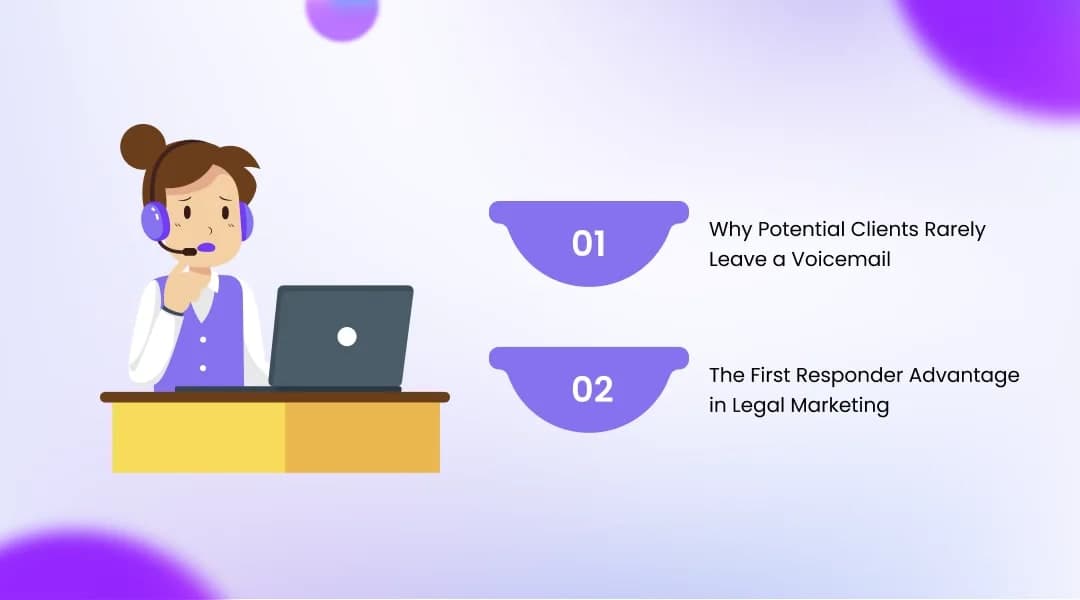
Why Potential Clients Rarely Leave a Voicemail
Legal consumers behave very differently from consumers in most other industries when a call goes unanswered. Someone shopping for a product will often leave a message or fill out a contact form because the purchase is not urgent and they are comparing options at leisure. Someone calling about a legal problem is frequently in a state of stress, urgency, or fear, and the instinct in that state is to keep calling until a human voice answers, not to leave a voicemail and wait for a callback.
Industry intake data consistently shows that the large majority of callers who reach a voicemail on a law firm's main line simply hang up and call the next firm on their list. This single behavior pattern is why voicemail, no matter how professionally recorded, functions as a lead destruction mechanism rather than a lead capture mechanism for most legal practice areas. A firm that treats voicemail as its after-hours intake strategy is effectively handing every after-hours lead directly to a competitor.
The First Responder Advantage in Legal Marketing
Legal marketing spend across paid search, local SEO, and referral programs is only as valuable as the intake process that converts the resulting calls. Firms routinely spend significant budget driving phone calls through advertising, only to lose a large share of those calls to poor answer rates, slow callback times, or inconsistent intake quality. The firm that answers first, asks the right qualifying questions, and schedules a consultation while the caller is still on the line wins a disproportionate share of available cases in any competitive local market.
This is the core strategic reason AI voice agents for law firms matter beyond simple convenience. Speed to answer and consistency of qualification directly determine how much of a firm's existing marketing investment actually converts into signed clients, which means fixing intake often produces a faster return than increasing the marketing budget itself.
Why Traditional Call Handling Methods Fall Short
Most law firms have already tried to solve the missed call problem with one of three traditional approaches, and each one comes with structural limitations that prevent it from fully closing the gap. Understanding why these approaches fall short is what makes the case for AI voice agents clear rather than theoretical.
The Limits of Outsourced Legal Answering Services
Outsourced answering services have long been the default fix for after-hours legal calls, and they do solve the basic problem of having a human voice answer the phone. The limitation is that these services typically use generalist call center staff who are not trained on the specific qualifying questions a personal injury intake requires versus a family law intake versus an immigration intake. Callers frequently end up giving basic contact information without being properly screened for case viability, statute of limitations concerns, or conflicts of interest, which means the attorney still has to do the real qualification work on a callback the next morning, by which point the urgency that drove the original call has often faded.
Cost is the second structural issue. Answering services typically bill per minute or per call, and costs scale directly with call volume, which means the firms that most need reliable intake coverage during high-volume periods are also the firms facing the highest variable costs from using one.
Why One Receptionist Cannot Cover Every Hour
Hiring an in-house intake specialist solves the quality problem that answering services struggle with, since a trained employee who works exclusively for the firm understands its specific practice areas and intake criteria. The unavoidable limitation is that one person, or even a small intake team, can only be on the phone during scheduled working hours and can only handle one call at a time. The moment two qualified leads call simultaneously, one of them is going to voicemail regardless of how skilled the receptionist is.
Staff turnover compounds this further. Legal intake is a demanding, repetitive job, and turnover in these roles is common, which means firms are frequently retraining new staff on intake scripts and case qualification criteria, with consistency suffering during every transition period.
How AI Voice Agents for Law Firms Actually Work
AI voice agents close the gap left by both traditional approaches by combining the always available coverage of an answering service with the consistency and specificity of a dedicated intake specialist. A modern AI voice agent answers every inbound call in real time, conducts a natural-sounding conversation using the firm's specific intake criteria, and either books a consultation directly onto the attorney's calendar or routes the lead to the appropriate staff member based on case type and urgency.
The conversation itself works because the underlying voice AI is built to understand natural spoken language, including interruptions, pauses, and the kind of emotional or stressed speech patterns common in legal intake calls. Response latency is critical here, since a noticeable delay between when a caller finishes speaking and when the agent responds makes the interaction feel robotic and erodes caller trust within seconds. Voice agents built on platforms like OnDial are engineered to respond in under 500 milliseconds, which keeps the back-and-forth feeling close to a natural human conversation rather than a stilted exchange with an obvious machine.
Capturing Case Details Accurately Every Time
A well-configured AI voice agent for legal intake captures the same structured information on every single call, which is something even the best human intake staff struggle to do consistently across a busy day. This includes basic contact details, the nature of the legal issue, key dates relevant to the statute of limitations, whether the caller has already retained another attorney, and any conflict of interest flags relevant to the firm's existing client base.
Because the AI agent follows the same qualification logic on call number one and call number two hundred of the day, firms eliminate the variability that comes from human fatigue, mood, or inconsistent training. Every transcript and call recording is also logged automatically, giving attorneys a complete and searchable record of exactly what was discussed before they ever pick up the phone for a callback.
Qualifying Leads Before They Reach an Attorney
Not every inbound call to a law firm represents a viable case, and attorney time is the firm's most expensive resource. AI voice agents apply consistent qualification logic during the initial call itself, screening for case type fit, geographic jurisdiction, and basic viability criteria before a lead is ever passed to a human team member. This means attorneys spend their limited callback time on genuinely qualified prospects rather than working through a list that includes unqualified inquiries, wrong jurisdiction calls, and solicitations mixed in with real cases.
Lead scoring takes this a step further by ranking qualified leads based on urgency and case value indicators gathered during the conversation, so the highest priority callbacks happen first. Voice agents built specifically for this kind of qualification and scoring work, which OnDial includes as a core capability, give intake teams a prioritized queue instead of an undifferentiated list of messages to work through.
The Business Impact of AI-Powered Client Intake
Law firms that deploy AI voice agents for client intake typically see the impact show up in three measurable places within the first few months of operation. The most immediate is answer rate, since a properly deployed AI voice agent answers one hundred percent of inbound calls regardless of time of day or simultaneous call volume, compared to answer rates that often fall well below that figure during evenings, weekends, and peak call periods at firms relying on staff coverage alone.
The second measurable impact is response time to qualified leads, since AI voice agents can engage a caller within seconds of the phone ringing and, where appropriate, schedule a consultation on the spot rather than requiring a callback hours or days later. Firms consistently report that reducing the gap between initial inquiry and scheduled consultation has a direct and significant effect on client intake conversion rate, since legal consumers who are still actively comparing firms are far more likely to commit to the one that locks in an appointment time immediately.
The third impact is consistency of data captured across every call, which improves both the quality of attorney callbacks and the accuracy of marketing attribution, since firms can finally see exactly which campaigns and channels are producing calls that convert into signed cases rather than relying on incomplete manual notes. Together, these three improvements typically translate into a meaningful increase in signed cases from the same volume of inbound calls and existing marketing spend, without requiring the firm to add additional intake headcount.
How OnDial Delivers Reliable AI Voice Agents for Law Firms
OnDial is built as a production-grade AI voice agent platform, which means it is designed to handle real call volume reliably rather than functioning as a basic chatbot with a voice interface attached. For a law firm, that distinction matters because intake calls are high stakes and a voice agent that mishandles a caller's information or fails under volume creates more problems than it solves. OnDial deploys both inbound and outbound AI voice agents that operate continuously, twenty-four hours a day and seven days a week, so a law firm's intake coverage never depends on staff schedules, sick days, or after-hours availability.
Language coverage is a meaningful consideration for firms serving diverse client populations, and this is an area where OnDial's capabilities are particularly relevant. The platform supports more than one hundred languages overall, including nine Indian languages with more than eighty regional voice variations, which allows multilingual firms to serve clients in the language they are most comfortable using during what is often a stressful initial call. Combined with response latency under 500 milliseconds, the conversation experience remains natural and unhurried regardless of which language the caller speaks.
Beyond the conversation itself, OnDial's appointment scheduling and calendar integration capability allows the voice agent to book qualified consultations directly into an attorney's existing calendar system during the call, removing the back and forth that typically delays scheduling by days. Smart analytics and call sentiment tracking give firm leadership visibility into which call types are converting, where callers express frustration or urgency, and how intake quality trends over time. Because legal client information involves sensitive personal data, OnDial's GDPR and CCPA-compliant data handling gives firms a documented standard for how caller information is collected, processed, and stored throughout the intake process.
Firms also have flexibility in how they bring OnDial into their existing systems, since the platform supports both API based deployment for firms with established practice management software and no-code deployment for firms that want a faster setup without engineering resources. This flexibility matters for legal practices specifically because firm sizes and existing technology stacks vary enormously, from solo practitioners running lean operations to multi-office firms with established case management infrastructure.
AI Voice Agents Across Legal Practice Areas
The specific value AI voice agents deliver shifts depending on practice area, since each type of legal work has different intake urgency patterns and qualification criteria. The following breakdown reflects how the same underlying AI voice agent capability applies differently across common practice areas.
Personal injury firms benefit from AI voice agents capturing accident details, injury severity, and incident dates immediately, since statute of limitations timing and evidence preservation make speed of intake directly tied to case viability.
Family law firms use AI voice agents to handle the emotionally sensitive first call professionally and consistently, gathering basic case information while routing urgent matters such as protective order requests to staff immediately rather than through a standard callback queue.
Immigration firms rely on multilingual AI voice agent support to serve callers in their native language during an already stressful process, which significantly improves the quality of information captured during initial intake.
Criminal defense firms depend on AI voice agents to provide rapid response coverage outside business hours, since arrests and urgent legal needs in this practice area frequently occur at night and on weekends when traditional staffing is unavailable.
Estate planning and elder law firms use AI voice agents to schedule consultations efficiently for a client base that often prefers phone communication over digital intake forms, capturing key family and asset details before the first attorney meeting.
What Implementation Looks Like for a Law Firm
Deploying an AI voice agent for client intake is a more contained project than most firms expect, but it does require deliberate setup work to get the qualification logic right for the firm's specific practice areas. The process generally follows a consistent sequence regardless of firm size.
The first step is defining intake criteria for each practice area the firm handles, including the specific questions that determine case viability, urgency flags that should trigger immediate human routing, and any jurisdiction or conflict of interest checks the voice agent should apply during the call. The second step is connecting the voice agent to the firm's existing calendar and, where applicable, practice management or client relationship management system, so that scheduled consultations and captured lead information flow directly into the tools attorneys already use. The third step is a testing period where the firm reviews real call transcripts and recordings to confirm the agent is asking the right questions and routing calls appropriately, with adjustments made to the conversation logic based on actual caller behavior.
Most firms can move from initial setup to a live AI voice agent handling real inbound calls within a few weeks, with the no-code deployment option significantly compressing that timeline for firms that do not need deep integration with existing case management software. Firms typically run the AI voice agent alongside existing staff initially, using it to capture overflow and after-hours calls before expanding its role as confidence in call quality builds.
Stop Losing Clients to a Phone That Does Not Answer
The pattern running through every part of this blog comes down to three connected points. Missed calls in legal client intake are not a minor inconvenience; they represent direct and measurable revenue loss because legal consumers call multiple firms and commit to whoever answers first. Traditional fixes, whether outsourced answering services or in-house receptionists, each solve part of the coverage problem but leave real gaps in consistency, availability, or cost control. AI voice agents close those gaps by answering every call immediately, applying the same qualification logic every time, and capturing the structured information attorneys need before a callback ever happens.
OnDial brings these capabilities together specifically for businesses, including law firms, that cannot afford to lose another qualified lead to a voicemail box. With response times under 500 milliseconds, support for more than one hundred languages including nine Indian languages with over eighty regional voice variations, twenty four seven inbound and outbound call handling, built in lead qualification and scoring, direct calendar integration for consultation scheduling, smart analytics with call sentiment tracking, and GDPR and CCPA compliant data handling, OnDial is built to function as a genuine extension of a firm's intake process rather than a basic automated answering tool. The platform's flexible API and no-code deployment options mean firms of any size can get a voice agent live without a lengthy technical project.
If your firm is losing winnable cases simply because a phone went unanswered at the wrong moment, the fix is more straightforward than it might seem. Reach out to OnDial to schedule a demo and see exactly how an AI voice agent would handle your firm's actual intake calls before you commit to anything.