Here is a number that reframes the whole conversation. An AI-handled business call costs somewhere between $0.30 and $0.50 per interaction, while a human-handled call runs $6 to $12, according to ElevenLabs. That gap is why an automated calling system has stopped being a "nice to have" and become a core piece of how modern businesses communicate.
I know the skepticism, though. You have sat through those endless "press 1 for sales" menus. You have wondered whether automated calls just annoy customers or land you in legal trouble with TRAI. Fair concerns, all of them.
So let me be direct about what this is. An automated calling system is software that places, answers, and routes phone calls at scale, using dialers, IVR, and increasingly AI voice agents, so your team stops dialing numbers by hand and starts focusing on conversations that matter. At OnDial, building these systems for Indian businesses is what we do every day.
This guide walks through exactly what these systems are, how they work, the features and benefits that count, the India compliance rules you cannot skip, and the best practices that separate a helpful system from a hated one.
What Is an Automated Calling System?
The term sounds technical, but the idea is simple. Let me define it cleanly first, then show how far it has come.
The Simple Definition
An automated calling system is technology that automatically dials or answers phone numbers, then plays a message, routes the call, or holds a conversation using AI, all without a person manually dialing. It replaces repetitive manual calling with predefined rules, workflows, and voice technology.
Think of it as the difference between an agent dialing 80 numbers a day and a system that dials thousands while your team only speaks to people who actually pick up. The automated calling system handles the grind. Your people handle the judgment. That division of labour is the entire point.
From Robocalls to AI Voice Agents
Here is a counter-intuitive truth: the "robocall" most people picture is already outdated. Historically, automated calling meant a pre-recorded message blasted to a list of numbers. Today, that is only the most basic mode.
Modern systems have moved from "play a message" to "hold a full conversation." As Troika Tech notes, AI voice agents now understand speech, answer questions, update records, and route calls intelligently, rather than just reading a script. In projects at OnDial, we have watched this shift firsthand. A well-built AI voice agent can ask a real estate lead about budget, location, and move-in date, then book a site visit only if the lead qualifies. That is not a robocall. That is a colleague who never sleeps.
How Does an Automated Calling System Work?
Most people picture something more complicated than the reality. Underneath the surface, the mechanics follow a clean, repeatable loop.
The Core Workflow: Dial, Detect, Deliver, Log
An automated calling system dials numbers from a contact list, detects whether a human or voicemail answered, delivers a message or connects a live agent, then logs every outcome to your CRM automatically. That four-step loop is the engine, whether you are running 100 calls or 100,000.
The "detect" step matters more than it looks. Good systems skip busy signals, disconnected lines, and voicemails, so your agents only ever hear a live human. As BonVoice points out, manual dialing might reach five to ten clients in an hour, while an auto-dialer connects agents only to real pickups. The time your team saves there is not marginal. It is the whole business case.
Inbound, Outbound, and Hybrid Systems
Automated calling is not one thing. It comes in three shapes, and the right one depends on what you are trying to solve.
Outbound systems make the calls: sales follow-ups, appointment reminders, payment collection, and marketing broadcasts. This is where dialers and voice broadcasting live.
Inbound systems answer the calls: an IVR or AI receptionist greets callers, answers routine questions, and routes complex cases to the right team. Many businesses now replace traditional reception desks with an AI receptionist that answers calls, routes customers, and handles common questions around the clock.
Hybrid systems do both from one platform, automating routine interactions while letting a human agent step in the moment nuance is needed.
Most growing businesses end up hybrid, and for good reason. Your customers do not think in "inbound" and "outbound" categories. They just want their issue handled.
The Key Features of an Automated Calling System
Feature lists can blur together fast. So instead of listing everything, let me focus on the capabilities that actually change your outcomes.
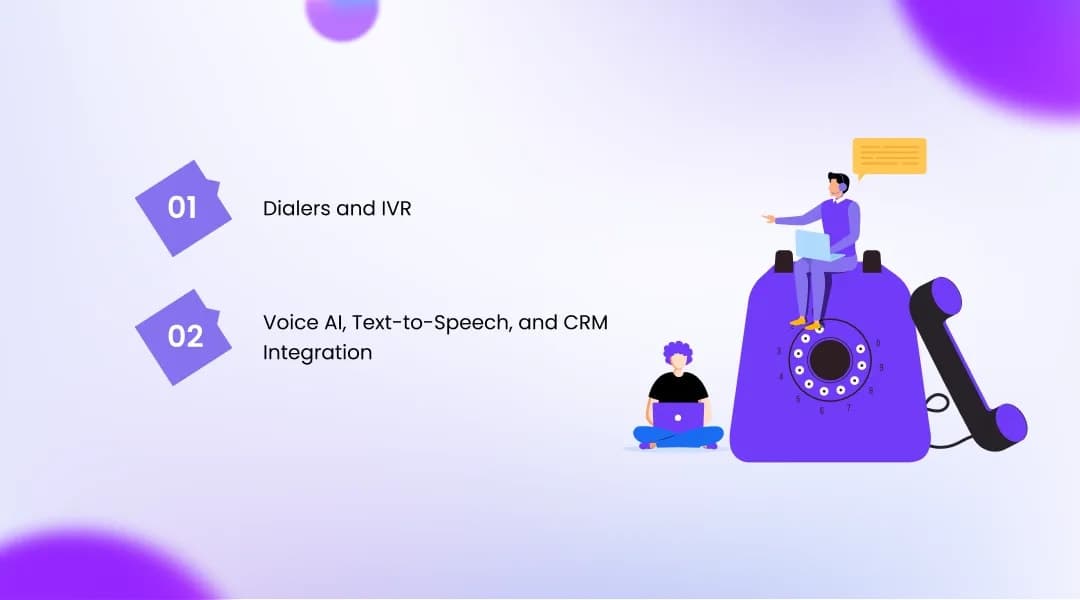
Dialers and IVR
The dialer is the muscle of any outbound system, and there is real nuance in the types.
Predictive dialers use algorithms to dial several numbers at once and connect agents only to live answers, which can push agent talk time from around 20 minutes an hour toward 45. They suit high-volume campaigns.
Power dialers work one-to-one, dialing the next number only when an agent is free, which reduces awkward abandoned calls.
Preview dialers show the customer's history before the call connects, ideal for high-value or complex sales.
On the inbound side, Interactive Voice Response (IVR) is the self-service front door. A logistics firm can let callers track a package or reschedule a delivery by entering a tracking ID, deflecting a large share of routine queries before an agent is ever involved.
Voice AI, Text-to-Speech, and CRM Integration
This is where older systems and modern ones part ways. Text-to-speech (TTS) converts written scripts into natural audio in multiple languages and accents, so you can iterate and A/B test without re-recording anything.
Layered on top is natural language processing (NLP), which lets an AI voice agent understand what a caller actually says instead of forcing them through keypad menus. Then comes the feature that quietly ties it all together: CRM integration. When your calling platform syncs with your CRM, every call arrives with the customer's context already loaded, and every outcome writes back automatically. Deep CRM sync, as Bland AI describes it, means fewer contextless transfers and faster resolution. Miss this feature and even a smart system feels blind.
The Real Benefits of an Automated Calling System
The benefits get repeated so often they start to sound like noise. Let me ground them in numbers instead.
Cost and Efficiency Gains
The economics are the first thing you notice. In India, a single telecaller costs roughly ₹25,000 to ₹40,000 per month with benefits, meaning a ten-person team burns ₹3 to ₹4 lakh monthly on salaries alone, per BotSense. An automated calling system reduces the manual labour behind routine dialing, so you handle far more volume without scaling headcount at the same rate.
The authority data backs this up at scale. Gartner projects that conversational AI will save businesses $80 billion in contact-centre labour costs by 2026. Companies using AI-powered customer service tools report a 20 to 30 percent drop in operational costs. These are not marketing claims. They are the reason CFOs, not just IT teams, now push for adoption. Businesses looking to automate customer conversations can also explore our AI Customer Support solutions.
Scale, Consistency, and 24/7 Availability
Cost is only half the story. The other half is what money cannot easily buy: consistency.
A human agent has good days and bad days. An automated system delivers the same pitch, the same disclosure, and the same follow-up logic on the thousandth call as on the first. It also runs around the clock, which matters because a meaningful share of leads reach out or need follow-up outside standard business hours. And it scales on demand. Whether a campaign generates 1,000 leads or 10,000, the automated calling system absorbs the spike without overtime or a drop in service quality. This is the backdrop for India's rapid growth: the country's conversational AI market is projected to reach USD 5,907.5 million by 2034, at a 25.61 percent CAGR, according to IMARC Group.
Is an Automated Calling System Legal in India?
Short answer, and I want to be clear about it: yes, but only if you follow the rules. This is the section most global guides skip entirely, and it is exactly where Indian businesses get caught out.
TRAI, DLT, and the DND Registry
Automated calling is legal in India when it complies with TRAI regulations, which require DLT registration, DND scrubbing, and calling only within permitted hours. Skip any of these, and you are exposed.
Here is what compliance actually demands. You must register your business, sender identity, and message templates on a DLT (Distributed Ledger Technology) platform. You must scrub your contact lists against the DND (Do Not Disturb) registry and avoid calling registered numbers without consent. And you must respect calling time windows, typically 9 AM to 9 PM for promotional communication. A platform that does not build these in leaves you at compliance risk from day one, which is why we treat them as non-negotiable defaults, not add-ons, in every OnDial deployment.
The DPDP Act and Consent
Compliance in India is no longer only about telecom rules. The Digital Personal Data Protection Act, 2023 (DPDP Act) governs how you collect, store, and process the personal data flowing through your calls, including recordings and transcripts.
The honest nuance here is that this is an evolving space, and the safest posture is to treat consent as an ongoing relationship rather than a one-time checkbox. Capture consent clearly, store it with a timestamped audit trail, offer easy opt-outs, and secure your data with proper encryption. I will not pretend the regulatory landscape is fully settled, because it is not. What I can say is that vendors who bake consent playback, opt-out handling, and audit logging into the platform save you from the worst of the risk.
Best Practices for Automated Calling: Customers Don't Hate
Now for the part nobody wants to admit. Plenty of automated calling is genuinely awful, and customers say so loudly.
Design for the Human on the Other End
Spend an hour reading complaints on Quora or Reddit and a pattern jumps out. People do not hate automation itself. They hate being trapped. The most common frustrations are five-level menus that never recognize an account number, scripts that break on any edge case, and no obvious escape to a human.
So design against those failures directly.
Give a fast escape to a human. Make "talk to an agent" obvious and early. Trapping people is what breeds the hatred.
Keep menu paths short. Aggressive menu depth reduces transfers but raises dropout, so build clear exits.
Personalize with CRM data. A simple name reference or a mention of a past interaction turns a robotic script into something closer to a real conversation.
Disclose that it is AI. Telling callers they are speaking with an AI is both an ethical baseline and, increasingly, a regulatory one.
Would you stay on a call that ignored everything you said? Neither will your customers.
Measure, Test, and Stay Compliant
An automated calling system is not a "set and forget" tool. Treat it like a product you keep improving.
Track the metrics that reveal the truth: connection rates, containment (how often the system resolves without a human), CSAT, and drop-off points in your call flows. Then run small experiments. A/B test scripts and prompts, review where callers abandon, and iterate monthly rather than annually. Feed your agents' frontline observations back into the design, because they hear what the dashboards miss. And revalidate compliance before every campaign, since a strong campaign that ends in a TRAI penalty was never worth running. Data from recent implementations suggests hybrid setups, where AI handles first contact, and humans take escalations, outperform either extreme.
Conclusion
A well-built automated calling system is not a robocall machine. It is a compliant, scalable way to place, answer, and route calls so your team spends its energy on conversations that need a human. Three things matter most: the four-step dial-detect-deliver-log engine that drives efficiency, the India compliance rules (TRAI, DLT, DND, and the DPDP Act) that keep you safe, and the human-first design choices that decide whether customers appreciate the call or resent it.
You came in skeptical, and rightly so. You can leave with a clear framework for doing this properly. If you are ready to build a voice AI system that respects both your customers and India's regulations, OnDial designs tailored, human-centric calling solutions, with compliance built in from day one. Let's talk about what a system shaped around your business could actually do.