Roughly 70 percent of online shopping carts are abandoned before checkout, according to the Baymard Institute. A large share of those shoppers had a simple question that nobody answered fast enough. An AI voice agent for ecommerce rewrites that math: it picks up every call, answers order and product questions in seconds, re-engages carts before they go cold, and keeps your people free for the conversations that genuinely need a human touch.
If you run an online store, you have felt the grind. The same "where is my order" calls stack up while the hard problems sit in a queue. You are probably skeptical too, because you have heard the hype before and do not want a robot voice frustrating the customers you worked hard to earn.
That skepticism is fair, so this guide keeps it honest. You will learn what an e-commerce voice agent really is, where it delivers measurable wins, where it still falls short, and how to roll it out so shoppers feel served rather than processed.
What Is an AI Voice Agent for Ecommerce?
An AI voice agent for ecommerce is software that holds natural spoken phone conversations with shoppers to answer questions, track orders, and complete tasks. It listens, understands intent, pulls live data from your store, and speaks back, all without a human on the line.
Here is a clean, quotable definition of how it behaves on a real call:
An AI voice agent for ecommerce is an AI system that speaks with customers over the phone in real time. It understands natural language, pulls live order data, and resolves routine requests like tracking, returns, and product questions on its own, escalating only when a shopper needs a person.
How It Differs From Old IVR and Chatbots
Traditional IVR systems force callers down rigid menus. Press 1 for orders. Press 2 for returns. Press 3 if you are already annoyed. They route calls, but they rarely resolve anything, and shoppers resent the maze.
A voice agent flips that. The caller simply says "I want to change my delivery address," and the system understands the request without a single button press. It remembers context across the call, so nobody has to repeat their order number three times. In the deployments I have worked on at OnDial, that single shift from routing to resolving is what customers notice first.
Chatbots solve a different slice of the same problem. Chat suits shoppers who are browsing and typing on your site, while voice suits people who reach for the phone when a payment fails, or a parcel goes missing. Most healthy stores run both, because they cover different moments in the buyer journey rather than competing. For ecommerce brands managing thousands of customer conversations daily, AI customer support automation helps businesses resolve repetitive queries faster while improving response times.
The Three Technologies Behind Every Call
Under the hood, an e-commerce voice agent chains three technologies in real time. Each one has to be fast, because even a small delay feels awkward on a live phone call.
Automatic Speech Recognition (ASR): converts the shopper's spoken words into text, including messy real-world speech with background noise and interruptions.
Natural Language Processing (NLP) and a language model: figure out what the caller actually wants, hold context across turns, and decide the right action to take.
Text-to-Speech (TTS): turns the response back into natural, human-sounding audio so the reply lands in under a second.
When these three pieces work together and connect to your CRM and order systems, the agent stops sounding like a menu and starts sounding like a prepared assistant. That is the difference between deflection and resolution.
Why Online Stores Are Turning to Voice AI Right Now
Adoption is not driven by novelty. It is driven by a simple accounting problem: support demand spikes faster than you can hire, and every unanswered call is a shopper heading to a competitor.
The Rising Cost of Every "Where Is My Order?" Call
Support costs quietly bleed margins. Industry figures cited by Ringly put the average cost to outsource a single customer service call at around 5.60 dollars in 2026, and a busy month of routine order inquiries adds up fast. Multiply that across a seasonal spike, and the phone line becomes one of the most expensive parts of your operation.
An AI voice agent absorbs that repetitive volume. It answers thousands of concurrent calls, handles the routine questions, and drops the load on your human team without you staffing up for Black Friday. Have you ever added temporary agents just to survive a sale week? That is exactly the cost voice AI is built to remove.
Shoppers Expect Answers, Not Tickets
Speed is now part of the product. Salesforce reports that 80 percent of customers say the experience a company provides matters as much as its products and services. A slow email reply or a long hold is not a minor annoyance to them. It is a reason to buy elsewhere.
Voice AI meets that expectation by answering instantly, at 2 a.m. or during a viral traffic surge, in the caller's own words. The shopper gets a real answer in seconds instead of a ticket number and a wait. That immediacy is what "transforming ecommerce customer experience" actually means in practice.
Where an AI Voice Agent Actually Moves the Needle
Not every use case is equal. The strongest returns cluster around high-volume, repeatable moments where speed changes the outcome. Here is where I have seen voice AI earn its place.
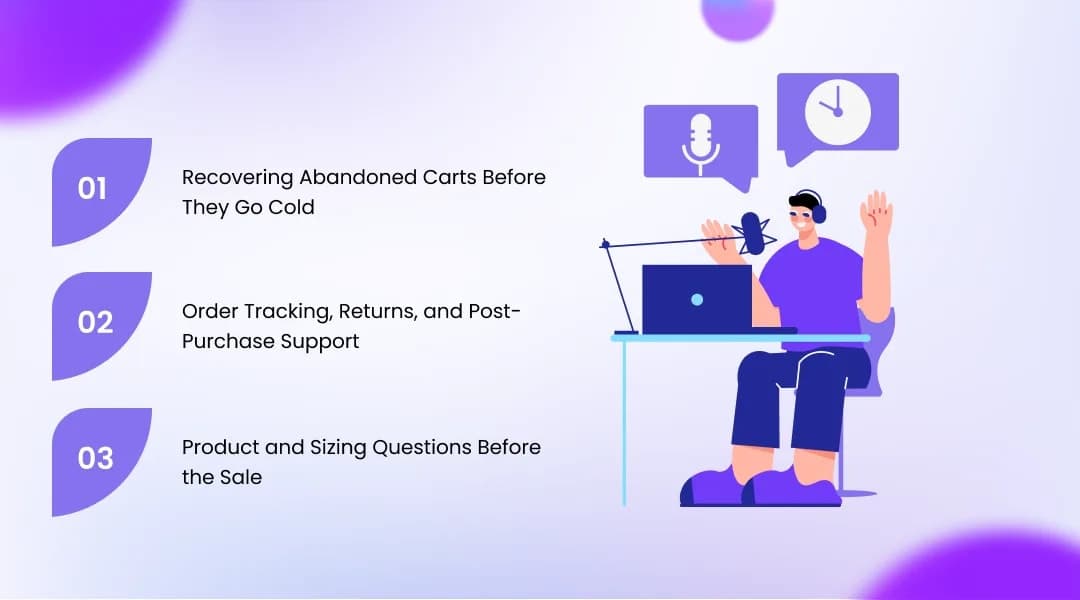
Recovering Abandoned Carts Before They Go Cold
Abandoned cart recovery is the clearest win, and the numbers explain why. With cart abandonment sitting near 70 percent, most of your ad spend is buying visitors who leave at the final step. Industry analyses put conversational AI cart recovery at roughly 35 percent, far above the single-digit recovery you get from email alone.
A voice agent can call a shopper who dropped off at checkout, answer the last-minute worry about shipping or sizing, and guide them back to a completed order. It is not a generic discount blast. It is a timely conversation at the exact moment hesitation peaks, which is why it converts.
Order Tracking, Returns, and Post-Purchase Support
Post-purchase is where repetitive volume lives, and it is perfect territory for automation. These are the calls that flood your queue without needing human judgment.
Order tracking: the agent verifies the caller, pulls live shipping data, and reads back the tracking status in seconds- no rep required.
Returns and refunds: it walks the customer through your policy, collects the order details, and triggers the return label or refund directly in your system.
Delivery updates: it proactively confirms delivery windows and reschedules, cutting the anxious "where is it" calls before they even happen.
The key is deep integration. An agent wired into Shopify and your order management system resolves the issue on the call, rather than answering vaguely and transferring, which is what separates a useful agent from a glorified answering machine.
Product and Sizing Questions Before the Sale
A surprising truth: most shopper questions are not about finding products. They are about trusting them. Recent conversational commerce research suggests a majority of shopper queries center on validation, sizing, compatibility, and use-case fit, not discovery.
A voice agent trained on your catalog answers "does this run small?" or "is this in stock in blue?" instantly, at the moment of doubt. Handled well, that answer is the difference between a checkout and a bounce. Answered slowly, the shopper leaves to search elsewhere and rarely comes back.
The India Angle: Multilingual Voice AI and Compliance
Most global voice platforms treat India as an afterthought, adapted later rather than built for it. For an Indian online store, that gap is the whole game. Two things matter here that international guides skip entirely: language and law.
Hindi, Hinglish, and Regional Languages That Convert
India is home to hundreds of languages, yet most support systems still default to English. That mismatch costs real conversions, especially in Tier-2 and Tier-3 cities where first-time digital shoppers prefer their own language.
Hinglish code-switching: urban callers blend languages mid-sentence, as in "Aapka order dispatch ho gaya hai, delivery kal tak." A strong e-commerce voice agent parses that without dropping context.
Regional depth: Hindi, Gujarati, Marathi, Tamil, Telugu, Bengali, and more, with accent variation across regions, so a Delhi caller and a Mumbai caller both feel understood.
Trust and conversion: localized, native-language conversation builds familiarity, and reports from Indian voice AI providers link regionally tuned models to higher connectivity and conversion.
At OnDial, this is the part we care about most, because it is where global tools quietly fall down. Multilingual voice AI built for IndiaChatbots solve a different slice of the same problem. Chat suits shoppers who are browsing and typing on your site, while voice suits people who reach for the phone when a payment fails, or a parcel goes missing n speech patterns is not a nice-to-have for a domestic store. It is the differentiator.
TRAI, DLT, and DPDP Act 2023 Compliance
Language earns trust. Compliance keeps you operating. Automated e-commerce calling in India sits inside a real regulatory frame, and skipping it is not an option.
TRAI and DLT: telecom rules and DLT registration govern automated and promotional calling, including consent and opt-in requirements for outbound campaigns.
DPDP Act 2023: the Digital Personal Data Protection Act sets how you collect, store, and process customer data, with consent and data-handling obligations that apply directly to voice interactions.
Consent and transparency: callers should know they are speaking with an automated agent, and records need audit trails and encryption.
A voice platform built for the Indian market bakes this in rather than bolting it on. That is a deliberate design choice, and for a store scaling across states, it is the difference between growth and a compliance headache.
Do AI Voice Agents Actually Work? An Honest Look
This is the question every operator really wants answered, so let me give you the straight version, including the parts vendors skip.
Here is the honest snippet answer:
Yes, for routine calls. Well-built ecommerce voice agents resolve roughly 40 to 70 percent of inbound calls without escalation, covering order status, returns, and product questions. They still struggle with emotional or complex disputes, so the strongest setups pair AI with a fast human handoff.
What the Data Says About Resolution and Conversion
The evidence is genuinely encouraging when the agent is well built. Hands-on testing published by Retell AI in 2026 found that solid voice systems resolve between 40 and 70 percent of inbound calls without escalation, covering order checks, verification, and basic troubleshooting.
The broader shift is bigger than support. McKinsey estimates that agentic AI could influence between 3 and 5 trillion dollars in global retail commerce by 2030, and an ICSC and McKinsey survey found that 68 percent of consumers used at least one AI tool while shopping in a recent three-month window. Shoppers are already comfortable with AI in the buying journey. The question is no longer whether they will accept it, but whether your version is any good.
Where Voice AI Still Needs a Human
Now the counterintuitive part. The best voice AI deployment is not the one that automates the most.
It is the one that knows exactly when to step aside. SurveyMonkey found in 2026 that 89 percent of consumers still want a human option, and that number should shape your whole strategy. Fraud concerns, a damaged medical delivery, an escalating complaint: these are not "wait your turn" moments, and an AI that traps an upset caller in a loop destroys trust fast.
Accuracy has limits too. Generic models stumble on industry terms and edge cases, which is why training on your own products, policies, and real call transcripts matters so much. Honesty about these boundaries is not a weakness in the technology. It is the mark of a team that has actually shipped it.
How to Roll Out Voice AI Without Annoying Your Customers
A good tool deployed carelessly still fails. The difference between a voice agent customers thank you for, and one they dread comes down to rollout discipline.
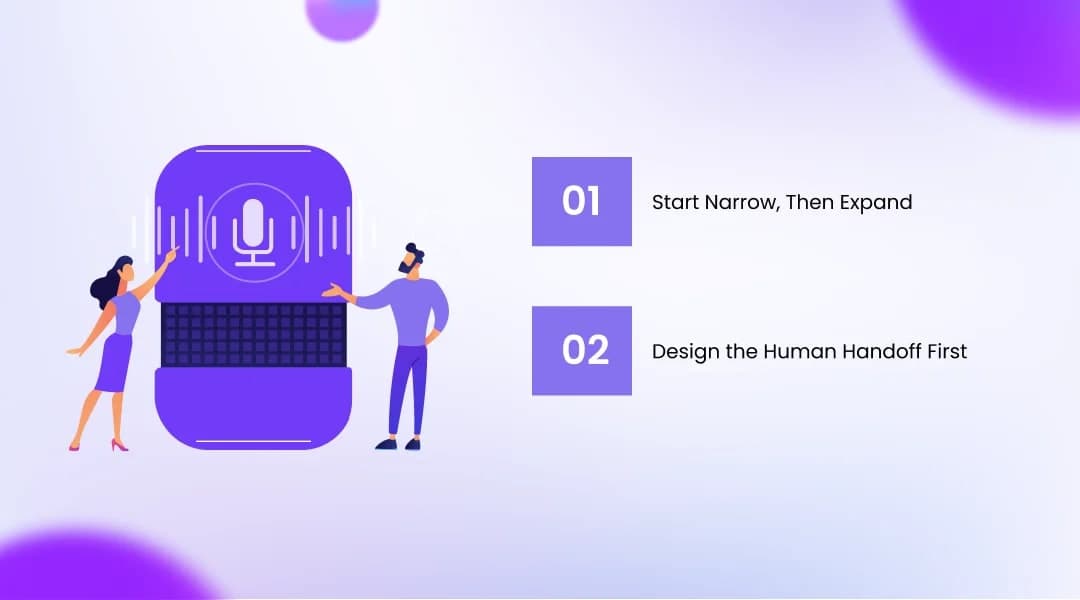
Start Narrow, Then Expand
The biggest predictor of success is a tight, well-defined scope. Pick one high-volume, low-risk task first, such as order tracking, and get it genuinely excellent before you add more.
Trying to automate everything on day one is how projects break in front of live callers. Once the narrow use case proves out on real traffic, you expand into returns, then cart recovery, then pre-sale questions. Each addition builds on a foundation you have already tested, rather than gambling your customer experience on an untested flow.
Design the Human Handoff First
Counter to instinct, you should design the escalation path before you design the automation. The handoff is where trust is won or lost.
Detect frustration early: the agent should recognize confusion, anger, or complex intent and route those calls out quickly.
Pass full context: the human should pick up with the caller's history and issue already summarized, so nobody repeats their story.
Make the exit obvious: a caller who wants a person should be able to reach one without a fight.
Ground the whole thing in real call transcripts, not guessed-at scripts, and connect it to current policies and clean data. If your return window changed last week, the agent has to know it today. Get the handoff right, and the automation feels like a helpful front door rather than a wall.
Conclusion
An AI voice agent for ecommerce is no longer a bet on the future. It is a practical answer to three problems you already have: rising support costs, shoppers who refuse to wait, and abandoned carts that quietly drain revenue. Used well, it handles the repetitive volume, recovers sales at the moment of hesitation, and hands the hard cases to your team with full context.
You do not need to automate everything to win. You need to automate the right things, in your customers' language, inside the rules that govern your market, with a human always one step away.
If your store serves Indian shoppers across Hindi, Hinglish, and regional languages, OnDial builds ecommerce voice agents tuned for exactly that: natural conversation, TRAI and DPDP-aligned calling, and a human handoff designed in from the start. Start with one use case, prove it on real calls, and scale from there.