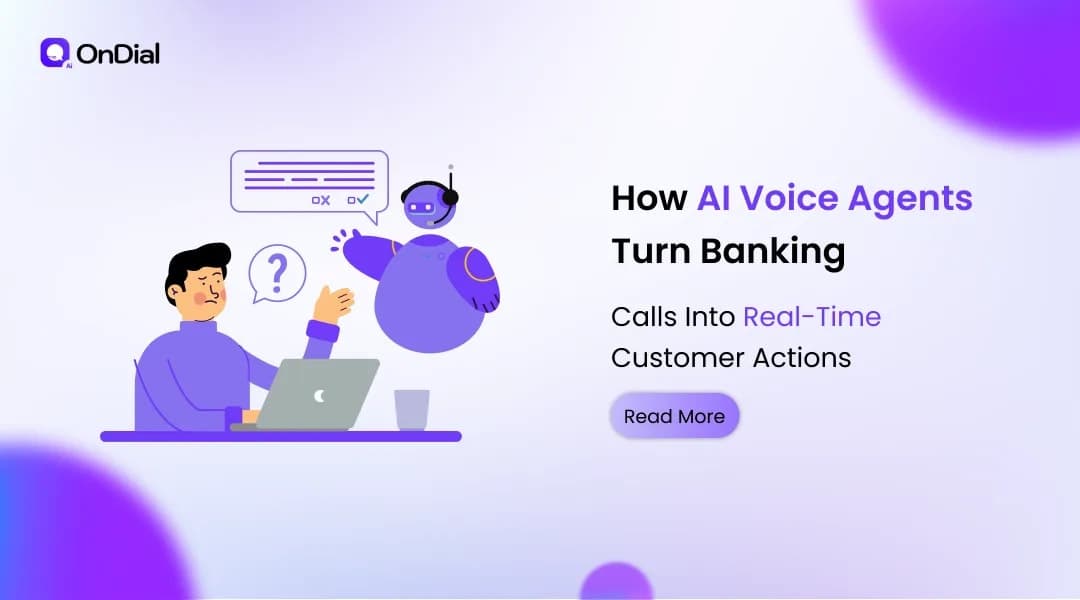
In a 2026 Deloitte survey of US banking customers, 71% ranked ease of resolving an issue as their top support priority, ahead of fast response times at 63%. Read that again. Your customers care less about how quickly the phone gets answered and more about whether the problem is actually gone when they hang up. That single finding explains the entire shift toward AI voice agents in banking: systems that do not just answer a caller in natural language, but authenticate them, pull their account, and complete the actual task inside one live conversation. If you have watched IVR promise the moon and hand over a menu, your skepticism is earned, and I share it.
Here is the honest version of what changed. The newest voice agents close the loop on the call rather than routing the work to a queue, so a blocked card gets unblocked, a dispute gets filed, and a payment gets scheduled while the caller is still on the line.
This article walks through exactly what these agents can do, how they verify identity before touching an account, why containment and resolution are not the same number, and what separates a production system from a demo.
What Can AI Voice Agents Actually Do on a Banking Call?
The short answer is the part most people underestimate. Real-time customer actions are the whole point, and they go well past reading a balance aloud.
An AI voice agent in banking is a conversational system that listens to natural speech, understands intent, verifies identity, connects to core banking systems, and completes account actions inside a single call. That definition matters because the last clause, completing actions, is what separates this generation from every voicebot before it.
From information lookup to completed action
Older voice tools were readers. They could tell you a balance or your last transaction, then send you to a human for anything that changed the account. The new agents are doers, and that difference is structural, not cosmetic.
In deployments I have worked on at OnDial, the moment a system can safely execute an action is the moment call economics change with enterprise AI voice agent services. A caller stops describing a problem and starts watching it get solved. That shift, from surfacing information to executing work, is the same inflection the wider industry is naming as the move from assistants to agents.
The real-time actions callers complete today
Have you ever called a bank just to freeze a card, only to spend four minutes in a phone tree first? That specific pain is where voice agents earn their keep. Here are the actions a well-built agent handles end to end:
Card management: activating a new card, blocking a lost or stolen one, and ordering a replacement through spoken commands, no menu navigation required.
Payments and transfers: scheduling a recurring payment, confirming a transfer, or setting a reminder, with identity confirmed first.
Dispute initiation: locating the exact transaction a caller describes in their own words, explaining any fees, and filing the dispute in the same conversation.
Fraud response: confirming or blocking a suspicious charge on an outbound call, then updating the case record automatically.
Loan servicing: running eligibility checks, explaining documentation, and tracking an application status without a transfer.
Each of these reads and writes to real systems. That combination of reading and acting is the line between a modern agent and a legacy IVR.
Voice AI vs Traditional IVR: Why the Menu Model Capped the Phone Channel
Here is a counterintuitive statement to sit with: your IVR was never designed to solve problems. It was designed to route them. Understanding voice AI vs traditional IVR starts with accepting that the old system did its job perfectly and the job was simply too small.
Traditional IVR routes calls using menu inputs or basic intent detection, but it cannot take action inside banking systems, so the actual resolution still falls to a human. That one sentence is the whole limitation.
What IVR was built to do
The IVR model asks callers to translate a real problem into menu language. A missing payment becomes "press 3 for account services," which is not how anyone actually describes a missing payment. The result is a rigid list that rarely matches the caller's words.
Then there is the dead end. When the menu cannot classify a call, it queues the customer with no context, so the human agent starts from scratch, and the caller repeats everything with OnDial. Legacy IVR systems contain only a small share of calls on their own, which is why the phone channel has felt broken for a decade.
What agentic voice does instead
Agentic voice replaces the routing model with an outcome model. It understands natural speech, reasons over approved bank knowledge, executes an action through an API, verifies the result, and confirms it back to the caller.
The practical effect shows up in adoption. Voice AI handled 19% of inbound contact-center volume in 2026 versus 6% in 2024, with banking and telco leading the surge, per Forrester Wave research cited by Digital Applied. That is not a gentle trend line. That is a channel being rebuilt around resolution, and Gartner expects task-specific agents to reach 40% of enterprise applications by the end of 2026, up from under 5% a year earlier.
How AI Voice Agents Verify a Caller Before Taking Action
Now the part that keeps banking leaders up at night. You cannot let a system move money until you are certain who is on the line. In-call authentication is the gate that everything else depends on.
In-call authentication means the agent verifies a caller's identity inside the natural flow of the conversation, before any account action, without a separate step or transfer. Get this wrong, and nothing else you built matters.
Authentication inside the conversation
Strong voice authentication collects and validates the identity factors the bank requires without breaking the conversation into a clumsy verification detour. Some deployments layer voice biometrics, analyzing pitch, tone, and cadence, with an OTP fallback, which replaces the slow security-question flow that eats thirty to forty-five seconds per call.
What I have learned building these flows is that authentication is not a feature you bolt on with AI voice agents for every language. It is the spine of the whole design, because every downstream capability, from a balance check to a card freeze, is legally and technically blocked until identity clears. Treat it as an afterthought, and you will ship a system that talks well and does nothing safely.
Why identity gates every real action
No account action can execute until the caller is verified, and that ordering is deliberate. It protects the customer, and it produces the audit trail that regulators now expect on every automated interaction.
Consider the compliance frame honestly. Disclosure rules require the agent to identify itself as a bot and give any recording notice in the first several seconds, before any account discussion, and roughly a dozen US states require all-party consent for call recording. California's bot disclosure law makes undisclosed automated communication with consumers unlawful, which makes upfront disclosure the safest default nationwide.
Call Containment Rate vs Resolution: The Number That Actually Matters
I am going to argue against a metric that most vendors lead with. Call containment rate is useful, and it is also the number most likely to mislead you. If you buy on containment alone, you will be disappointed in ninety days.
Containment measures whether a call stayed inside the AI channel without reaching a human. Resolution measures whether the caller's problem was actually solved. Those are different questions, and the gap between them is where trust is won or lost.
What containment measures, and what it hides
A call can be perfectly contained and completely unresolved. An agent that collects information and promises a callback has technically contained the call and solved nothing, and the customer calls back two days later anyway.
The public numbers show the spread. Mature banking programs report 60 to 90% containment on well-defined Tier-1 intents, yet independent benchmarks put median Tier-1 deflection around 41% with the top quartile near 59%. When a vendor reports containment and an analyst reports resolution, you are not looking at the same metric, and pretending you are is how pilots quietly fail.
How to read a vendor's numbers honestly
Ask for containment and resolution together, and insist on the transfer rate alongside both. High containment with low resolution is a warning sign, not a win. The healthiest deployments keep both numbers high because the agent finishes the job rather than parking it.
There is a cost dimension worth naming too. Voice-AI resolutions averaged around $1.18 each against $7.40 for a human agent in the McKinsey AI in Customer Service 2026 sample, but that saving only materializes on calls the agent truly resolves with AI voice agents for call centers. A contained-but-unresolved call generates a second call, which erases the economics entirely. So the number to trust is the one tied to outcome, not the one tied to deflection.
What Makes Agentic Voice Resolution Work in Production
The difference between a polished demo and a live banking system is not the voice. It is everything around the voice. Agentic voice resolution works when the agent is grounded, governed, and gracefully able to hand off.
Agentic voice resolution is the ability to authenticate, retrieve, apply policy, execute the transaction, and confirm the outcome inside one conversation with no human handoff for defined tasks. Everything below is what has to be true for that to hold.
Grounding answers in approved knowledge
A voice agent that guesses a fee schedule or a coverage rule from its training data will sound fluent and be wrong, and on a phone call there is no link for the customer to double-check. This is the single biggest failure mode I watch for. Fluency without grounding is dangerous, not impressive.
The fix is retrieval-grounded answers. Product terms, fee schedules, and procedures sit in a searchable index; the model is prompted to retrieve before it answers, and if no approved document matches, the system blocks the answer and falls back to a human. That discipline, using natural language understanding on top of a controlled knowledge base rather than open generation, is what keeps a banking agent honest.
Compliance and escalation built in from day one
Governance cannot be reviewed at the end. It has to be architected from the first flow, which is a point the OCC's risk guidance keeps reinforcing as AI adoption outpaces oversight with AI agents that handle inbound calls automatically. Every deployment needs these built in:
Full audit trails: what the agent said, what the customer said, and what action was taken, transcribed, stored, and retrievable for examination.
Defined escalation paths: immediate handoff after repeated agent requests, two failed authentications, clear distress, or any fraud or legal dispute, with full context passed to the human.
PII minimization and consent capture: collecting only what the task requires and logging consent before proceeding.
This is where I will be candid about limits. Complex, emotionally charged, or genuinely novel calls still need human judgment, and any vendor claiming otherwise is selling you the demo. The goal is not to remove people. It is to let the agent own the high-volume, well-defined work so people handle what actually needs them.
Conclusion
AI voice agents in banking finally turn the phone channel from a routing tool into a resolution engine, and the three things that decide whether that works are worth holding onto. Verify identity before any action, ground every answer in approved bank knowledge, and judge success by resolution rather than containment. Get those right, and the caller hangs up with the problem solved, not deferred.
You do not need to guess which callers to automate first. At OnDial, I help banking and fintech teams scope one or two high-volume, low-risk intents, prove real resolution under live authentication, then expand from evidence rather than hope. If you want a voice agent that completes work instead of just answering, that grounded, honest pilot is where I would start the conversation.