Here is a number that should bother every sales leader. Leads contacted within five minutes are 21 times more likely to qualify than those contacted after 30 minutes, according to the MIT and InsideSales.com Lead Response Management study led by Dr. James Oldroyd. Yet the median B2B team still takes around 42 hours to respond to an inbound lead, based on 2026 speed-to-lead benchmark data.
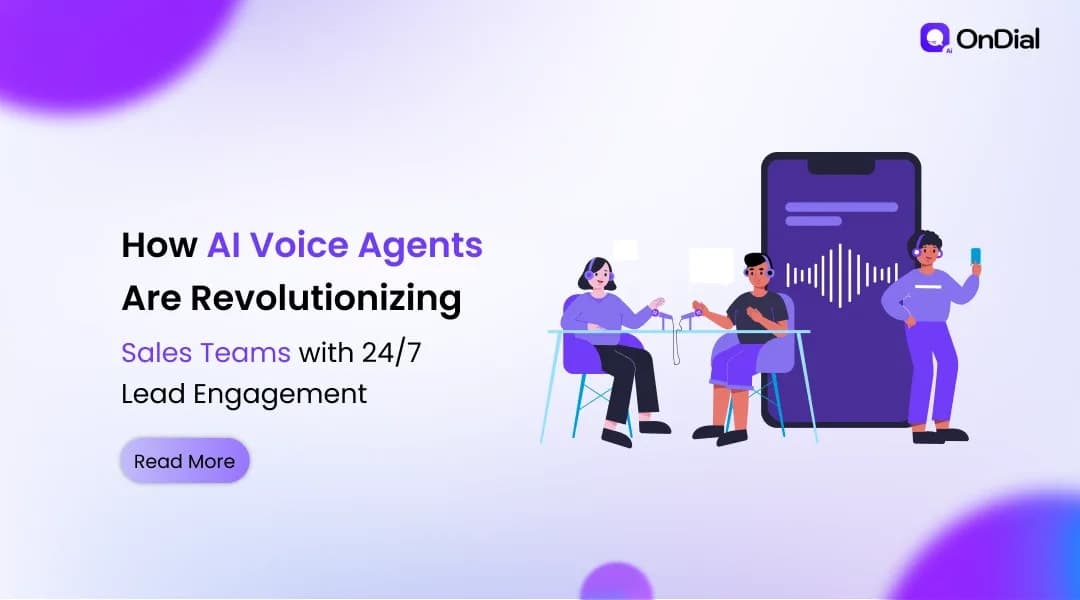
That gap is exactly where AI voice agents for sales earn their keep. An AI voice agent is software that calls or answers prospects, holds a natural spoken conversation, qualifies intent, and books meetings, all running 24/7 without a rep on the line. If you have ever watched good leads go cold overnight or over a weekend, you already feel the problem this solves.
I have spent years at OnDial building voice AI for businesses across India and beyond, and the pattern is depressingly consistent. Most pipeline is not lost to a weak product or a bad pitch. It is lost to silence. This guide breaks down how 24/7 lead engagement actually works, what these agents genuinely can and cannot do, the India-specific rules you have to respect, and whether the investment pays off for a team like yours.
Why Sales Teams Keep Losing Deals They Already Paid For
Your marketing budget buys attention. Your response time decides whether that attention becomes revenue. And for most teams, the second half of that sentence is quietly broken.
The 42-Hour Problem Nobody Talks About
Speed to lead is the time between a prospect raising their hand and your first real response. It is consistently the single strongest predictor of whether an inbound lead converts. The data is not subtle: a Harvard Business Review analysis, "The Short Life of Online Sales Leads," found that firms contacting a prospect within an hour were seven times more likely to have a meaningful conversation, and 60 times more likely to qualify the lead than those who waited 24 hours.
So why do teams still take days? Because humans sleep, take lunch, sit in meetings, and log off on Fridays. A form that lands at 10 PM on a Saturday waits until Monday. By then the prospect has often submitted three other forms and spoken to whoever called back first. Research shows that 35 to 50 percent of sales go to the vendor that responds first, which means slow response is not a minor inefficiency. It is deals walking out the door.
What 24/7 Lead Engagement Actually Changes
24/7 lead engagement means every inbound inquiry gets a real, qualifying conversation within seconds, at any hour, without waiting for a human to be free. That is the shift. Not "we will get back to you," but an actual call while intent is still hot.
I have seen this change the shape of a pipeline in a single quarter. When the first touch happens in under a minute instead of the next business day, contact rates climb, no-shows drop, and reps stop starting their mornings by chasing yesterday's cold leads. The lead volume did not change. The response layer did.
What AI Voice Agents for Sales Actually Do
Let me clear up a common confusion first, because "AI voice agent" gets used for two very different things.
How AI Voice Agents Work Under the Hood
An AI voice agent for sales is a system that conducts live phone conversations using speech recognition, a language model, and text-to-speech, so it can understand what a prospect says and respond naturally in real time. It is not an auto-dialer, and it is not an old IVR phone tree.
Under the hood, three layers do the heavy lifting. Speech-to-text (STT) turns what the prospect says into text. The NLU and language-model layer interprets meaning and decides the next move, distinguishing "I am not sure we have budget right now" from a flat "not interested." Then text-to-speech (TTS) speaks the reply. The whole round trip needs to happen fast, because latency is where most agents fail. Industry testing shows that response delays above 1.5 seconds cause many prospects to hang up or write the call off as a robocall, while sub-500-millisecond responses feel genuinely conversational. Conversation quality also depends heavily on how well AI understands accents, regional dialects, and multilingual conversations.
Do AI Voice Agents Actually Work for Sales?
Yes, AI voice agents work well for high-volume, structured sales tasks like inbound qualification, follow-ups, and appointment booking, but they still hand off complex negotiation and high-value closing to human reps. They are strongest where speed and consistency matter, and weakest where nuance and relationship do. One area where AI consistently outperforms scripted automation is handling common sales objections without forcing prospects through rigid decision trees.
Be honest with yourself about the failure modes, though. In blind testing by one platform across 400 calls, prospects could not tell the agent from a human SDR 74 percent of the time, which is impressive but not 100 percent. Agents also tend to stumble on layered objections such as "we already have a vendor, our contract runs six more months, and we are in a budget freeze." (This is precisely why the good deployments qualify and warm-transfer rather than trying to close.) The technology is real. The magic is not.
How AI Voice Agents Qualify Leads Around the Clock
AI lead qualification is where most sales teams see the fastest return, because it targets the least glamorous and most time-consuming part of the funnel.
How AI Voice Agents Qualify Leads
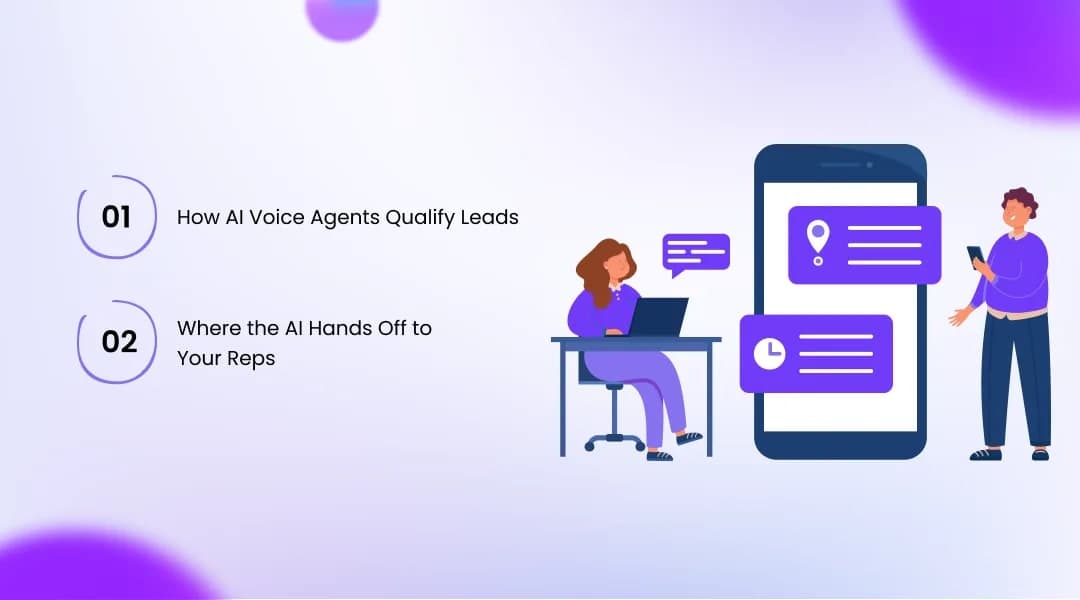
AI voice agents qualify leads by calling the moment interest peaks, asking structured discovery questions, scoring the answers against your criteria, and routing sales-ready prospects to a rep with full context. Most teams map this to a framework like BANT or MEDDIC.
In practice, the agent confirms budget range, decision authority, timeline, and a couple of product-fit questions, then pushes structured data straight into your CRM. Because it follows the script every single time, you get clean, consistent qualification data instead of the patchy notes a rushed rep leaves at 6 PM. That structured output is what makes the difference between a messy lead list and a pipeline your team can actually forecast against.
Where the AI Hands Off to Your Reps
Here is the counter-intuitive part: the best AI sales deployments are the ones that do less, not more. They qualify and route, then get out of the way.
A well-built agent recognizes when a conversation moves past its depth, an emotionally sensitive situation, a complex custom requirement, a serious negotiation, and transfers to a human with a live summary so the prospect never repeats themselves. Trying to make the AI close a large enterprise deal is where teams get burned. Match the tool to the task: AI for volume and speed, humans for complexity and trust. That is not a limitation to apologize for. It is the design.
Outbound, Inbound, and Reactivation: The Full-Funnel Play
Outbound sales automation is the use case people ask about most, usually with a raised eyebrow. It deserves a straight answer.
Can AI Voice Agents Make Outbound Calls?
Yes, AI voice agents can make outbound calls, dialing prospects autonomously, holding two-way conversations, qualifying interest, and booking meetings, at a volume no human team can match. A single agent can handle several hundred to a few thousand calls a day, compared with 40 to 60 for a human rep.
But volume without judgment is just faster noise. Cold outbound is the hardest environment for any voice AI, because prospects are skeptical and quick to disengage the moment a call feels scripted. The teams that win here pair the calling engine with good targeting and enrichment data, so the agent references the prospect's company or role instead of reading a generic pitch. Personalization at scale is the difference between a booked meeting and an instant hang-up.
Reactivating Stalled Pipeline and After-Hours Capture
Some of the highest-return work is not new leads at all. It is the pipeline you already have. Consider these workhorse use cases:
Pipeline reactivation: Deals that went quiet 60 to 90 days ago can be re-engaged with a call that references the last conversation and asks what changed, either re-qualifying the deal or clearing it out of your forecast.
Post-demo follow-up: When a prospect attends a demo and goes silent, an agent can follow up referencing the specific topics discussed, keeping the deal warm without a rep chasing it.
After-hours inbound capture: Prospects researching at 10 PM expect an immediate response. Instead of a voicemail box, they get a real conversation, and you get a qualified lead by morning.
Every one of these connects back to your CRM, whether that is Salesforce, HubSpot, Zoho, or LeadSquared, so the context lives where your team already works.
The India Reality: Compliance, Language, and Trust
Most articles on this topic quietly assume you are selling in California. If your buyers are in Bengaluru, Mumbai, or Ahmedabad, the rules and the reality are different, and this is where a lot of imported platforms fall down.
TRAI DLT, DPDP, and Staying on the Right Side of the Law
Running AI voice calls in India is legal, but it sits under several overlapping frameworks at once. TRAI DLT governs commercial outbound communication and requires registered senders, registered templates, call classification, and DND scrubbing before non-transactional calls. The DPDP Act 2023 governs what you do with the personal data every call generates, the recording, transcript, and CRM entry, with penalties that can reach 250 crore rupees for serious breaches.
Sector rules stack on top. A lender running collection or reminder calls must respect the RBI Fair Practices Code, including calling only between 8 AM and 7 PM, clear identification, and no harassment. Insurers answer to IRDAI norms on disclosure and mis-selling. The important mental model, and the one I stress with every client, is that TRAI consent to place a call is not the same as DPDP consent to process the voice data. You need both, separately, and building that in from the start is far cheaper than retrofitting it after a notice arrives.
Hinglish, Regional Languages, and Sounding Human
A US-trained speech model loses meaningful accuracy on Indian English, and it falls apart entirely on real Hinglish. Indian buyers do not speak in clean, single-language sentences.
A genuine Indian sales call sounds like "Haan bhai, actually we are looking for something jo humari cold calling automate kar sake." That code-switching, mid-sentence, is normal, and handling it requires speech models trained on mixed-language audio rather than a monolingual model with a language detector bolted in front. There is also cultural subtext to read: a polite "acha, dekhte hain" usually means no, not "let me check." Getting this right is not a nice-to-have in the Indian market. It is the whole game, and it is a core reason we built OnDial as an India-first platform rather than a translation layer on top of a Western one.
Are AI Voice Agents Worth It for Your Sales Team?
Let us talk money, because "revolutionizing" is a nice word and a spreadsheet is a better argument.
The Cost Math
The case for AI voice agents is really an SDR-cost case. Human SDR teams run around 32 percent annual turnover with a roughly three-month ramp, and every departure carries real replacement cost. An AI agent runs from day one, does not quit, and does not need ramping.
On the per-lead side, published platform testing puts the cost per qualified lead in the range of a few dollars once you add telephony and model costs, which is a fraction of a human hour spent on the same first-touch call. And the tailwind is real: Salesforce's State of Sales research found high-performing sales teams are 4.5 times more likely to use AI and automation than underperformers. The teams pulling ahead are not working harder on dials. They built a system that answers in seconds.
Are They Worth It for Small Businesses?
AI voice agents are often more valuable for small teams than large ones, because they let a lean business respond instantly and compete with far bigger competitors without hiring an SDR bench. When you have three reps, not thirty, never missing a lead is a genuine edge.
The honest caveat is that these tools are not fully hands-off. You need to review early call transcripts, tune the script based on what prospects actually say, and keep a human ready for the calls that need one. Treat it like hiring a very fast, very consistent junior rep who still needs a manager. Do that, and the math works quickly. Most teams that start with a focused use case, after-hours capture or inbound qualification, see returns inside a quarter rather than a year.
Conclusion
AI voice agents for sales are not a gimmick, and they are not going to fire your reps either. What they do is close the 42-hour gap that quietly kills pipeline by engaging every lead within seconds, qualifying with consistency, and handing the good ones to humans with full context. The three things to hold onto: speed to lead is the single biggest lever you have, AI is strongest on volume and weakest on nuance, and in India the compliance and language layer is not optional.
You do not need to overhaul your whole sales motion to start. Pick one leaky use case, after-hours inbound or stalled-pipeline reactivation, and let a voice agent own it for a quarter. If you want that built for the Indian market, in real Hinglish and compliant with TRAI and DPDP from day one, that is exactly what we do at OnDial, and I would rather show you a real call than a demo script.