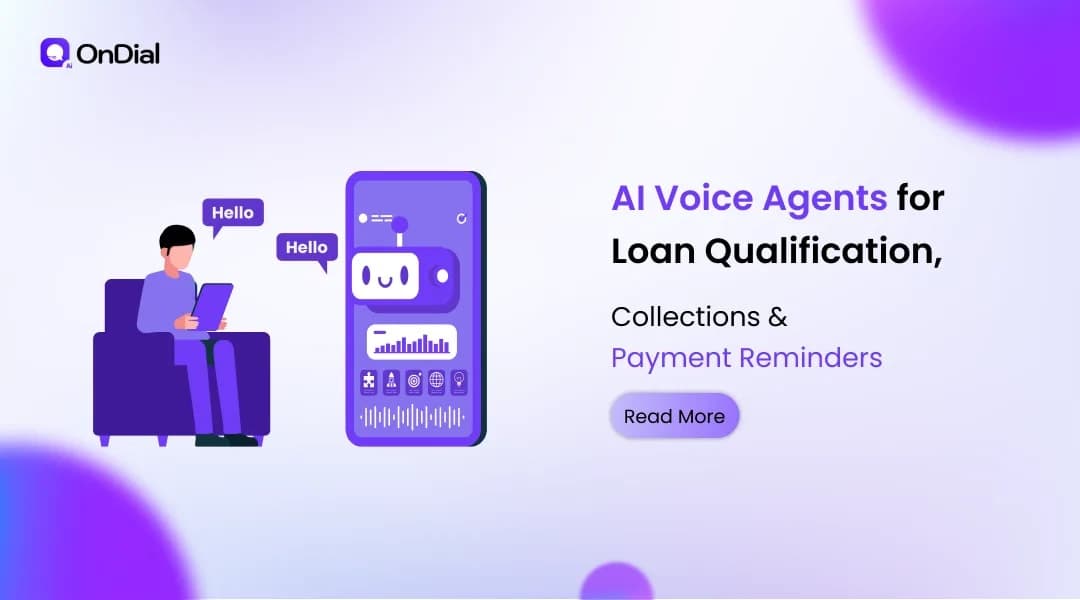
The New York Fed's February 2026 Household Debt and Credit Report put total U.S. household debt at $18.8 trillion, with roughly 4.8 percent of all balances sitting in some stage of delinquency, the highest reading in several years. Behind that number is a problem every collections leader recognizes: far more delinquent accounts than any tele-calling team can reach well. AI voice agents for loan collections, qualification, and payment reminders exist to close that gap. They are autonomous phone agents that call borrowers, verify identity, deliver a reminder or capture a promise-to-pay, and route anything sensitive to a human. They are not recorded IVR menus. They hold a real conversation, understand what the borrower actually says, and respond in the borrower's language.
If you have been burned by clunky IVR, or you are nervous about a synthetic voice touching regulated conversations, that caution is well placed. I have deployed these systems at OnDial across lending workflows, and the honest answer is that they win decisively in some stages and should never be trusted in others. This guide maps where AI voice agents earn their place across the lending lifecycle, how compliance is enforced in code, and exactly where a human still has to pick up the call.
What an AI Voice Agent Does Across the Lending Lifecycle
An AI voice agent for lending is software that autonomously calls borrowers to qualify, remind, and collect, routing complex cases to human agents. The distinction that matters most is behavioral, not technical. It listens, understands intent, and adapts, which is why lenders who tried it after years of IVR frustration tend to react with surprise on the first live call.
From IVR to Conversation: Why This Is Not a Robocaller
A traditional IVR plays a recorded message and asks the borrower to press 1 or 2. It cannot understand speech, so a borrower who says "I already paid this morning" or "my salary is delayed until the 10th" gets nowhere. The system simply moves to the next number and the moment is lost.
An AI voice agent holds the actual conversation instead. It parses that reply, checks it against the loan record, and responds correctly: confirming the payment, rescheduling the commitment, or transferring the call with Call Centers AI voice agents. In projects I have worked on, this single capability is what separates a reminder that resolves an account from one that annoys a borrower into churning.
The Three-Stage Map: Qualification, Reminders, Collections
Most vendor pages blur the three functions into one feature list, which hides the fact that each is a different conversation with a different risk profile. Treating them separately is where good deployment design starts.
Loan qualification: an inbound or outbound call that captures applicant information such as income, employment, and tenure, then feeds a faster underwriting decision. Low regulatory risk, high volume, easy to automate well.
Payment reminders: scheduled pre-due and early post-due calls that confirm the amount owed and offer a way to pay. Moderate sensitivity, extremely repetitive, ideal for automation.
Collections: outreach on delinquent accounts that negotiates repayment and captures a promise-to-pay. Sensitivity rises sharply as accounts age, which is where human judgment starts to matter.
AI Voice Agents for Loan Qualification
AI voice agents for loan qualification are the lowest-risk, highest-return place to start, because the conversation is structured and the stakes per call are modest. The agent collects what your underwriting model needs and never has to negotiate anything.
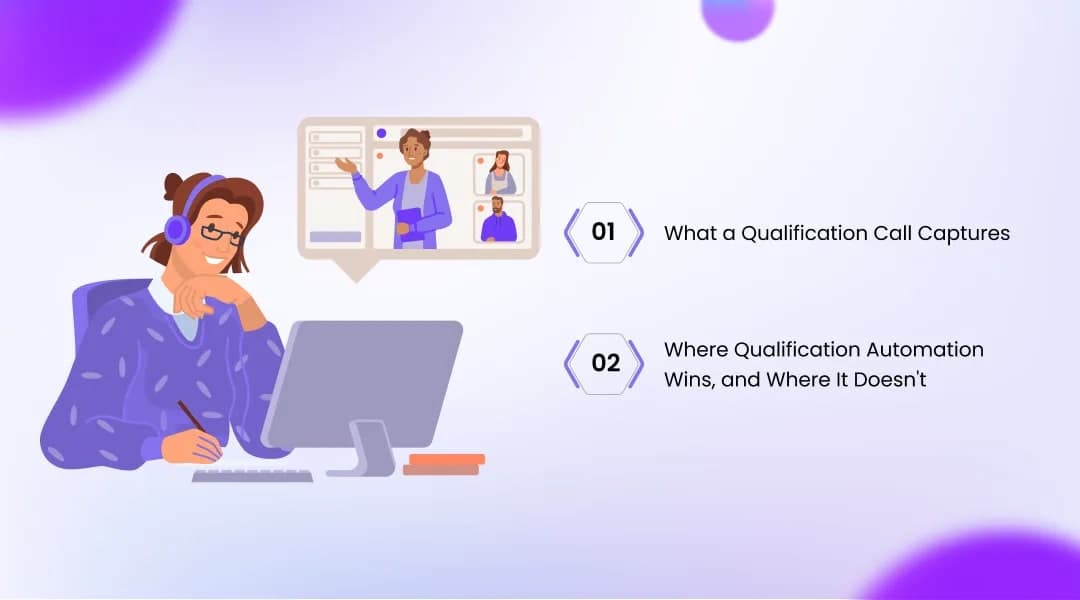
What a Qualification Call Captures
A well-designed qualification agent gathers income, employment status, and tenure automatically, then writes those fields back to your CRM or loan origination system in real time. That means your team makes faster decisions without a person transcribing answers into a form. It also means every applicant, including the ones who call at 9 p.m., gets an immediate, consistent screening rather than a voicemail box.
The consistency is the quiet advantage here. A human tele-caller on their fortieth call of the day skips questions and mishears numbers, while the agent asks the same sequence every time. That reliability is what makes the captured data trustworthy enough to route into a scoring layer.
Where Qualification Automation Wins, and Where It Doesn't
Automation wins on volume, speed, and audit consistency. It lets a small origination team behave like a much larger one, and it scales capacity without adding headcount during demand spikes.
It does not replace judgment. The agent should qualify and route, not approve or reject. When an applicant's situation is ambiguous, or the answers do not add up, the right design hands that person to a human underwriter with the full transcript attached. Qualification is screening, not decisioning, and blurring the two is a mistake I see teams make early.
Automated Payment Reminders That Keep Accounts Current
Automated payment reminder calls are the single most repetitive task in loan servicing, and also the easiest to automate well with voice AI beyond static call scripts. A voice agent calls a borrower a few days before a due date, confirms the exact amount from the loan management system, and offers a payment link or a transfer to a live agent. Done consistently, reminders become a dependable touchpoint instead of an afterthought that competes with underwriting for staff time.
Anatomy of a Compliant Reminder Call
The structure of a good reminder call is deliberately short and easy to exit. It follows a fixed shape that keeps the interaction professional and on the right side of the rules.
Greeting and disclosure: the agent identifies itself and the lending institution at the start, which the RBI Fair Practices Code and U.S. rules both require.
The specifics: it states the exact EMI or installment amount and due date, pulled live from the loan record rather than a static script.
The path to pay: it offers an immediate payment link or channel and captures whether the borrower intends to pay.
The exit: if the borrower raises a dispute or hardship, it transfers to a human rather than pushing.
Pre-Due Nudges Versus Post-Due Soft Reminders
Timing changes the tone. A pre-due nudge is friendly and purely informational, a gentle confirmation that a payment is coming up. A soft post-due reminder in the 0-to-30-day window stays polite but adds a clear next step, because the account has slipped and needs momentum.
Getting this bucket-specific is where recovery actually improves. Indian lending playbooks for 2026 emphasize different scripts by days-past-due bucket precisely because a first-time borrower who forgot needs a different call than one who is 60 days late. The agent's ability to run the right script for the right bucket, automatically, is what keeps early delinquency from hardening.
AI Debt Collection for Early-Stage Delinquency
AI debt collection earns its keep in the early buckets, where the work is high-volume, and the conversations are still standard. Voice AI reaches 45 to 50 percent call containment on collection calls, meaning nearly half resolve without a human, according to figures reported by Retell AI. That is capacity a human team cannot match, since a single collector typically manages only 40 to 60 accounts a day.
DPD Buckets and Bucket-Specific Scripts
Collections is not one conversation; it is a sequence of them, keyed to how overdue an account is. The 0 to 30 day bucket is soft and friendly, 31 to 60 is firmer, and later buckets escalate in seriousness. A modern agent runs the correct script for each, so the borrower who is three days late is not treated like one who is three months late.
This is also where AI's resolution rates are strongest. One analysis put AI resolution as high as 85 percent in the initial 0 to 30-day delinquency window, which is exactly the volume-heavy, low-complexity work you want off human desks with AI voice agents for finance and lending. The further an account ages, the more that advantage narrows, which shapes where you should draw the automation line.
Promise-to-Pay Capture and Payment Links
The core outcome of a collections call is a promise-to-pay, a committed date and amount, logged and followed up automatically. The agent captures the commitment, confirms the next step, and pushes a payment link, then writes the whole outcome back to the collections system.
Real deployments show the scale this unlocks. One leading Indian NBFC using AI voice agents reported collecting roughly 20 crore rupees per month at a 63 percent collection rate while cutting monthly operating expenses, according to figures published by Gnani AI. (That is the kind of number that turns a skeptical head of collections into a pilot sponsor.) The point is not the specific figure, which will vary by book, but that early-bucket automation moves real money.
Compliance: FDCPA, TCPA, and the RBI Fair Practices Code
Here is a claim that makes compliance officers flinch at first: a well-built AI agent is more reliably compliant than your best human team. That is not a knock on your people. It is a structural fact, because the rules can be hardcoded at the system level instead of remembered under pressure on call number fifty.
Featured answer: Yes, AI voice agents can be FDCPA compliant when the calling rules are enforced in code: identity disclosure, restricted calling hours, frequency caps, no third-party disclosure before verification, and full call logging. The CFPB has confirmed there is no regulatory carve-out for new technology, so the same FDCPA, Regulation F, and TCPA standards apply to synthetic and human callers alike.
The Global Rulebook: United States and India
In the United States, collections outreach sits under the Fair Debt Collection Practices Act and Regulation F (12 CFR Part 1006), which set disclosure and call-frequency limits, alongside the TCPA. The FCC's February 2024 declaratory ruling went further and recognized calls made with AI-generated voices as "artificial" under the TCPA, so consent rules apply directly to voice agents. The CFPB received about 207,800 debt collection complaints in a recent year, nearly double the prior year, which tells you how closely this space is watched.
In India, the RBI Fair Practices Code governs the same ground: calls only between 8 a.m. and 7 p.m. local time, identity disclosure at the start, no intimidation or abusive language, no discussion of the account with third parties, and clear grievance redressal. The DPDP Act adds data-protection obligations on top. An agent that enforces these limits by design has a real advantage over a dialer queue that runs late and places a call at 7:45 p.m.
Why Hardcoded Rules Beat Human Memory
A calling-hour boundary written into the system does not get tired, rushed, or forgetful. Identity disclosure fires on every single call because it is a required step, not a habit. Every utterance is recorded and retained for audit, which turns a regulatory inspection from a scramble into a query.
The regulator does not grade on a curve.
That is precisely why hardcoded compliance matters. Indian microfinance analyses report AI compliance rates near 99.97 percent against 87 to 92 percent for human call centers, because the rules are enforced in software rather than left to individual agents. When one rogue call can become a central-bank penalty, that consistency is the whole point.
Where AI Stops and Humans Start
So which of your buckets should an AI ever touch on its own? This is the question that separates a responsible deployment from a reckless one, and the honest answer is that AI should not run the whole book.
The Later-Stage Delinquency Problem
The strongest evidence for restraint comes from outside the vendor marketing. A recent NBER working paper by Choi and colleagues found that AI callers were substantially less effective than human callers in certain contexts, using a randomized experiment and a regression-discontinuity design. That finding lines up with what practitioners see: as accounts age, more borrowers have genuine disputes, hardship, or complex financial situations that reward empathy and negotiation.
This is where the technology's limits are real and worth stating plainly with OnDial. Later-stage recovery is a human strength, and a hybrid model AI for early and standard work, humans for hard cases — consistently beats an all-AI approach. Anyone selling you full autonomy across every bucket is overselling.
Designing the Escalation Path
The escalation path is not an afterthought; it is the core safety design. The agent must detect the signals that mean "stop and transfer": a dispute, a hardship disclosure, emotional distress, or a request to negotiate.
Detect early: natural-language understanding flags disputes and distress in real time, ideally within seconds.
Warm transfer with context: the human receives the full conversation history and a summary, so the borrower never repeats themselves.
Log and learn: the outcome and transcript write back to the system, feeding both compliance records and script improvement.
Handled this way, the AI keeps routine volume moving and the humans get the conversations where judgment and a little compassion actually change the outcome.
Conclusion
Deployed with judgment, AI voice agents for loan collections, qualification, and reminders turn an impossible volume problem into a manageable one. The three takeaways are simple: automate the high-volume, low-complexity stages first, enforce every compliance rule in code rather than in habit, and keep humans firmly in charge of disputes and later-stage recovery. You do not have to choose between scale and compliance, and you do not have to bet the whole book on autonomy.
You now have the map that most vendor pages skip: which stage to automate, how the rules are enforced, and where a human has to take the call. At OnDial, we build lending voice agents around exactly this line: bucket-specific scripts, hardcoded RBI and FDCPA guardrails, and warm human handoff with full context. If you are sizing where voice AI fits your portfolio, start by picking one early bucket and one qualification flow, and measure it against your current team.